
Gador-Whyte, Sarah. 2025. “Performing Orthodoxy in Byzantine Hymnography: Romanos the Melodist’s On the Three Children.” In “Performance and Performativity in Late Antiquity and Byzantium,” ed. Niki Tsironi, special issue, Classics@ 24. https://nrs.harvard.edu/URN-3:HLNC.ESSAY:104135602.
Introduction
Romanos and his kontakion as a performative genre
The night vigil was a cathedral-rite service which involved hymn- and psalm-singing, bible readings, and prayers. It was a time of preparation for the feast day (or other Sunday service). Sometimes it was an all-night vigil, but more often would have been held in the early hours of the morning before dawn. It sometimes involved a procession through the streets. [13] Congregants were actively involved in the vigil, from its institution in the fourth century, by joining in the singing of hymns and psalms. Sozomen explains that the crowd was divided into groups to sing psalms antiphonally (HE VIII.8). We get a glimpse of the vigil setting in Romanos’ kontakion, On the Man Possessed by Demons (11.1):
Ὁ λαὸς ὁ πιστὸς ἐν ἀγάπῃ Χριστοῦ
συνελθὼν ἀγρυπνεῖ ἐν ψαλμοῖς καὶ ᾠδαῖς,
ἀκορέστως δὲ ἔχει τοὺς ὕμνους θεῷ·
ἐπειδὴ οὖν Δαβὶδ ἐμελῴδησε,
καὶ ἀναγνώσει εὐτάκτῳ γραφῶν ἐπευφράνθημεν,
αὖθις Χριστὸν ἀνυμνήσωμεν καὶ ἐχθροὺς στηλιτεύσωμεν·
αὕτη γὰρ γνώσεως κιθάρα·
τῆς δὲ γνώσεως ταύτης Χριστὸς ὁδηγὸς καὶ διδάσκαλος,
ὁ πάντων δεσπότης.
The people, faithful in their love of Christ,
come together to hold a vigil in psalms and songs,
and unceasingly keep up the hymns to God.
So since the psalm has been sung,
and we have rejoiced in the well-ordered reading of the scriptures,
hereafter we may celebrate Christ in song and denounce the enemies.
For this is the lyre of knowledge
and of this knowledge Christ is the guide and the teacher,
the Lord of all.
The three in Late Antiquity
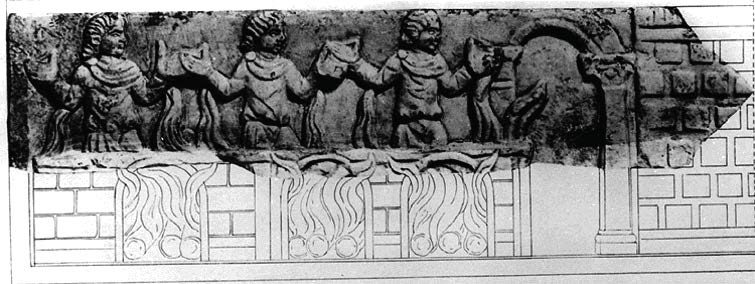
Performing faith
The Three Hebrews are placed in the context of other biblical stories and are held up as examples of God’s saving powers:
Τάχυνον, ὁ οἰκτίρμων, καὶ σπεῦσον, ὡς ἐλεήμων,
Εἰς τὴν βοήθειαν ἡμῶν, ὅτι δύνασαι βουλόμενος·
ἐκτεινόν σου τὴν χεῖραν ἧς πάλαι ἔλαβον πεῖραν
Αἰγύπτιοι πολεμοῦντες καὶ Ἑβραῖοι πολεμούμενοι·
μὴ καταλίπῃς ἡμᾶς, καὶ καταπίῃ ἡμᾶς
Θάνατος ὁ διψῶν ἡμᾶς καὶ Σατᾶν ὁ μισῶν ἡμᾶς·
ἀλλ’ ἔγγισον ἡμῖν καὶ φεῖσαι τῶν ψυχῶν ἡμῶν,
ὡς ἐφείσωποτὲ τῶν παίδων σου
τῶν ἐν Βαβυλῶνι ἀπαύστως δοξαζόντων σε
καὶ βληθέντων ὑπὲρ σοῦ εἰς τὴν κάμινον καὶ ἐκ ταύτης κραζόντων σοι·
«Τάχυνον ὁ οἰκτίρμων καὶ σπεῦσον ὡς ἐλεήμων
Εἰς τὴν βοήθειαν ἡμῶν, ὅτι δύνασαι βουλόμενος.»
Hurry, merciful one, and in your compassion hasten
To our aid, since you can do what you will.
Stretch out your hand which long ago the Egyptians who were fighting
and the Hebrews who were being assailed, put to the test.
Do not leave us, and do not let us be swallowed up.
Death thirsts for us and Satan hates us.
But come near to us and spare our souls,
As you once spared your children,
Those who in Babylon praised you without ceasing,
And did obeisance to you in the furnace and from there cried out to you,
“Hurry, merciful one, and in your compassion hasten
to our aid, since you can do what you will.”
In the second proem, Romanos emphasizes their role as exemplar to his listeners, this time with particularly Trinitarian imagery:
Οἱ τρεῖς τῇ Τριάδι δουλεύσαντες ἐν ὁμονοίᾳ,
Θυμὸν βασιλέως καὶ πρόσταγμα ἀπανθρωπίας
κατῃσχύνατε, ἅγιοι παῖδες, ἡμῖν ὑπογραμμὸν καταλείποντες,
πρόβολοι τῆς πίστεως γεννηθέντες.
The three of you, serving the Trinity in unanimity,
Were putting to shame the anger of the king and the commands of inhumanity.
Holy children, you were making a model for us,
begotten as guardians of the faith.
The approval of Shadrach, Meshach, and Abednego’s faith that Romanos expresses through this characterization and varied imagery stands in stark contrast to the characterization of King Nebuchadnezzar. As his advisers speak to the king about the Hebrews, Romanos says
… ὑφῆψαν τὸν βασιλέα
καὶ ὥσπερ πῦρ ἐν ἀκάνθαις ἐξεκαύθη ὁ θυμὸς αὐτοῦ·
… they inflamed the king,
and like a fire kindled in brambles, anger consumed him.
The king’s anger is hot, like the fire of the furnace, and eats away at him as if he were dry twigs. He becomes a savage beast, gnashing his teeth (10.3). He attempts to reason with Hananias, Misael, and Azarias and convince them to follow his commands, but they laugh (12.1–2) and argue their own case. Their arguments enrage him further:
Ἅμα ἤκουσε τούτων, ὁ ἄθλιος καὶ πανώλης
ὡς σίδηρος ἐπυρώθη καὶ φλογμὸν ἀπεσπινθήριζε,
κράζων, βράζων, ἀσθμαίνων …
As soon as he heard these things, the pitiful and all-destructive one,
like iron he became red hot and emitted sparks of fire,
crying, growling, panting …
The king becomes fiery, both consumed by blazing anger and emitting dangerous flames; he becomes animalistic, non-human. In this passage Romanos calls him ‘pitiful’ (ἄθλιος), worthy of pity for his idolatrous desire for worship. His anger is incredibly hot, and he wants the furnace to match it:
ταύτης τὸ πῦρ αὐξήσαντες τῷ θυμῷ μου ἰσώσατε·
ὁμοίως γὰρ ταύτης ἀνάπτομαι καὶ φλέγομαι,
ὅτι οὗτοι ἠθέτησαν ἐμέ·
Strengthening the fire of this [furnace], make it equal to my anger,
For like this [furnace] I am inflamed, and I burn,
because these men have disobeyed me.
Nebuchadnezzar’s anger stems from the disobedience of Hananias, Azarias, and Misael, but their concern is obedience to God. As far as they are concerned, the choice is made for them:
Μέγαν ἔχομεν πόθον πρὸς τὸν Θεὸν τῶν Ἑβραίων,
θερμότερον τοῦ πυρός σου καὶ καμίνου καυστικώτερον
. . . . . . . . . . . . . . . . . . . . . . . . . . . . . . . . . . . . . . . . . . . . . .
οὐκ ἔστι γὰρ οὗτος ὡς αὕτη ἣν ἐχάλκευσας,
ἀλλ’ ἐπάνω πέλει πάσης τῆς κτίσεως, ἀσιγήτως ὑμνούμενος·
We have a great longing for the God of the Hebrews,
who is hotter than your fire and more burning than your furnace
. . . . . . . . . . . . . . . . . . . . . . . . . . . . . . . . . . . . . . . . . . . . . .
For this one is not like that which you have forged,
but he is above the whole creation, being hymned continually …
Romanos presents the three youths as unwavering in their devotion to God, as they contrast him with the king’s anger and the heat of the furnace. Given the numerous characterizations of anger as fire in the hymn, and the three’s concern earlier in the hymn to appease God by their scented faith, this imagery for God might suggest the strength of God’s righteous wrath if they were to reject him as well as his power over all creation. It is much more dangerous to work against God than it is to enter the furnace. They are not afraid to die, even as they sing to God (19.9–10; 20.1–4), but it is not an option to reject God. This is the key message, as far as Romanos is concerned. He drives home this point for his congregation in the final stanza (30.7–12):
Διό, ἀδελφοί μου, ὁρᾶτε μὴ λυπήσωμεν
τὸν δεσπότην καὶ δοθῶμεν ἐχθροῖς·
λυποῦμεν γὰρ τοῦτον ἐὰν αὐτὸν ἀφήσωμεν
καὶ τὴν πίστιν <τὴν> ὀρθὴν παρατρώσωμεν ἧς ἐκτὸς λέγειν ἄδεκτον·
Τάχυνον ὁ οἰκτίρμων καὶ σπεῦσον ὡς ἐλεήμων
εἰς τὴν βοήθειαν ἡμῶν, ὅτι δύνασαι βουλόμενος.
Come, my brothers, see that you do not grieve
The Master and be supporters of enemies.
For we grieve him if we neglect him
And do violence to orthodox belief, outside of which you cannot say,
Hurry, Merciful one and in your compassion hasten
to our aid, since you can do what you will.
The setting of On the Three Children
At first glance Romanos’ hymn may not seem to point openly to a pre-Christmas setting. We might therefore be tempted to disregard the placement recorded in the kontakaria or assign it to a celebration of Daniel without reference to Christmas. But the kontakion does prefigure Christmas in the description of the furnace. The furnace is made so hot that people are terrified and die even at the mention of it (16.3–4), and yet when the three are thrown into it, the furnace becomes, not a site of destruction, but one of growth and protection, like the womb of the Theotokos (21.3–10):
Δέχεται οὖν ἐκείνη τὴν τρίκλωνον αὐτῶν ῥίζαν
καὶ οὐ φλέγει, ἀλλὰ φυλάττει φοβουμένη τὸν φυτεύσαντα·
ἀλλὰ εἰς πνεῦμα δρόσου ἡ φλὸξ μεταβληθεῖσα
θεῖον οὕτω διέψυχε τὰ στελέχη τὰ ἅγια.
Καὶ ἦν ἰδεῖν ξένον· τὸ πῦρ γὰρ ἐπελάθετο
τῶν ἰδίων καὶ γέγονε πηγή,
ἀρδεύουσα μᾶλλον ἢ καίουσα οὓς ἔλαβεν
καὶ φρουροῦσα ὥσπερ ἄμπελον τρίφορον, ἵνα δῷ τὸν καρπὸν αὐτῆς.
So [the furnace] received the three-pronged shoot of them
And did not burn, but guarded it, fearing the one who planted it.
But the flame turned into the divine breath of dew
So that it might cool the holy logs.
And it was strange to see. For the fire forgot
Its own [nature] and become a fountain,
Watering rather than burning those it received
And guarding, as if it were a vine, the thrice-bearing, so that it might give its fruit.
These images continue in the next stanza when the angel appears and makes the furnace into paradise for the three, so that “they walked on coals as on wild roses” (22.5). The angel then encourages the three to sing to the praise of the creator “because the fire gushes forth [like a fountain] and the furnace is dewy for those who believe in him and flee error.” (24.4–5) And by singing the three youths transform the furnace into a church (25.1–4): [39]
Στὴσαντες οὖν οἱ παῖδες χορὸν ἐν μέσῳ καμίνου,
οὐράνιον ἐκκλησίαν ἀπειργάσαντο τὴν κάμινον,
ψάλλοντες μετ᾽ ἀγγέλου τῷ ποιητῇ τῶν ἀγγέλων
καὶ πᾶσαν τὴν λειτουργίαν τῶν ἀσάρκων ἐκμιμούμενοι·
So the youths, standing as a choir in the midst of the furnace,
Made the furnace into a heavenly church,
Singing with angels to the creator of angels
And imitating faithfully the whole liturgy of the incorporeal ones.
The meeting of the divine is made even clearer when Romanos gives voice to the thoughts of the three youths:
«Τί, φησίν, ἐστὶ τοῦτο; Οὐκ ἔστιν ἄγγελος οὗτος,
ἀλλὰ Θεὸς τῶν ἀγγέλων· ἐν ἀγγέλου μορφῇ φαίνεται
ὁ εἰς τὸν κόσμον μέλλων ἔρχεσθαι, καὶ σβεννύειν
τὴν τῶν εἰδώλων γέενναν ὥσπερ ἄρτι τὴν κάμινον.
Αὐτὸς καὶ νῦν ὤφθη καὶ τῶν μελλόντων γίνεσθαι
τὴν εἰκόνα ὑπέδειξεν ἡμῖν·
καθάπερ καὶ ἄρτι τὴν κάμινον ἐδρόσισεν,
οὕτως μέλλει ὡς ὑετὸς εἰς τὴν ἄγαμον καταρδεύειν τοὺς ψάλλοντας·
“What”, they say, “Is he? For he is not an angel,
But God of angels. He appears in the form of an angel,
He who is going to come into the world, and quench
The Gehenna of idols, as he has just now [quenched] the furnace.
And it is he who was seen now and the image of what is going
to be was shown to us.
As if just now he bedewed the furnace,
Thus he will be as rain on the virgin, [40] refreshing those who sing …”
These images of the furnace, foreshadowing the incarnation, suggest that the hymn fits well into the lead up to Christmas, whether part of a feast of Daniel or not. In addition, Romanos is at pains to emphasize the two natures of Christ as prefigured by the angel of God in the furnace. The children see the angel in two forms:
καὶ ὁτὲ μὲν θεῖος, ἄλλοτε δὲ ὡς ἄνθρωπος
ἑωρᾶτο, καὶ ποτὲ μὲν ἐκέλευε, ποτὲ δὲ συνικέτευεν·
And at one time was seen as divine, and at another as a man,
And sometimes commanded and sometimes supplicated.
They hymn him, saying:
Ὁ πρὸς ἡμᾶς καὶ ἄνω καὶ ἐν ἑκάστῳ τόπῳ
ἄφθαστε καὶ κρατούμενε, χωρητὲ καὶ ἀχώρητε,
. . . . . . . . . . . . . . . . . . . . . . . . . . . . . . . . . . .
ἐφ’ ἡμῖν παρακλήθητι·
You who are with us and above, and in each place,
Inaccessible and present, finite and infinite,
. . . . . . . . . . . . . . . . . . . . . . . . . . . . . . . . . . .
intercede for us …
They thus emphasize the two natures of the incarnate being they see in the furnace, whom they do not name but who is clearly intended to be understood as the person of Christ. [44] Not only they, but the king also recognises the two natures of the being in the furnace. Nebuchadnezzar comes to gloat over the ashes of his enemies and sees instead the fire chained and the three dancing free. He is afraid and puzzled over the appearance of a fourth man:
Τρεῖς ἐρρίψαμεν ἔνδον καὶ τέσσαρας αὐτοὺς βλέπω,
καὶ τοῦ τετάρτου ἡ ὄψις συνταράσσει τὴν καρδίαν μου·
οὔτε γὰρ οἶδα τίνι συγκρίνω τὸν τοιοῦτον·
εἴπω ὅτι βροτός ἐστιν; Ἀλλ’ υἱὸς Θεοῦ πέφυκεν·
δικαίως ἡττήθη τὸ πῦρ, οὔτε γὰρ ἴσχυσεν
ἀντιστῆναι πρὸς πύρινον ἡ φλόξ·
We threw three men within and I see four,
And the appearance of the fourth troubles my heart.
For I do not know who could compare to such a one.
Could I say that he is a mortal? But he is a son begotten of God.
Rightly did the fire yield, for the flame was not powerful enough
To withstand the fiery one.
Conclusion
As we have seen, these elements lend themselves to a pre-Christmas hymn, but they might also hint at a particular performance context. On the fourth of November 512, the emperor Anastasius enforced (by imperial edict) the use of a miaphysite version of the Trisagion hymn: [45]
ἅγιος ὁ θεός, ἅγιος ἰσχυρός, ἅγιος ἀθάνατος, ὁ σταυρωθεὶς δι᾽ ἡμᾶς, ἐλέησον ἡμᾶς.
Holy God, Holy Strong, Holy Immortal, who was crucified for us, have mercy on us.