
Mosaic and Mimesis: The Eikōn tou Theou and Models of Katanyxis in the Middle Byzantine Church

  Pentcheva, Bissera. 2024. “Mosaic and Mimesis: The Eikōn tou Theou and Models of Katanyxis in the Middle Byzantine Church.” In “Performance and Performativity in Late Antiquity and Byzantium,” ed. Niki Tsironi, special issue, Classics@ 24. https://nrs.harvard.edu/URN-3:HLNC.ESSAY:104135614.


Introduction
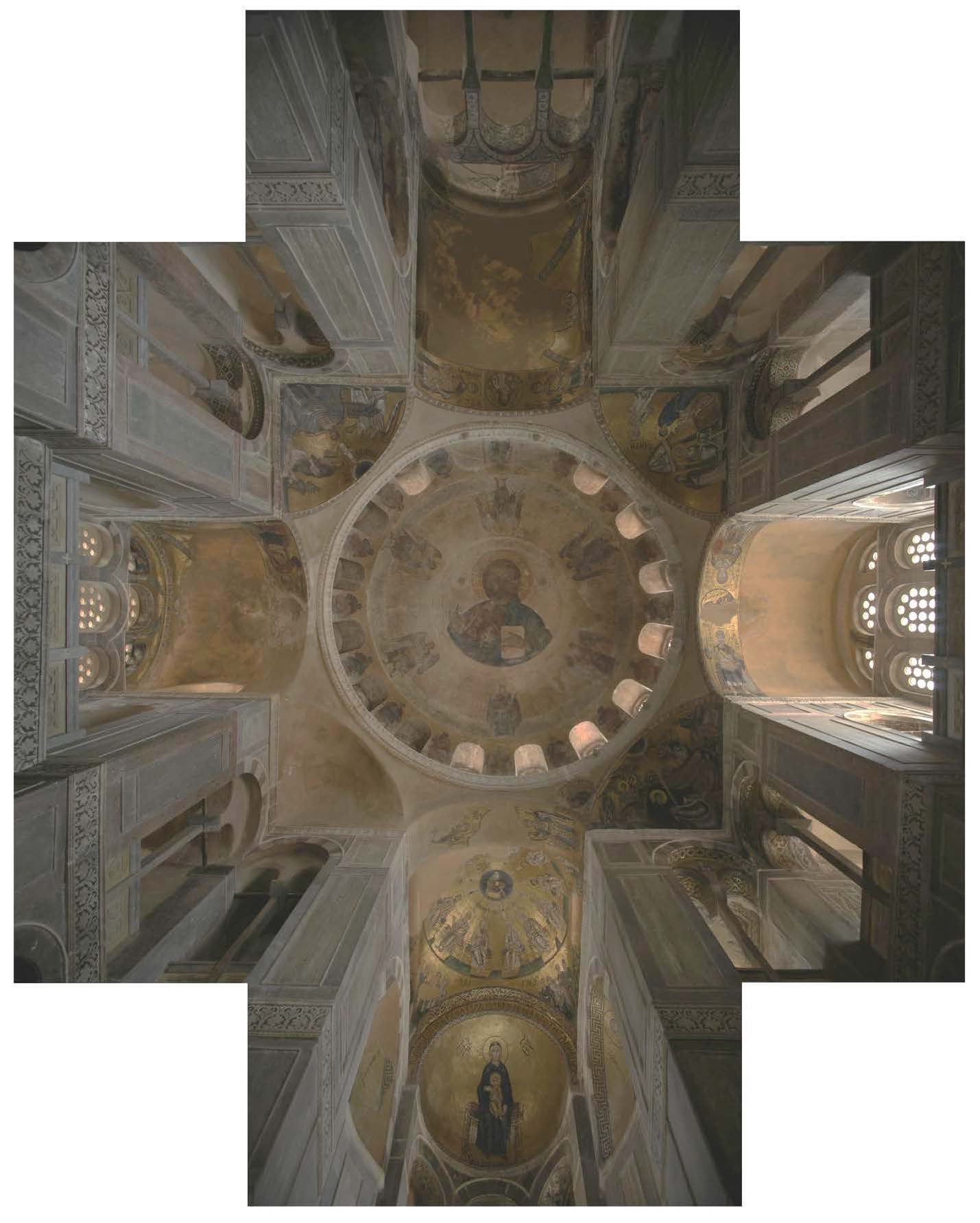
This essay focuses on the Middle Byzantine figural program in the ecclesiastical interior. The system that develops after Iconoclasm (726–843 CE) places the image of Christ in the dome; narrative images from his life in the squinches (trumpet-shaped niches at the transition zone between the cube and the drum of the cupola); the Theotokos in the apse; and finally portraits of saints at the lower levels of the wall, niches, and soffits of arches. [1] The analysis here focuses on a specific manifestation of this program: the eleventh-century church of Hosios Loukas, whose architecture and mosaic program was completed in 1011. [2] While the interior has lost the mosaics in the dome, the sixteenth-century fresco faithfully records the original composition and thus completes a wholistic view of this visual system (Figure 1).
Figure 1.

The image of Christ in the dome dominates and centers the program. The Anaphora (Eucharist Prayer) in the liturgy of Saint Basil defines the significance of this image. [3] Set at the apex, it visualizes the image of God––εἰκών τοῦ θεοῦ––the ideal form and model given to humanity but lost because of the sin of Adam. This icon calls the faithful to engage and try to recuperate this image in themselves and to imitate its example. The encounter encodes reciprocation: a performative act. Long before the establishment of the post-Iconoclast practice of placing of Christ’s figural icon in the cupola, the Byzantine liturgy trained the faithful in the mimesis of this εἰκών τοῦ θεοῦ even without material, visual stimuli. We recognize this practice in the liturgical poetry, more specifically in the kontakia and kanons which target the listeners’ imagination. For instance, Romanos Melodos’s (b. ca. late fifth century, d. ca. 550s) kontakion on the Second Coming speaks of the encounter with the face of Christ the Judge even through the contemporary sixth-century ecclesiastical interiors where this poetry was sang lacked the physical image of Christ. Romanos wrote: “All-Holy Savior of the world, as you appeared and raised up the nature / that was lying in offenses / as you are compassionate, appear invisibly to me (ἀοράτως ἐμφάνηθι) also, o Long-Suffering.” [4] In this stanza “appear[ing] invisibly” refers to imagined icon of God one conjures in one’s imagination as one confronts one’s past transgressions, repenting, and seeking forgiveness. The words trigger the reification of internal, ineffable icon: “When you come upon the earth, O God, in glory / and the whole universe trembles … then deliver me from unquenchable fire / and count me worthy to stand at your right hand.” [5] The faithful engage in a dialogue with this imagined image as they progress on their path to Salvation, uncovering, recognizing, and repenting for their past transgressions in order to re-form, recuperate the lost ideal form of the eikōn tou Theou. [6]

The mimetic practice inspired by the performance of kontakia does not stop here. The liturgical poetry created rich, immersive environments, stimulating the imagination of the faithful to plunge into different biblical characters, and to identify with their plight and struggles. In this way, sung texts encouraged imitation and emulation. My analysis draws more specifically on the kontakia, kanons, and stichera. The kontakion gains prominence in the sixth century with the compositions of Romanos Melodos (b. ca. late fifth century, d. ca. 550s), and his works continue to be sung in the Orthodox church of today. The kontakia were originally performed during vigils on major feast days in the cathedral liturgy. This chanted homilies led the congregation into the immersive inner world of major and minor characters of the Old and New Testament. This is a performative poetry both in the sense that it was publicly chanted but also because it fostered in its listeners the desire to imitate the main characters of the chants. Kontakia continue to be written past the time of Romanos and well in the twelfth century. [7] The kanon is the other major conduit in the training of the Byzantine faithful on their Christo-mimetic path. Andrew of Crete (ca. 660–740) is one of the most prominent composers. The kanon is structured into nine odes each emulating one of the Biblical canticles. This poetry is performed during orthros. [8] And finally, the stichera that are short poems often with their own music; they were intercalated in the singing of the morning psalmody.
The liturgical poetry, especially the one performed during Great Lent played an important role in training the faithful to engage in compunction (κατάνυξις) and repentance (μετάνοια). In fact, Romanos’s kontakion on the Second Coming explicitly channels the request of the authorial I, asking that repentance be divinely bestowed, for this is the only way to Salvation: “Let us not think that, if ever we sin, we are utterly cast out / for by the medicine of repentance we shall swiftly heal / the wound of sin, if at least we wish it. / And now let us all entreat the Savior as we cry: ‘Give compunction to your servants, Lord, that we may find pardon’.” [9] The authorial I pleads with Lord to be given the capacity for katanyxis in order to work one’s Salvation. The poet converses with the icon of God, even if this image is one’s imagination: internalized and immaterial. Only after Iconoclasm does this eikōn tou Theou become pictorialized in the material space. This essay will trace how the performance of liturgical texts in front of the material images stimulated the faithful to seek to recover in themselves the lost ideal eikōn tou Theou.

The Invisible Image and the Material Icon

The anaphora of Basil recited at the Eucharist already articulates the vision of the invisible icon of God that structured Byzantine piety. The prayer starts with an address to the Eternal Master and Lord, enthroned in glory and Father of the Lord Jesus Christ, whom the faithful approach with contrite heart (ἐν καρδία συντετριμμένη) and with humble spirit (πνεύματι ταπεινώσεως) trained through katanyxis. [10] The Son is called the image (εἰκών) through which the Father is revealed: the seal bearing the Lord’s likeness (σφραγίς ἰσότυπος). [11] While Christ preserves this likeness, mortals cannot maintain it and fall from it. At Creation, Adam is sculpted from clay in the image of God (εἰκόνι τῇ σῇ). Temptation and sin condemn Adam and Eve; they lose their likeness to God and are cast away from paradise. Death comes as a consequence of their Fall. Subsequently, moments of nearness are only brought in through the prophets, and humanity is caught in continual striving to recuperate this lost likeness. [12]

The incarnation of Christ offers the possibility for an eventual return of the faithful to the image of God. Christ is the pure icon of God. He both shares in humanity’s form (“of the same form as us” συμμόρφους ἡμάς) and simultaneously imbues this form with divine glory (δόξα):

In becoming incarnate from the holy Virgin,
he [Christ] emptied himself, taking the form of a slave,
conforming himself to the lowliness of our body,
that he might conform us to the image of his glory. [13]

Christ takes on the human form in order to uplift humanity to the image of glory. He invests this form with doxa (glory). Salvation (σωτήρια, sōtēria) is thus understood as the restoration of humankind to its status before original sin and thus a return to being made in “the image of God” (εἰκὼν τοῦ θεοῦ) and deification (θέωσις, theōsis). In reciting St. Basil’s anaphora, the faithful are stimulated to conjure up this image of glory. But it is only after Iconoclasm that this internal vision acquires material, anthropomorphic concreteness in the physical icon of Christ in the dome.

Christ in the Dome after Byzantine Iconoclasm

Byzantium develops a very idiosyncratic form of the eikōn tou Theou: an image of Christ set in a golden medallion. This particular shape became elucidated in the debates surrounding Byzantine Iconoclasm (726–843) and is likely anchored in the icon of Christ Chalkites that was set above the entrance gate of the imperial palace. The placement of the Chalkites celebrated the triumph of icon-worship in 843, and we see it in the preface miniature of the Khludov psalter (Figure 2). [14]
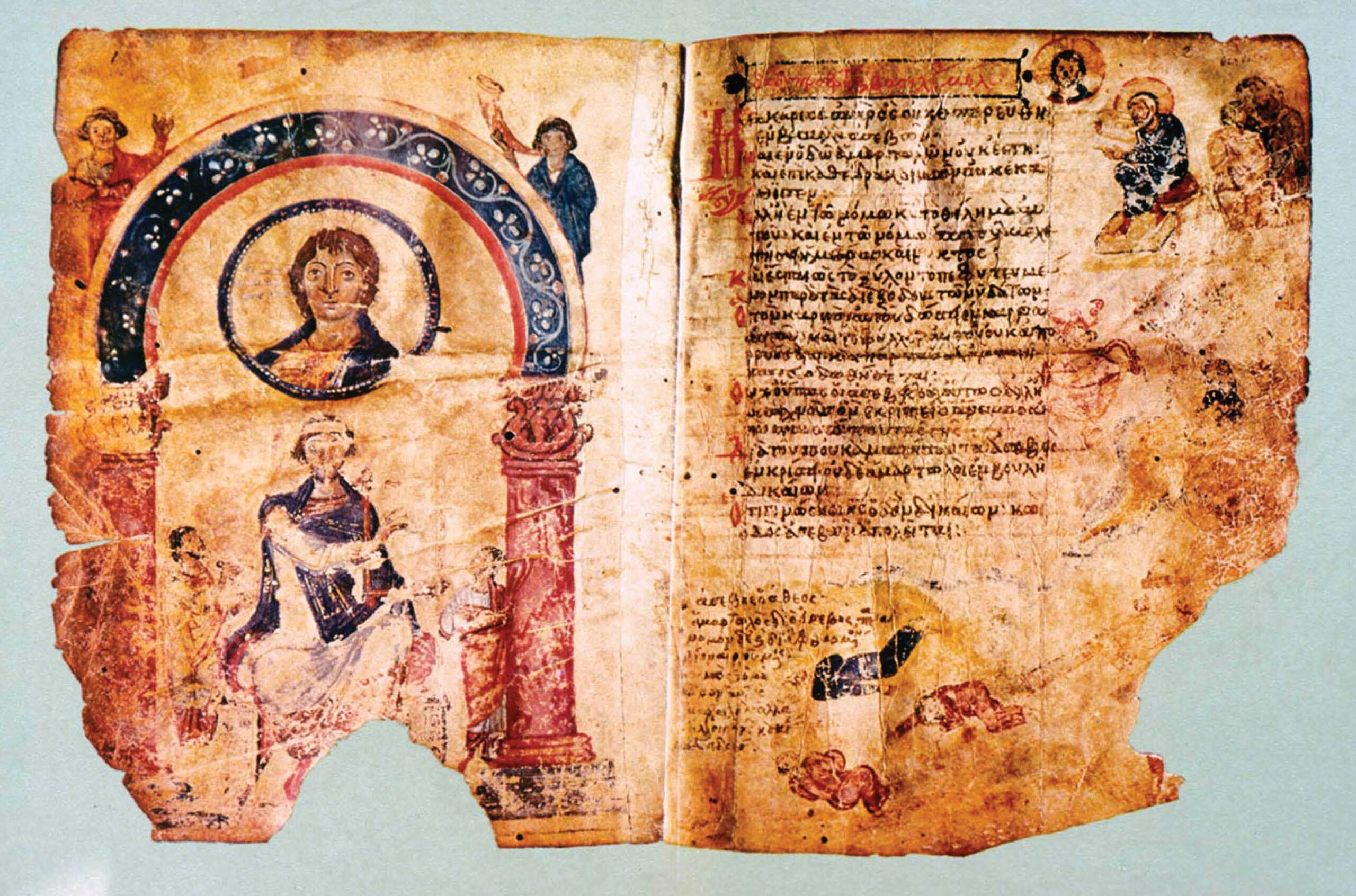
Figure 2.

Soon after, the same round image came to occupy the apex of the main dome of Byzantine churches, reifying the belief that conversion, prayer, judgment, and salvation all issued from the light of God’s face. And this image became the stage on which the faithful were invited to practice their proleptic encounter with the Last Judgment scenario. [15]

The medallion with the figural image of Christ takes over the sign of the cross (τύπος) enclosed in a circle. The aniconic sign  was often stamped on the Eucharist bread that the worshippers consumed, and the same symbol graced the apex of the Justinianic dome in Hagia Sophia; today copies of this formula remain in the domical vaults of the Great Church (Figure 3). [16]
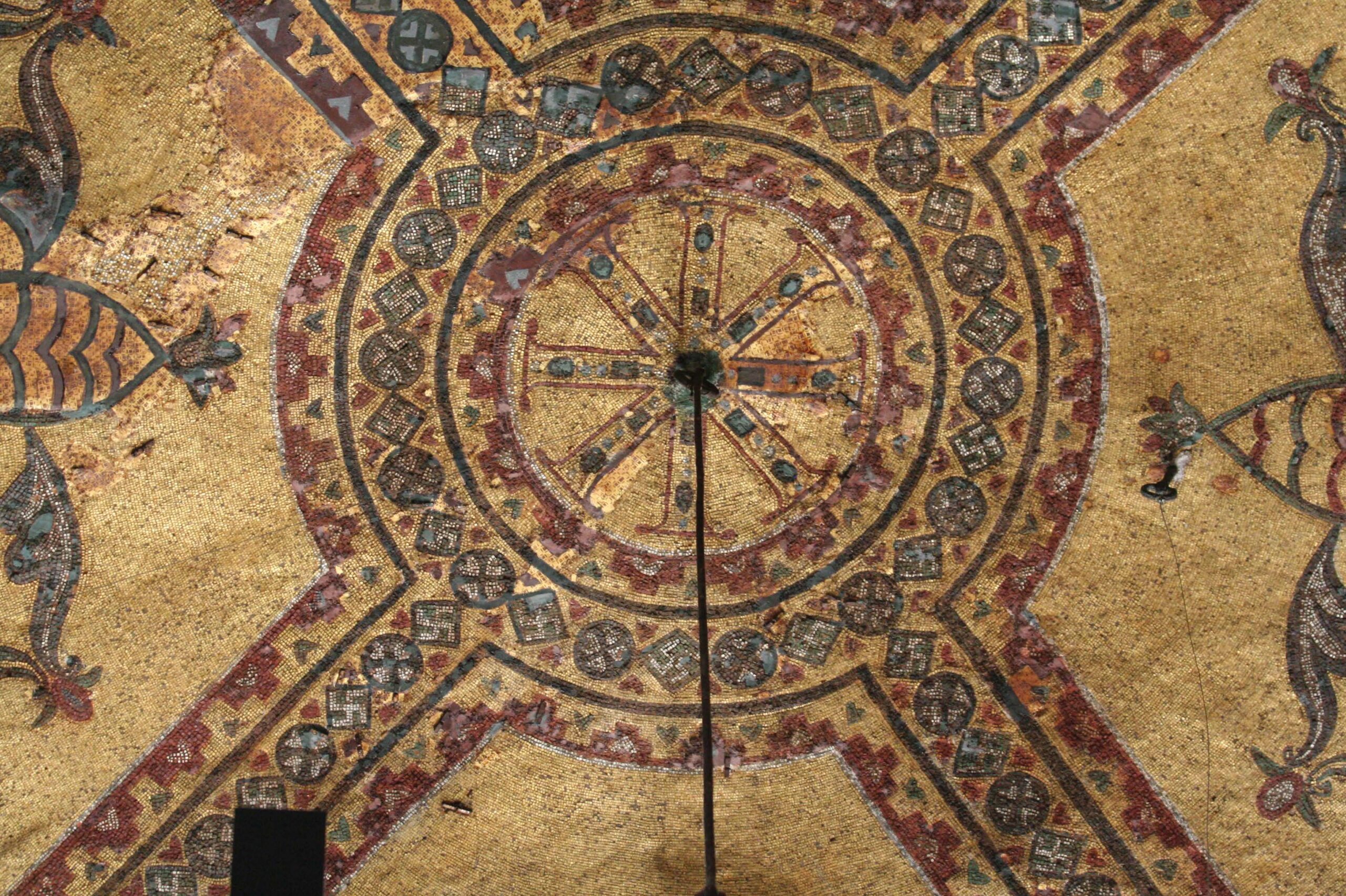
Figure 3.

In the course of the iconoclast controversy, a complex discourse develops, which aims and succeeds at drawing an equivalence between the typos (sign) of the cross and the medallion icon of Christ. Theodore Stoudites (759–826), a monk and hegoumenos of the important Constantinopolitan monastery of the Stoudios, articulated the significance of this change when the medallion icon of Christ superseded the typos of the Cross:

Likewise, as much is said about the representation (typos) of the cross as about the cross itself. Nowhere does Scripture speak about figure (typos) or image (eikon), since these have the same meaning, for it is illogical to expect such a mention, inasmuch as for us the effects share in the power of the causes. Is not every image (eikōn) a kind of a seal (typos) bearing in itself the proper appearance of that after which it is named? For we call the representation (aposphragisma,- ‘imprint’) ‘cross’ because it is also the cross, yet there are no two crosses, and we call the image (eikon) of Christ ‘Christ,’ yet there are no two Christs. [17]

Theodore Stoudites recognizes that the copies of the Cross are legitimate images of the Cross because they transmit the shape without change. He then asks what is the difference between the typos of the cross and the icon of Christ? Since the icon transmits the features of Christ unadulterated and thus preserves the form, then it too performs according to the same principle that legitimizes the typos of the Cross. By drawing on the equivalence between typos and eikōn, Theodore secures the legitimacy of the figural icon. Ninth-century images push this argument a step further, making the eikōn visually supersede the typos of the Cross. The marginal psalters reveal this visual polemics with the miniature of David prophesying about the Cross on Golgotha (Figure 4).
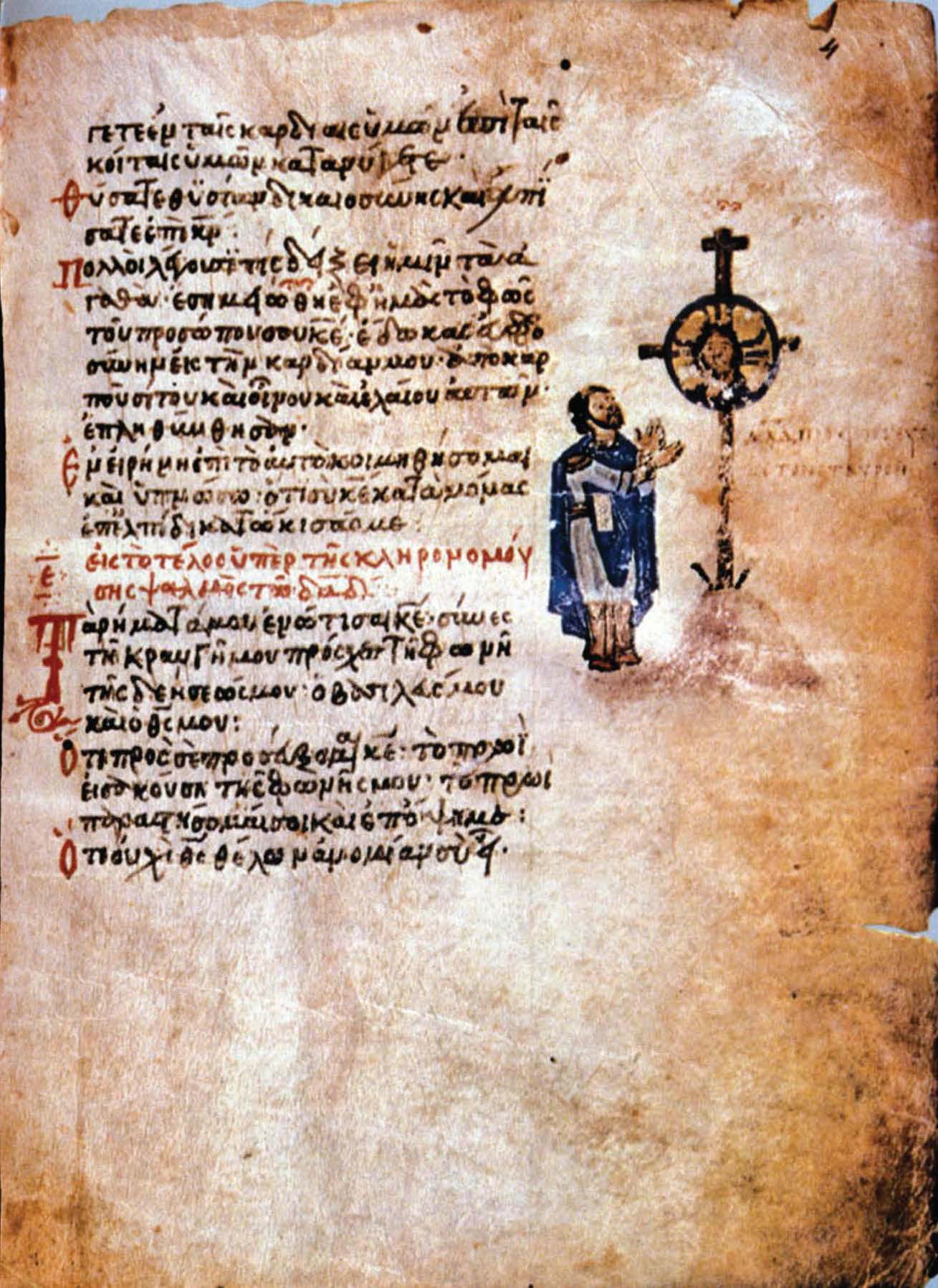
Figure 4.

Here a medallion icon is set at the center of the cross. The miniature illustrates the words of Ps. 4:7: “the Light of thy Face has been imprinted on us.” [18] All the faithful are imprinted with the Cross (in Baptism, in the Eucharist, through the blessing gesture), and this typos is now overlayered with the medallion icon of Christ: the light of Christ’s face.

The prominence of the round icon of Christ is attested in the Post-Iconoclast visualization of the cosmos in Kosmas’s Christian Cosmography. [19] The medallion eikōn tou Theou crowns the upper chamber of a space recalling an ecclesiastical interior. The icon in this upper realm marks the supracelestial domain (Figure 5).
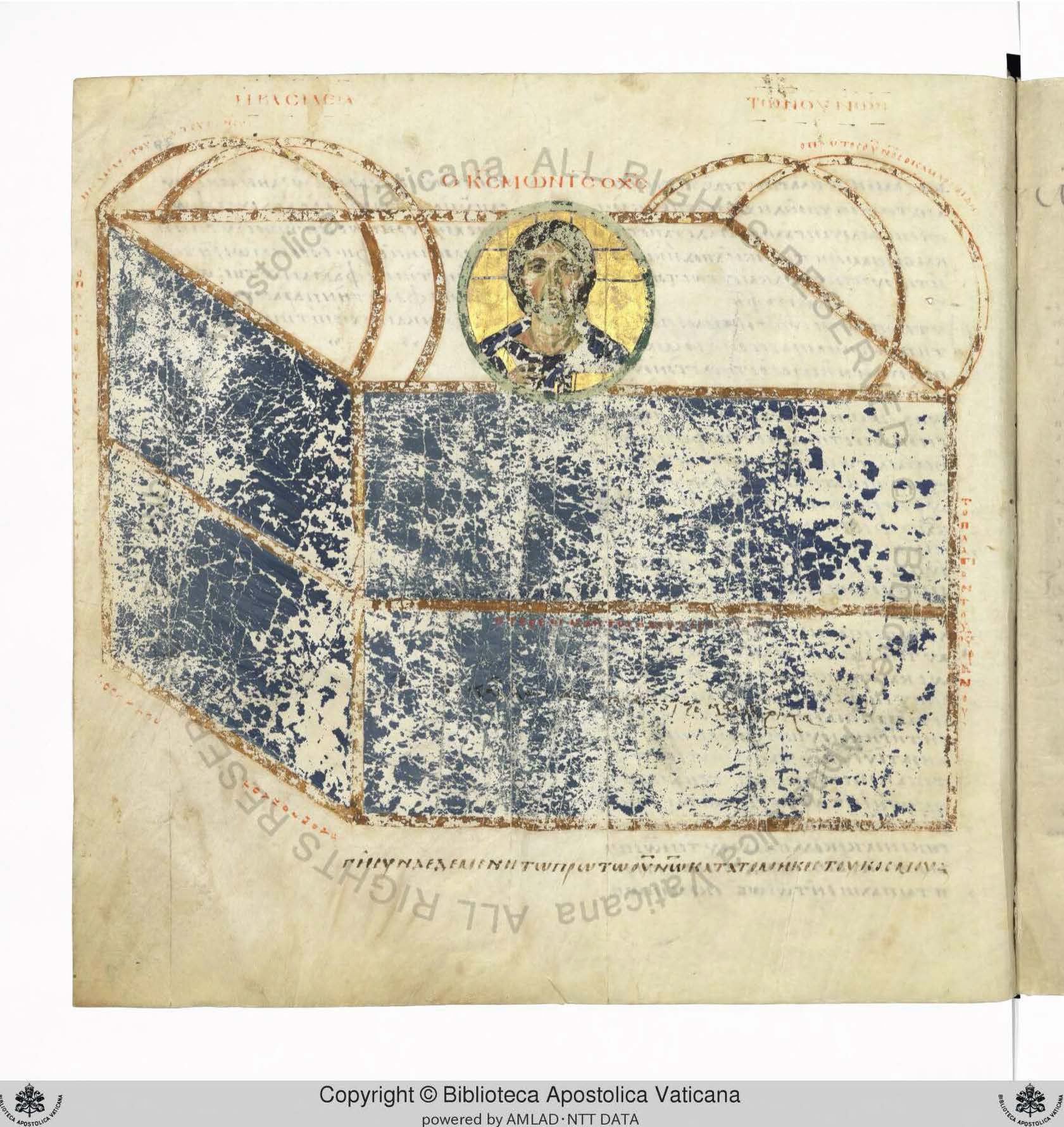
Figure 5.

The round icon of Christ further operates in scenes of conversion and prayer in the important Homilies of Gregory of Nazianzinos (Paris, BnF MS Gr. 510). The two miniatures reveal how the light of Christ’s face imprints itself on the faithful and transforms them. In the conversion of Saul/St. Paul (fol. 264v), Saul encounters the divine as he loses physical sight and at that moment metaphysical light streaming from the medallion icon of Christ touches and changes him forever from Saul to Paul (Figure 6).
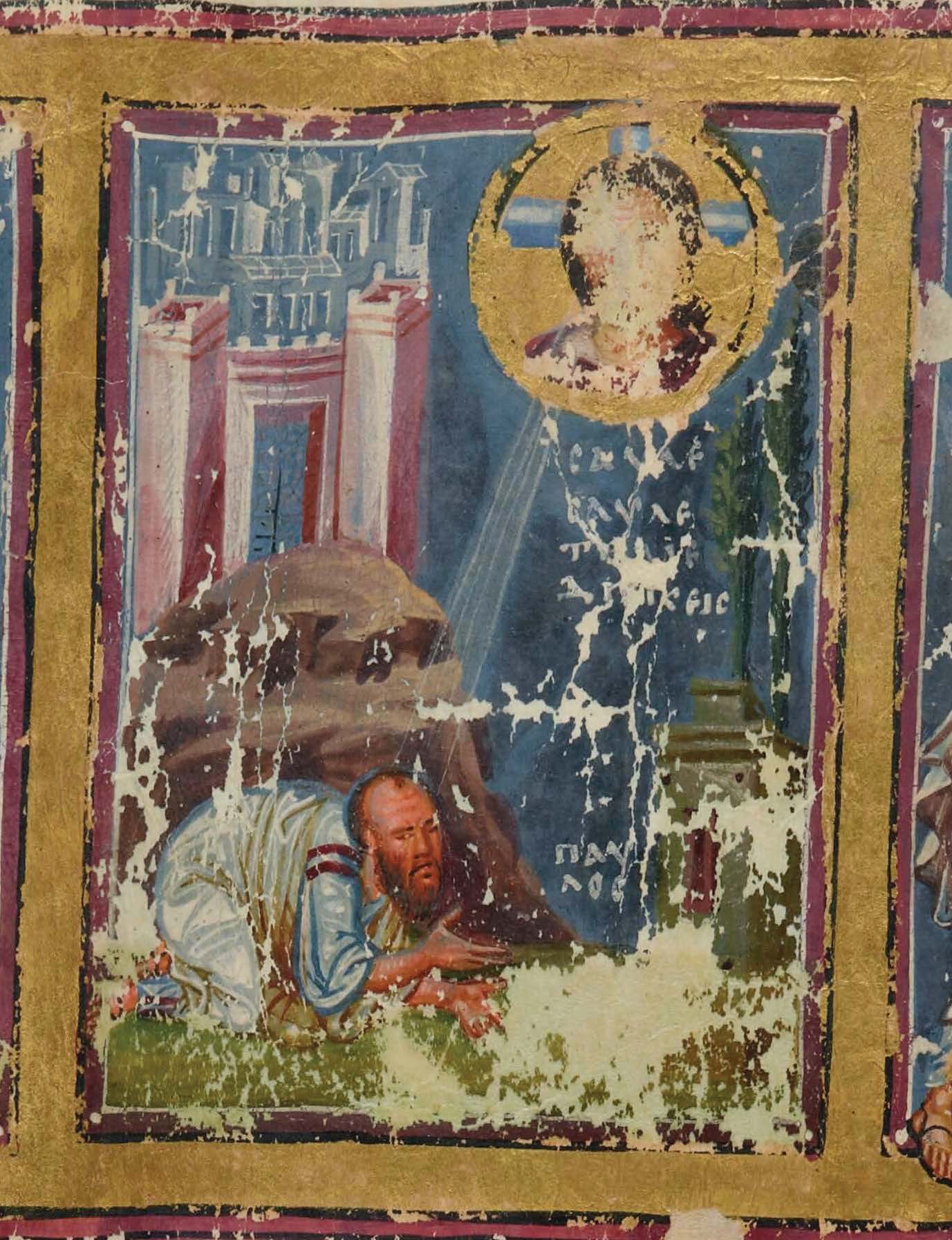
Figure 6.

Similarly, the prophetess Hannah praying to the Lord (fol. 332v) is envisioned in the privileged position of receiving divine grace that flows from a medallion image of Christ (Figure 7).
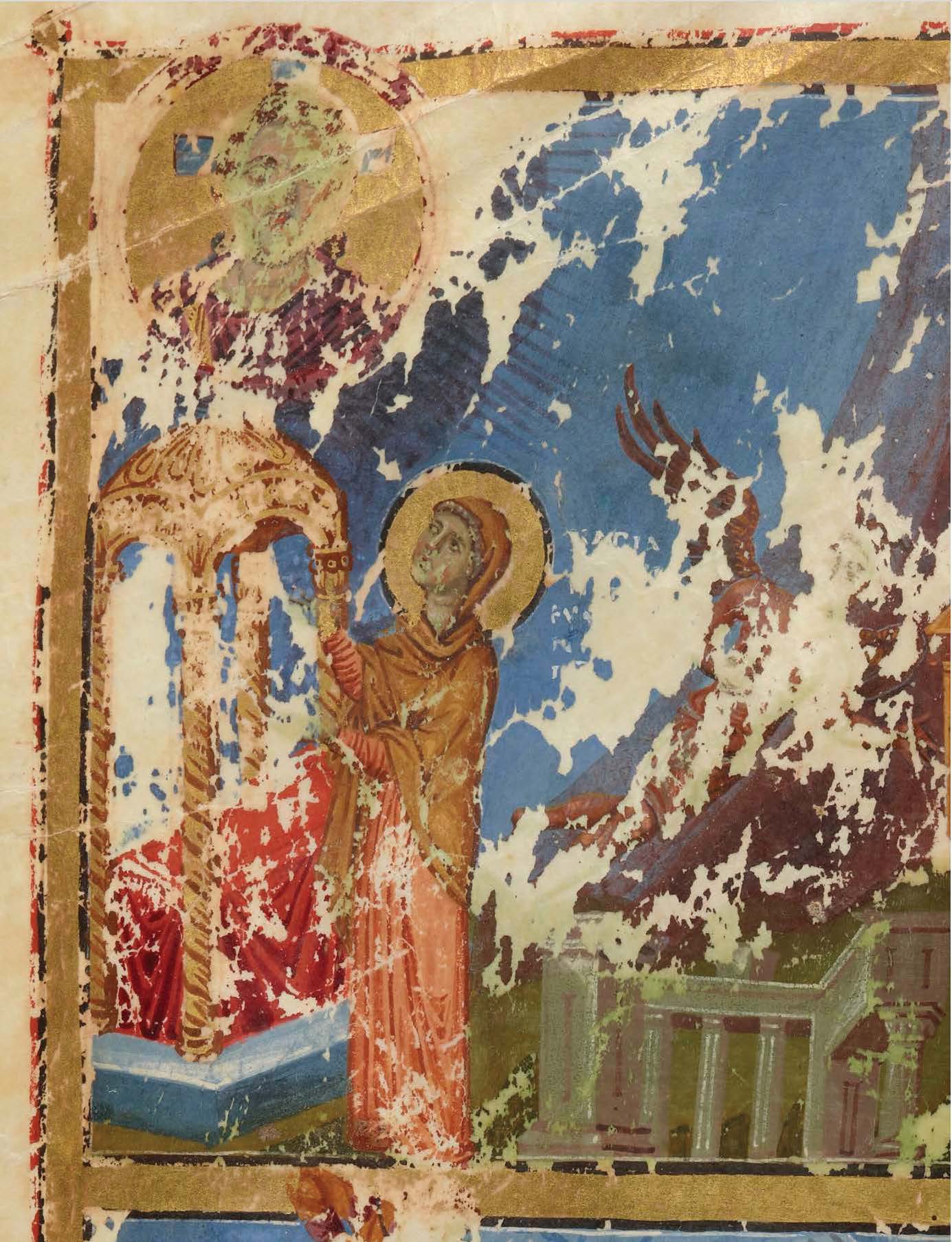
Figure 7.

Beyond the world of miniatures, the medallion icon superseding the cross becomes a spatial reality in the post-Iconoclast interior of Byzantine churches. This connection is recognized in the miniature of the tenth-century bible of Leo the Sakellarios that depicts the infrastructure of all the books of the Bible as a cross formation of tiny medallions, which resembles the ground plan of a cross-shaped church. The roundel with Christ emerges in the center in the space evoking the dome, while the medallion with the image of the Virgin is set at the top, reminiscent of the apse (Figure 8). [20]
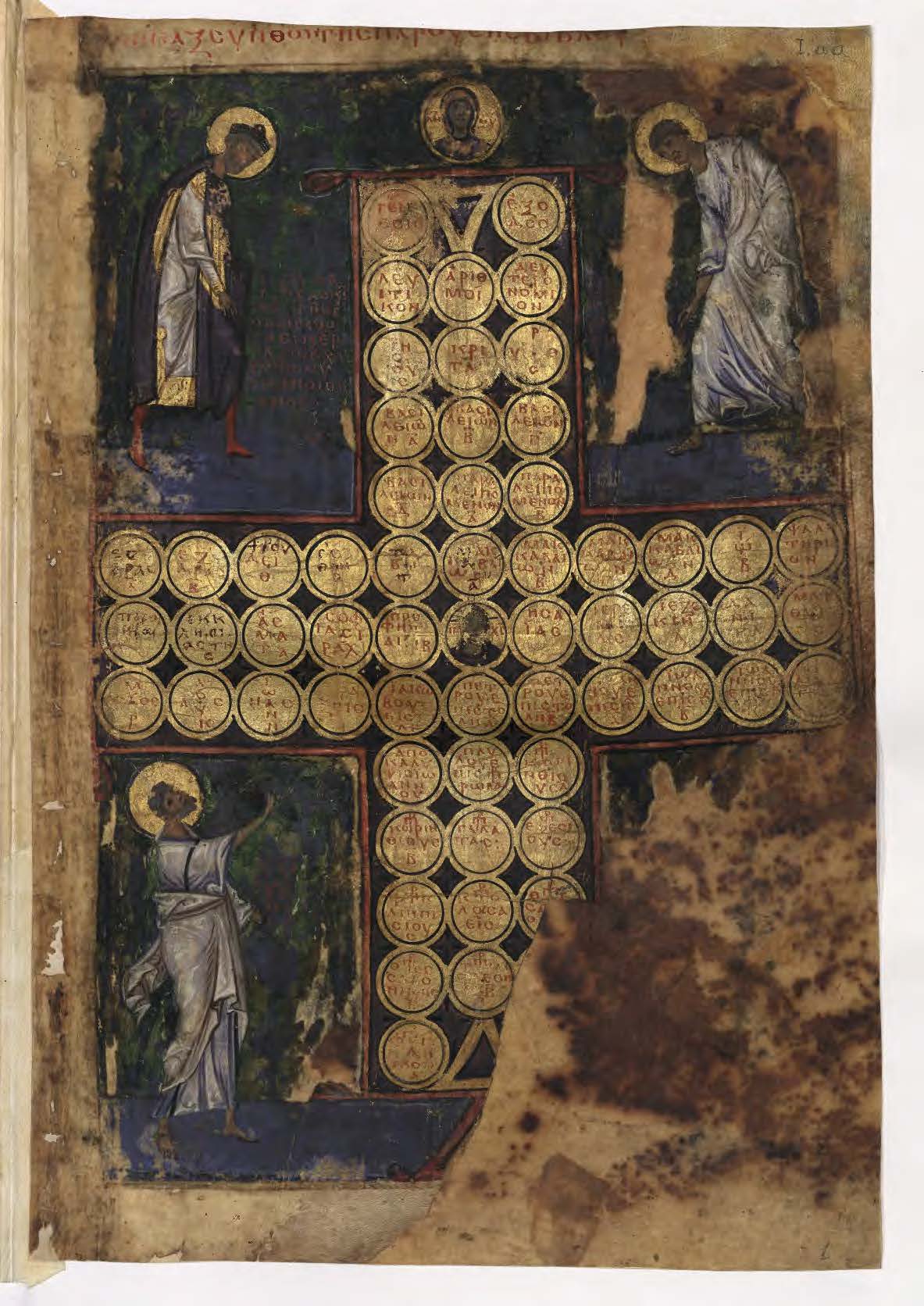
Figure 8.

This visual structure of the miniature of the Leo Bible can be overlaid on the interior of Hosios Loukas (see Figure 1). And while the medallion icon of Christ nestles in the highest point of the naos, this is not the only encounter with the eikon tou Theou in the church. The same image confronts the faithful at the entry from the narthex to the nave, set above the door (Figure 9).
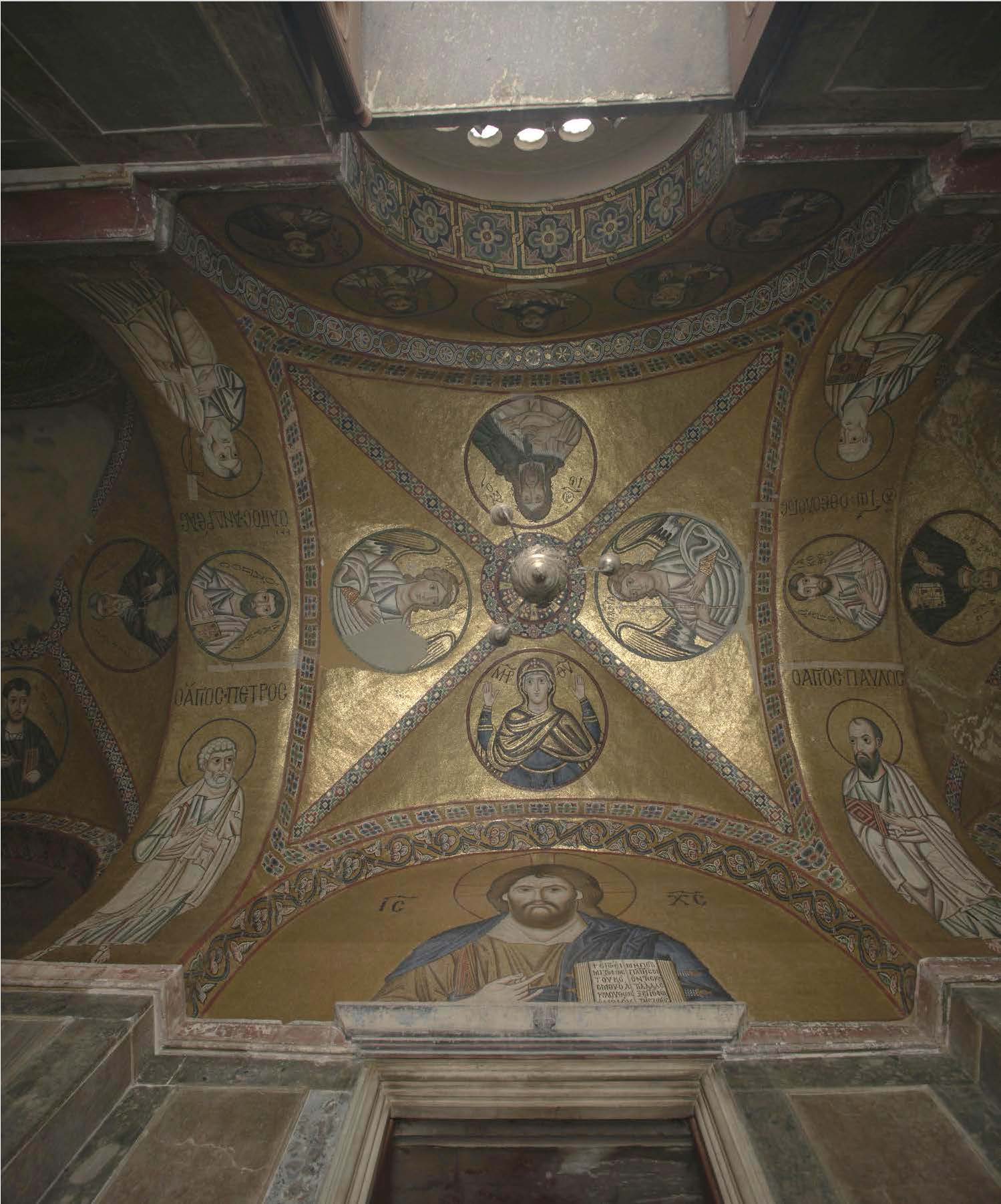
Figure 9.

The Great Kanon, written by Andrew of Crete and performed on the Fifth Week of Lent, gives access to how the face of Christ was meant to be experienced in architectural interiors like Hosios Loukas. Through the open gates of the narthex, one sees the spacious interior and is drawn to this sudden raise in height of the ceiling. If the mosaics in the narthex of Hosios Loukas start from a cornice placed at 3.39 meters from the floor, in the naos they start at the height of 12 meters (Figures 10 and 14).
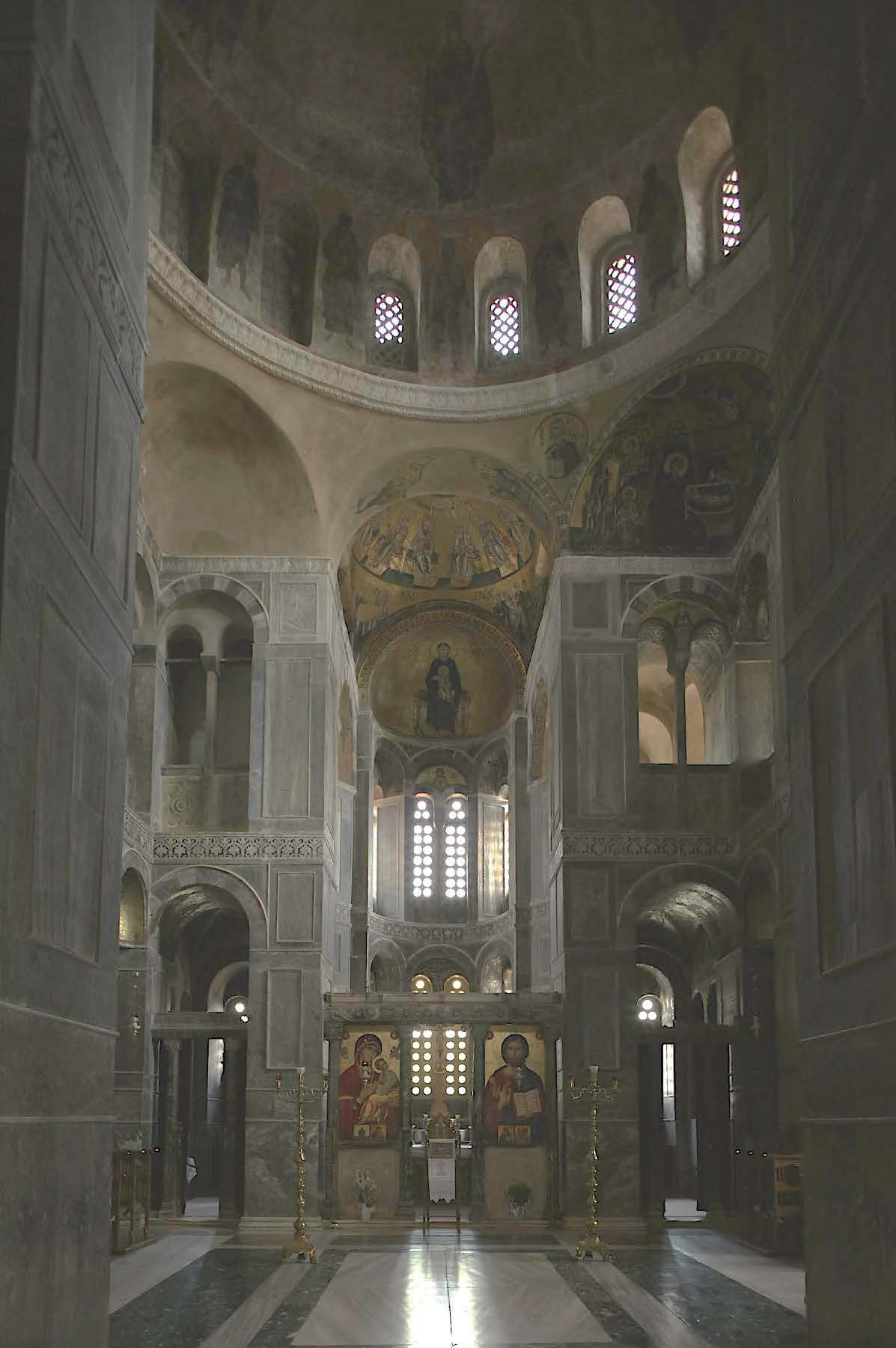
Figure 10.

The eikōn tou Theou in tympanum above the gates marking the transition between narthex and naos guards the symbolic border between earth and paradise. We can hear echoes of this idea in the kanon of Andrew of Crete. [21] His words voice the desire of the faithful. As they approach the door of the narthex, seeking entry into the naos, they are attracted by light pouring from the dome into the naos. The faithful are reminded how this vision of promised paradise became a reality for the Good Thief (Figure 11).
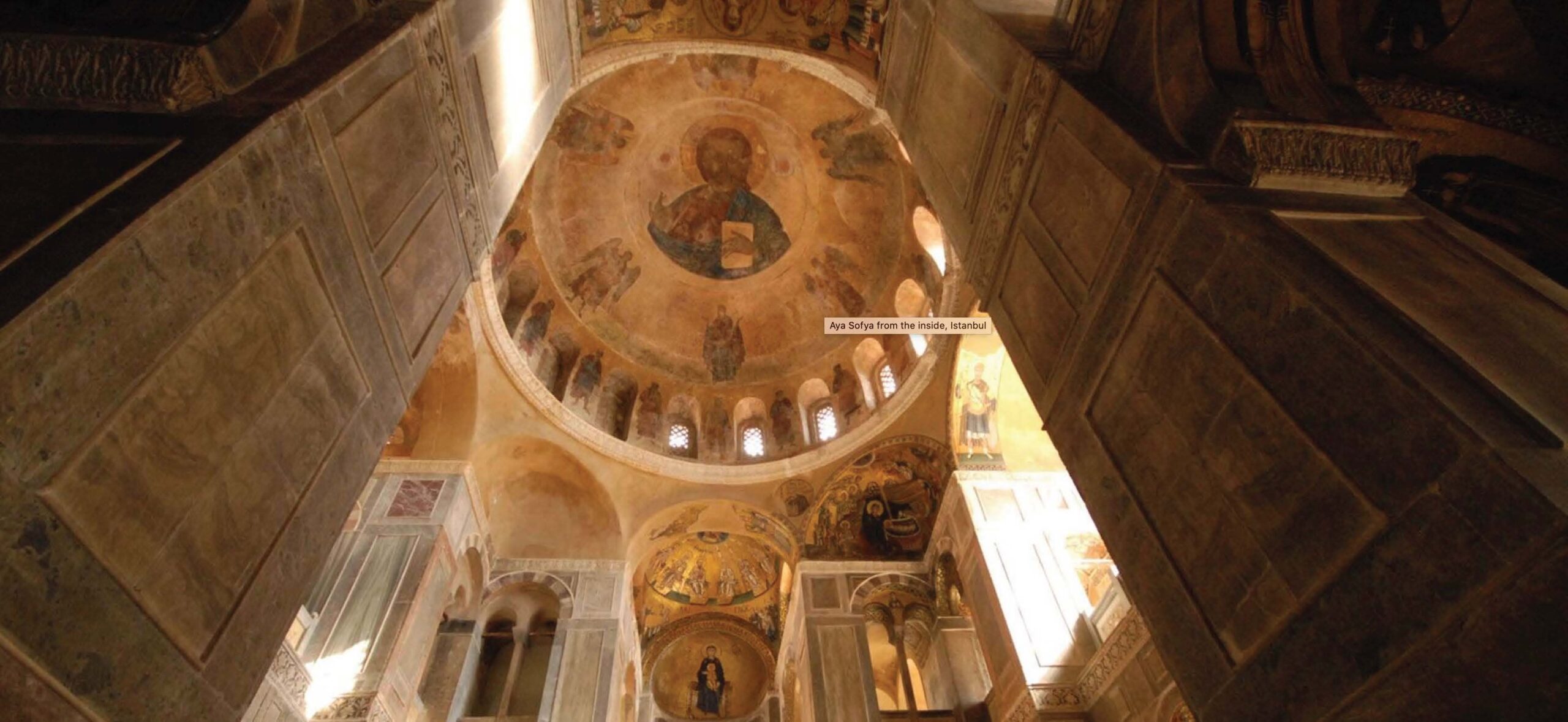
Figure 11.

Andrew of Crete writes: “A thief accused Thee, a thief confessed Thy Godhead: for both were hanging with Thee on the Cross. Open to me also, O Lord of many mercies, the door of Thy glorious kingdom, as once it was opened to Thy thief who acknowledged Thee with faith as God.” [22] The poetry voices the desire to emulate the model of the Good Thief and thus gain access to paradise. This drive to imitate is spelled out by the icon of Christ over the entry to the naos. And then the same image is repeated once more in the apex of the dome. Here it marks the end point of the journey.

Christ’s medallion icon in the cupola of the Byzantine church also mirrors another important encounter with the divine––the Eucharist chalice. The cup of the Patriarchs at the Treasury of San Marco offers one of the most articulate examples. The image of Christ is set in a medallion at the bottom of the chalice. The bowl inverts the great dome and becomes a transient container for the body of Christ. Once the cup’s Eucharistic content is consumed, the empty shell reveals the figural inscription of the Eucharist. The chalice functions as the microcosmic equivalent to the macrocosmos of the architectural dome (Figure 12). The pouring of the contents from the chalice could be seen in parallel to the cascading natural light from the cupola; the latter visualizes divine generosity, which offers the energy of life to the thirsty faithful.
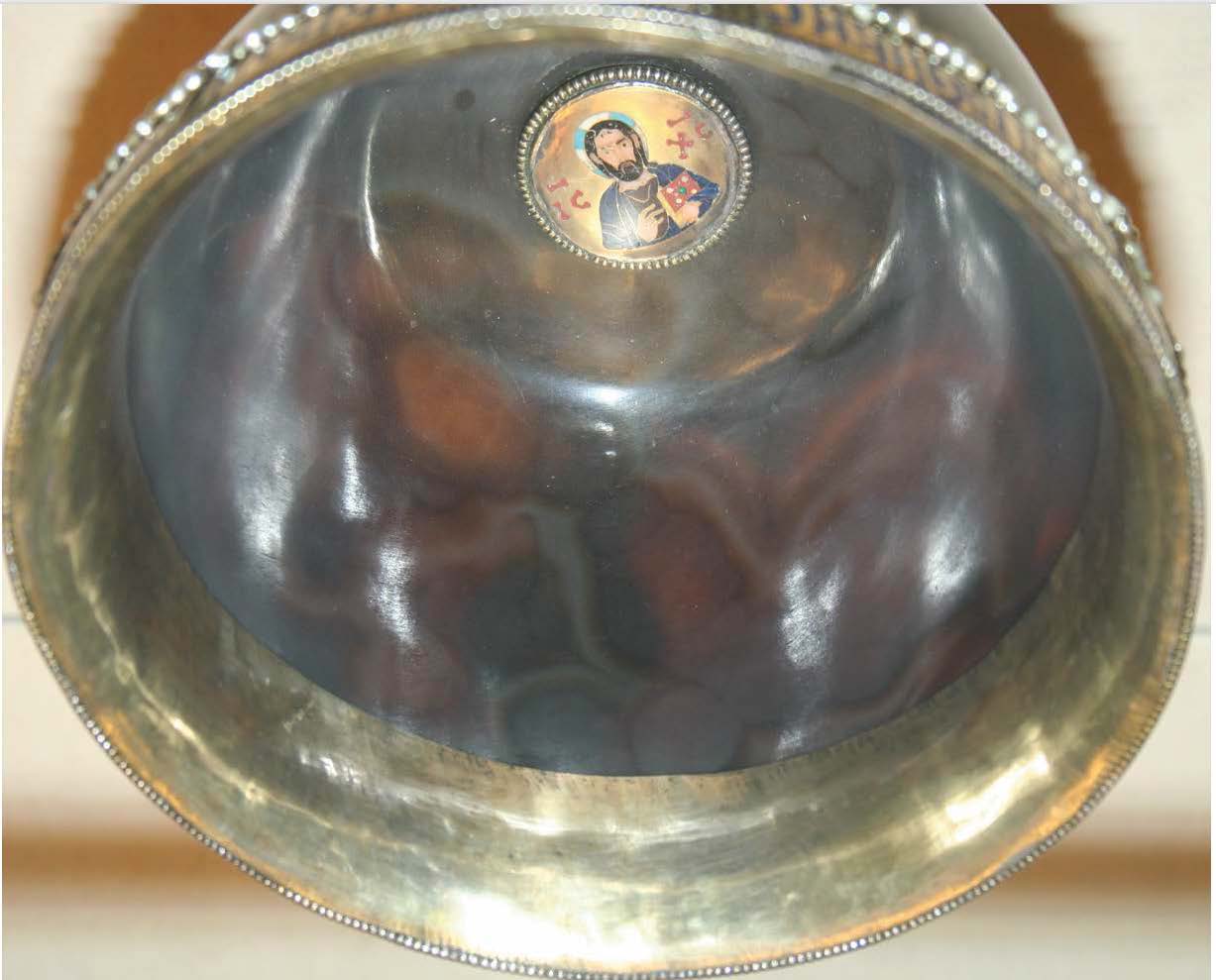
Figure 12.

Again, Andrew of Crete’s Great Kanon prepares the participant to perceive the architectural space in this way. He writes: “As a chalice, O my Savior, the Church has been granted Thy life-giving side, from which there flows down to us a two-fold stream of forgiveness and knowledge, representing the two covenants, the Old and the New.” [23] The entry into the church is envisioned as a fusion with the divine icon, structured on the model of the Eucharist. But the figural decoration after Iconoclasm makes this encounter more direct and this visual clarity and material directness is powerfully manifested in Hosios Loukas. The images of Christ set at the entry and at climactic apex of the dome uplift the faithful to the divine and recall the Eucharist chalice with its salvific outpour (Figures 9, 10, and 11).

Distance: Katanyxis and the Pantepoptēs

Placing the figural icon of Christ in the dome both gives immediacy to his presence in the ecclesiastical interior, but it also opens a distance between divine and mortal (see Figure 1). One partakes in the Eucharist; touch, taste are channels of closeness. Similarly physical light and reverberant sound in the ecclesiastical kallichoros envelop the faithful. [24] By contrast, anthropomorphic decoration on walls and ceiling introduces distance. With the victory over Iconoclasm, the formerly aniconic mosaic in the dome of the Great Church acquires the image of Christ. This mosaic introduces distance from the divine and this reshapes the spiritual experience.
This image of Christ constructs a stage setting for the practice of katanyxis. The faithful stepping into the church become confronted and interpellated; fear (φόβος) and stirred conscience impel them to examine their hearts and to repent for their sins. [25] Metanoia and katanyxis–repentance and compunction–as personal devotion collectively practiced, reveals a unique aspect of Byzantine culture, which placed the burden of Salvation on the individual’s capacity for compunction and repentance. Already in 565 katanyxis is given major importance. This happens as the traditional Ps 148 is replaced by a new communion verse that recalls the example of the two sinful figures (the repentant thief and the unrepentant Judas). The good thief models the behavior expected of the faithful: a mortal who is culpable and deserving punishment but who has the possibility to achieve pardon through the practice of katanyxis and metanoia. [26] Katanyxis entails the mourning for one’s sins; the split of the self into an accusing conscience (συνείδος) and accused soul; repentance and pleas for intercession. Through this imagined trial, the individual Christian rehearses and prepares for the Last Judgment. A church interior like Hosios Loukas stirs this affect both at the doors leading from the narthex into the nave and in the nave itself, where the gaze is pulled towards the light and thus towards the eikōn thou Theou in the dome.
Both the kontakion and the kanon train in katanyxis and metanoia. [27] The kontakion creates immersive environments at night, introducing major and minor characters from Scripture and giving access to their inner thoughts and struggles through monologues and dialogues, so that the participants could feel empathy and inhabit these models, awakening the conscience and fostering the work of compunction. The harlot, Doubting Thomas, Adam, the Prodigal Son are some of the exemplary figures. Similarly, the kanon works with the same set of biblical and New Testament characters to rehearse the models of the sinful but repentant figures. The successful implementation of the social practice of katanyxis greatly benefitted from the en-placement of the image of Christ in the cupola and from the development of figural programs that featured some of the characters discussed in the liturgical poetry.

The image of Christ in the dome transforms the nave (the kallichoros) into a personified space of judgment (see Figure 1). The medallion image of Christ in the apex triggers compunction and sonically articulates the descent of divine mercy and forgiveness. [28] Christ in the dome opens a stage for the rehearsal of the future Judgment as a proleptic scenario. A modern viewer cannot immediately grasp the drama of this interpellation. Yet, the fear and trepidation it can excite in the faithful can be recuperated by the medieval inscriptions framing the eikōn tou Theou in the dome. The verses inscribed around the image of Christ in the cupola in twelfth-century church at Trikomo in Cyprus reveal the intended approach to the divine Judge (Figure 13): “He who sees all from the distant place sees all those who enter here. He examines their souls and the movements of their hearts. Mortals, tremble (with fear) before the Judge [at Judgment!].” [29]
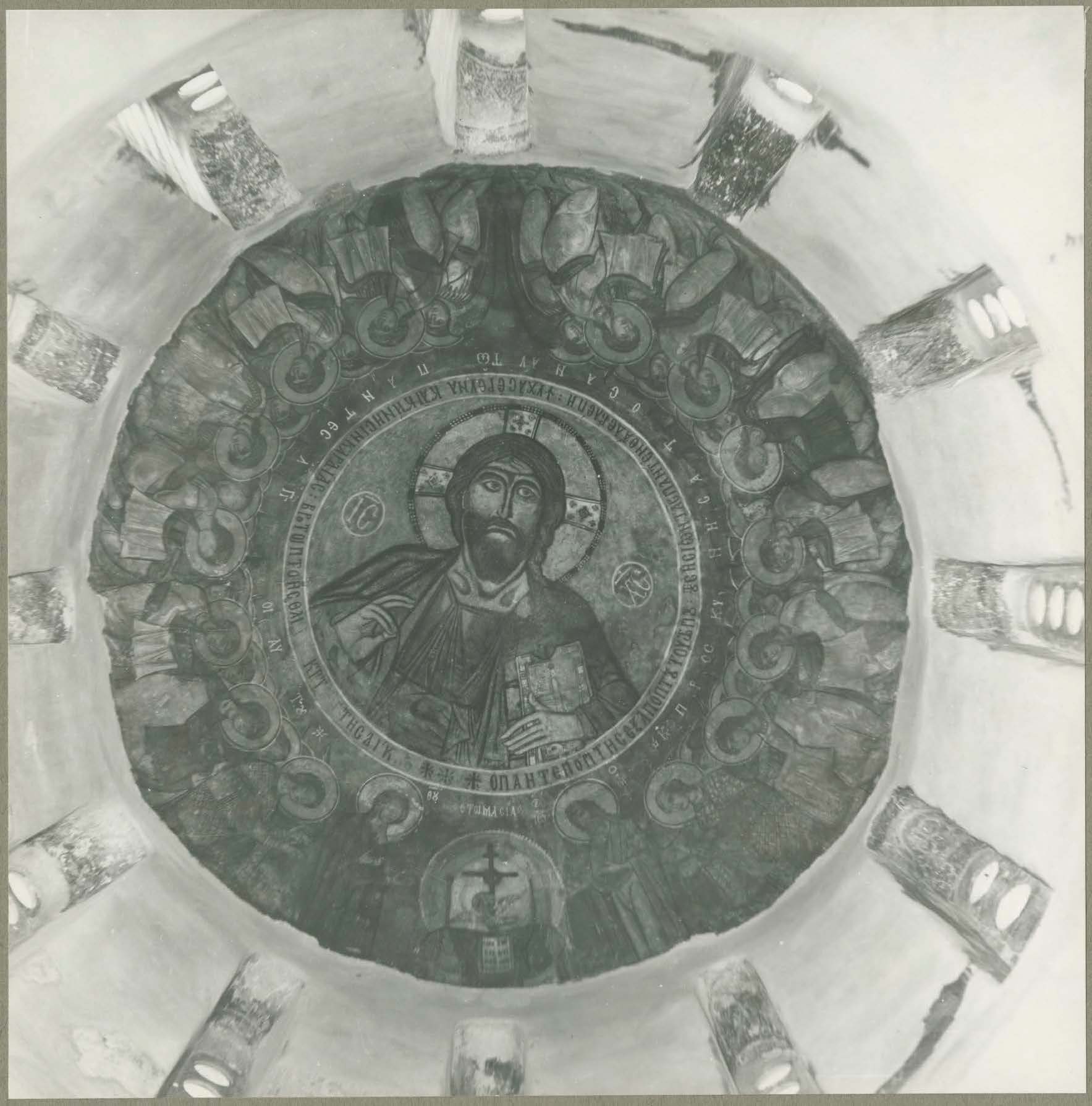
Figure 13.

The inscription states that nothing escapes the gaze of Christ; he observes all who enter and reads their hearts and the movement of their souls. The indictive voice abruptly switches to the imperative, warning the viewer to approach the Judge “with trembling and fear.” A second text further secures the futurity of the scene as that of End of Time: “And let all the angels of God worship him” (Hebrews 1:6). [30] The composition sets the stage that is only completed with the viewer, who becomes the accused standing before the judge. The visual and spatial composition makes all the visitors practicing the Byzantine liturgy to feel englobed inside the divine eye and liable for all their actions during their life on earth.

The human eye is attracted to the light which streams from the drum of the dome. Thus, the visitor’s gaze naturally lifts to meet the eyes of Christ in the apex of the cupola of a Byzantine church (see Figures 1 and 13). But we as modern viewers are unaware of the interpellation, for we lack the liturgical training that had developed the Byzantine sensitivity to the all-seeing eye and the summoning voice of the divine. The interpellation scenario is invested in some of the words that describe this bodily position: standing exposed (γεγυμνώμενος, gegymnōmenos, “naked”) and with lifted head and neck bending backwards (τετραχηλισμένος, tetrachēlismenos). [31] And this sacrificial stance is modeled after the Passion of Christ. We see tetrachēlismenos depicted in Late Byzantine icons of The Virgin and Christ, where the torqued body of the Child elicits the Crucifixion and models the bent back neck of the faithful. [32]
Yet, compunction is not forced, it descends through divine grace. This is how the abbot of Sinai, John Klimax (ca. 579-650) writes about katanyxis: “In the domain of creation as in that of compunction there is that which moves itself and that which is moved by some other agent, when the soul grows tearful, weeps, and is filled with tenderness, and all this without having striven for it, then let us run, for the Lord has arrived uninvited and is holding out to us the sponge of loving sorrow, the cool waters of blessed sadness with which to wipe away the record of our sins. Guard these tears like the apple of your eye until they go away, for they have a power greater than anything that comes from our own efforts and our own meditation.” [33] Katanyxis is fundamental to salvation and is thus compared to the energies of Creation. Compunction starts with the pricking of one’s conscience. But it is also a divine grace, arriving unexpectedly; the faithful find themselves suddenly near the divine. And this encounter brings relief, and like cool refreshing waters, it washes the record of past sins.

The image of Christ in the dome of the nave can stir katanyxis, but this complex feeling of fear and trembling can be coupled with the relief stemming from the possibility for divine forgiveness. At Hosios Loukas, a Crucifixion scene is depicted in the tympanum to the left of the main door leading from the narthex to the nave. This image shows the moment in which water and blood concretize as an efflux flowing out to save humanity. With the slight curve of Christ’s body, the Crucifixion visualizes the concept of divine condescension, συνκατάβασις; the Son bends down from his high celestial position to the lowliness of the human race in order to save the faithful (Figures 14 and 15).
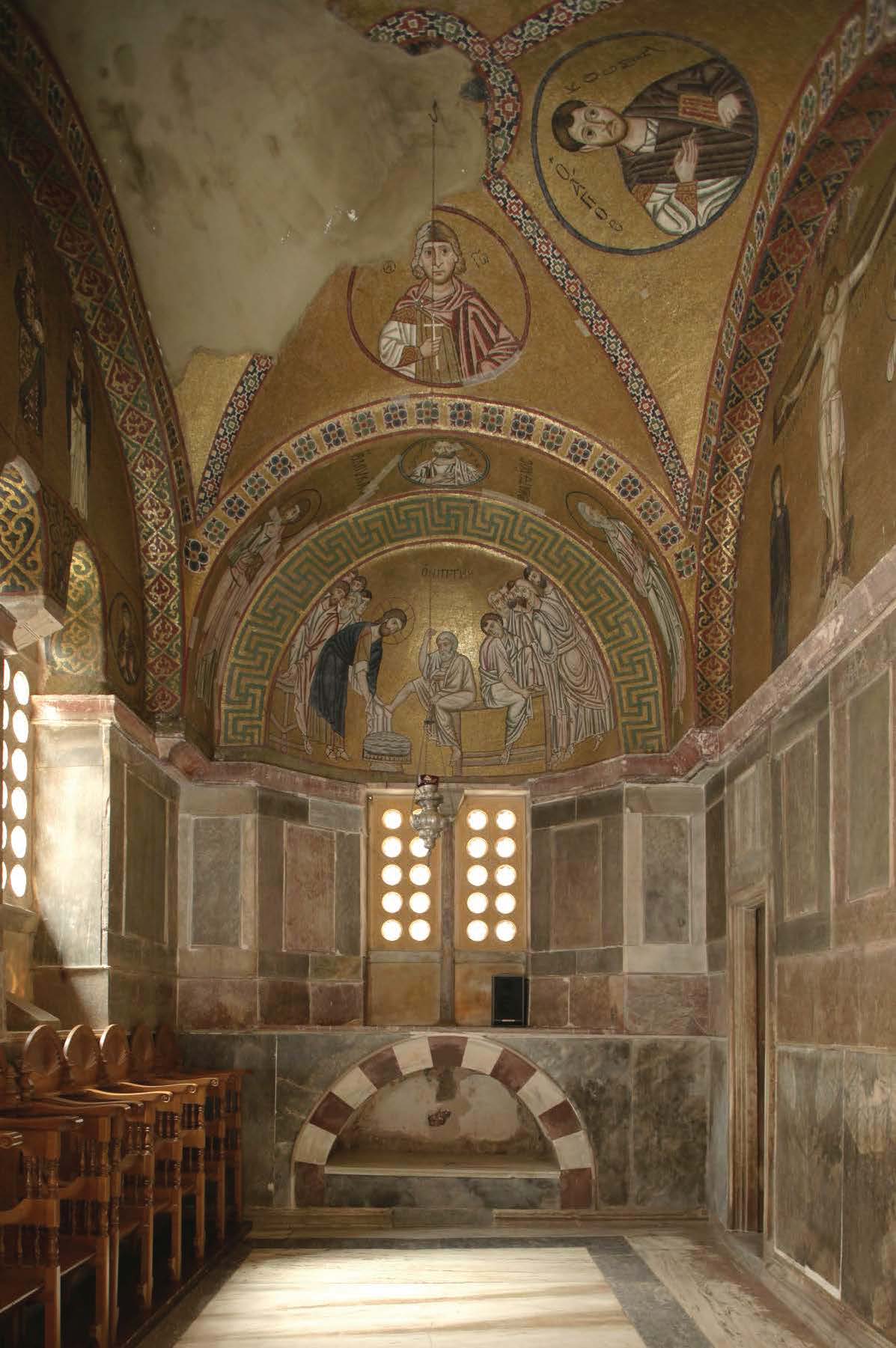
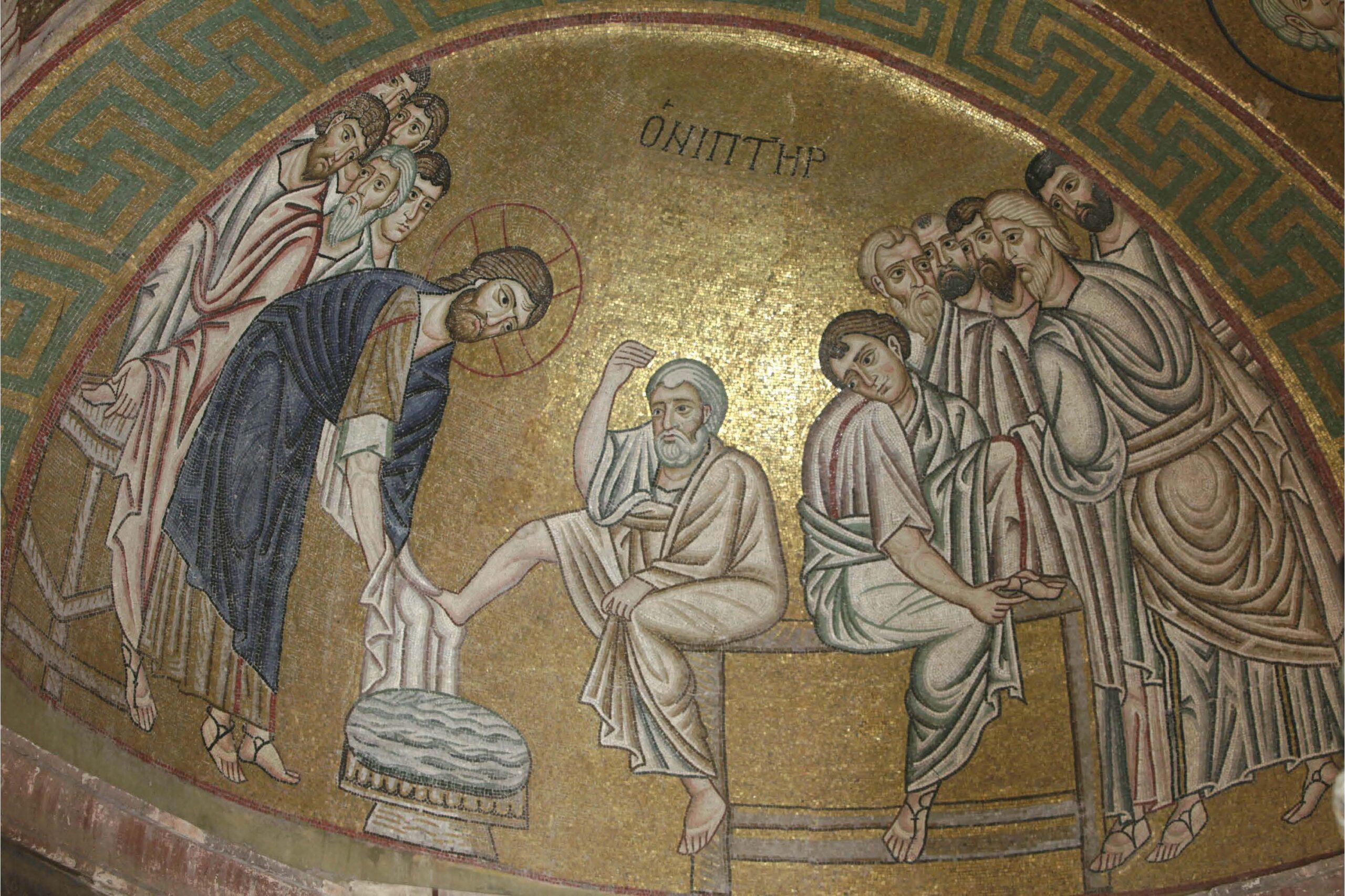
Figure 14.
Figure 15.

Mary’s words in the Great Kanon (Ninth Ode) of Andrew of Crete affirm the power of this divine condescension: “Christ became a child and shared in my flesh, and performed willingly all that belongs to my nature, only without sin. He set before thee, my soul, an example and image of His condescension.” [34] The two prefixes, syn– (“with”) and kata-(“down”) in the Greek word for condescension (synkatabasis) express both Christ’s descent and His willingness to bend down and partake in human nature and suffer death at the Crucifixion in order to raise it up through His Resurrection (Figure 16).
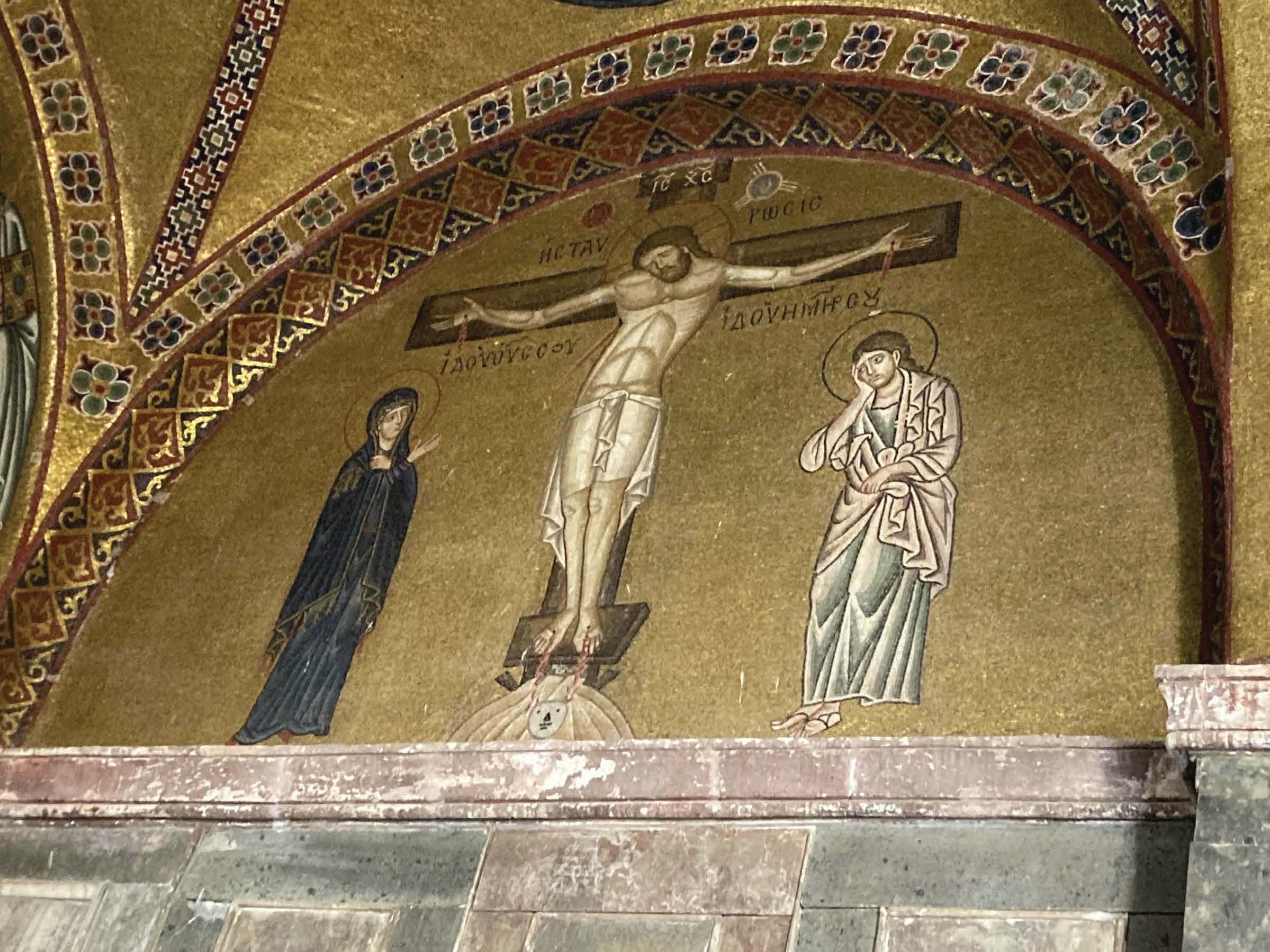
Figure 16.

Christ bending is linked to the outpour of his blood. It flows from the wounds in his hands, side, and feet. The blood forms clean, thin streams. It inspires penance and aims to trigger a reciprocal flow of tears in the faithful. Andrew of Crete’s Great Kanon expresses these ideas channeling the address of the repentant sinner:

I have defiled my body, I have stained my spirit, and I am all-covered with wounds: but as physician, O Christ, heal both body and spirit for me through repentance. Wash, purify and cleanse me, o my Savior, and make me whiter than snow.
Thy Body and Thy Blood, O Word, Thou hast offered at Thy Crucifixion for the sake of all: Thy Body to refashion me, Thy Blood to wash me clean; and Thou hast given up Thy spirit, O Christ, to bring me to Thy Father. [35]

By the outpour of His blood, Christ washed the sin away. And by the giving up of His Spirit, he lifted humanity to the divine. The words speak of divine descent and closeness. Similarly, the choice of place for the Crucifixion mosaic gives visual concreteness to synkatabasis. The Crucifixion set in the narthex is physically closer to the viewer (as mentioned earlier the mosaics in the narthex start at 3.39m height in the narthex as opposed to 12m in the nave).

The liturgical poetry engaging with the Passion of Christ also recognizes the paradoxical pairing of wound and humility. Sin is nakedness, but Christ is sinless even if he is stripped of his clothes at the Cross. He suffers without having committed sin and thus he gains credit, with which he can ransom humanity. This suffering of the blameless is also visually expressed in the whiteness of Christ’s nude body (a sign of purity and salvation) and the thin white transparent loincloth. Γύμνος mean “naked,” and this word forms an optical pair with νύγμα/νύγμη meaning “pricking” and “wound,” by the switch in position of the two letters γ and ν. Christ embodies both the wound and humility through which the faithful will be elevated to the divine. His willing synkatabasis ensures the Salvation of the repentant humanity.

Nearness: The Mosaics in the Narthex and the View from Below

As mentioned earlier, the road to salvation for humanity passes through metanoia and katanyxis. To reach the ascent, the faithful need to start with the opposite movement: to bend down and fall in proskynesis. The proskynesis of the faithful combined with the recollection and evocation of Christ’s synkatabasis produces nearness to the divine. The mosaics of Hosios Loukas visualize this process in the narthex (Figure 14). The mosaic program starts with the scene of the Washing of the Feet on the north side, a narrative from the gospels liturgically reenacted on Holy Thursday when the hegoumenos performs a ritual washing of the feet of twelve monks at the beginning of the sixth hour. [36] The scene visually ascertains that salvation is offered to those whom Christ touched and who live in Him and he lives in them: chiastically entwined. The liturgical text as recorded in the eleventh-century typicon of the Evergetes monastery of Constantinople, immediately brings to the fore the image of salvation seen in the paradox of inverted magnitudes and enjoinment: Christ, who puts on light as garment is now girding himself with a towel and bends down to wash the feet of the disciples. [37] This entwining of high and low ensures the possibility of salvation of mortals who live in Christ. A sticheron (a liturgical poem usually with its own melody, which is intercalated in the singing of the psalms) sung on Holy Thursday explicitly states how the Washing ensures the communion in Christ and leads to Salvation: “Oh the very great gifts of the Master! He makes his own disciples participants in his grace, and promises that they will have a share with him in ineffable glory, as he also said about the mystical cup, that he will drink it afresh with them in the kingdom of heaven.” [38] The word “companions” (κοινωνοί) echoes the Eucharist (κοινωνία) and thus speaks of the partaking in Christ on the model of communion. And then the poem states that the saved will have a part (μέρος) in the divine glory (δόξα). Doxa, glory, as light can be equated to the resplendent garments of Salvation that the blessed don at the End of Time. The kontakion on Peter by Romanos Melodos recognizes the centrality of the Feet Washing for Salvation and expresses this insight in the refrain that proclaims: “Hasten, Holy One, save your flock!” [39]
The mosaic of the Feet Washing at the monastery of Hosios Loukas captures the exchange between Christ and Peter. The latter is in a shock at seeing Christ bend, so he opposes the washing. But when Christ assures him that “If I wash thee not, you have no part of me,” Peter responds with “Lord, not my feet only, but also my hands and my head.” (Jn. 13:8–9). The placement of the mosaic in the niche of the northern side of the narthex deepens the significance of the Christ willing lowering and bending (συγκατάβασις). Christ bowing follows the curvature of the surface and visually confirms the divine mercy in the willingness to descend in order to enjoin with the faithful and raise them back to heaven. Another sticheron for the liturgy on Holy Thursday explicitly states these ideas: “Jesus, you who cloak the heaven with clouds, who on a throne of glory reign with your incorruptible Father, taking a towel you girded yourself with this to wash the feet of the creatures of clay, you, o Word being totally fire even through you were made flesh.” [40] Salvation arises from the paradoxical inverted magnitudes of the Creator of All stooping down to wash the feet of the creature and thereby elevate and sanctify it. The mosaic gives visually a manifestation of this future glory of the faithful as it catches the light in the gold mosaic of the conch and reflects it in a blinding spectacle of glory (doxa).

Christ in the kontakion on Peter by Romanos Melodos further assures his disciple about the future salvation with a powerful metaphor:

The first time you [Peter] cried out, but now as you weep, you will not find me
giving you my hand as before [reference to Christ’s rescuing Peter in the sea]
because, having taken in it a reed as a pen, I am starting to write a pardon for all Adam’s descendants.
My flesh, which you see, becomes for me like paper,
and my blood like ink where I dip my pen and write,
as I distribute an unending gift to those who cry:
‘Hasten, Holy One, save your flock’. [41]

Christ bends, he who weaves the clouds, bows to touch mortal feet in order to give a chance of the faithful to live in Him. He sacrifices His own body, making it into the book, writing Salvation with his own blood. The viewer in the narthex of Hosios Loukas is thus asked to move between the two scenes the Washing of the Feet and the Crucifixion, envisioning the progress of Salvation. And on the walls of the katholikon, these two images are also set in close in proximity.

Furthermore, the mosaic of the Washing of the Feet faces the Doubting Thomas in the southern niche (Figure 17). The latter too visualizes the overcoming of distance and the enjoining with the divine.
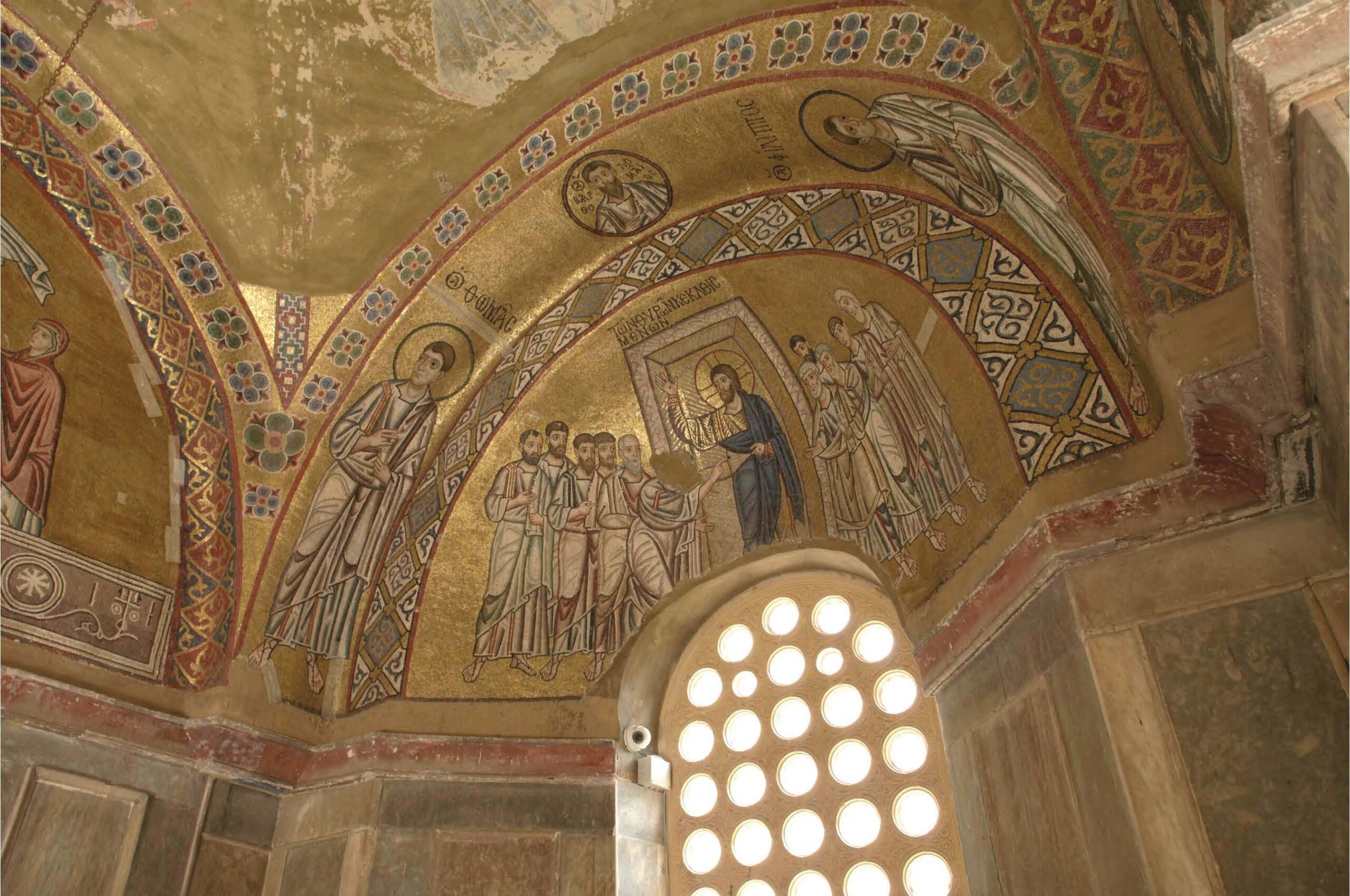
Figure 17.

Thomas’s doubt in Greek δίσταγμα (distagma from the verb διστάζω [distazō], ‘to doubt, to hesitate’) plays on sonic similarity with διάστασις (diastasis), ‘separation’. By choosing not to believe, he separates himself from his fellow disciples, who rejoiced in seeing the resurrected Christ. Thomas thus cuts himself off from their happiness and from the possibility to partake in the Savior. He only overcomes this diastasis in the moment he plunges his finger in the wound of Christ. Through the knowledge gained by touch, Thomas can disperse his distagma/doubt. With this regained intimacy with the Savior, he becomes reintegrated in the community of the faithful. Romanos’s kontakion on the Doubting Thomas is saturated with sensuality of this touch. [42] As he plunges his finger in the wound, Thomas whispers to Christ:

Stay gentle, that I may take my delight in you, Lord.
Satisfy me, who am yours. You were patient with strangers;
Be patient too with your own and show me your wounds,
that, like springs, I may draw from them and drink. [43]

Thomas burns in desire to touch and to satisfy a deeply seated need (Figure 18).
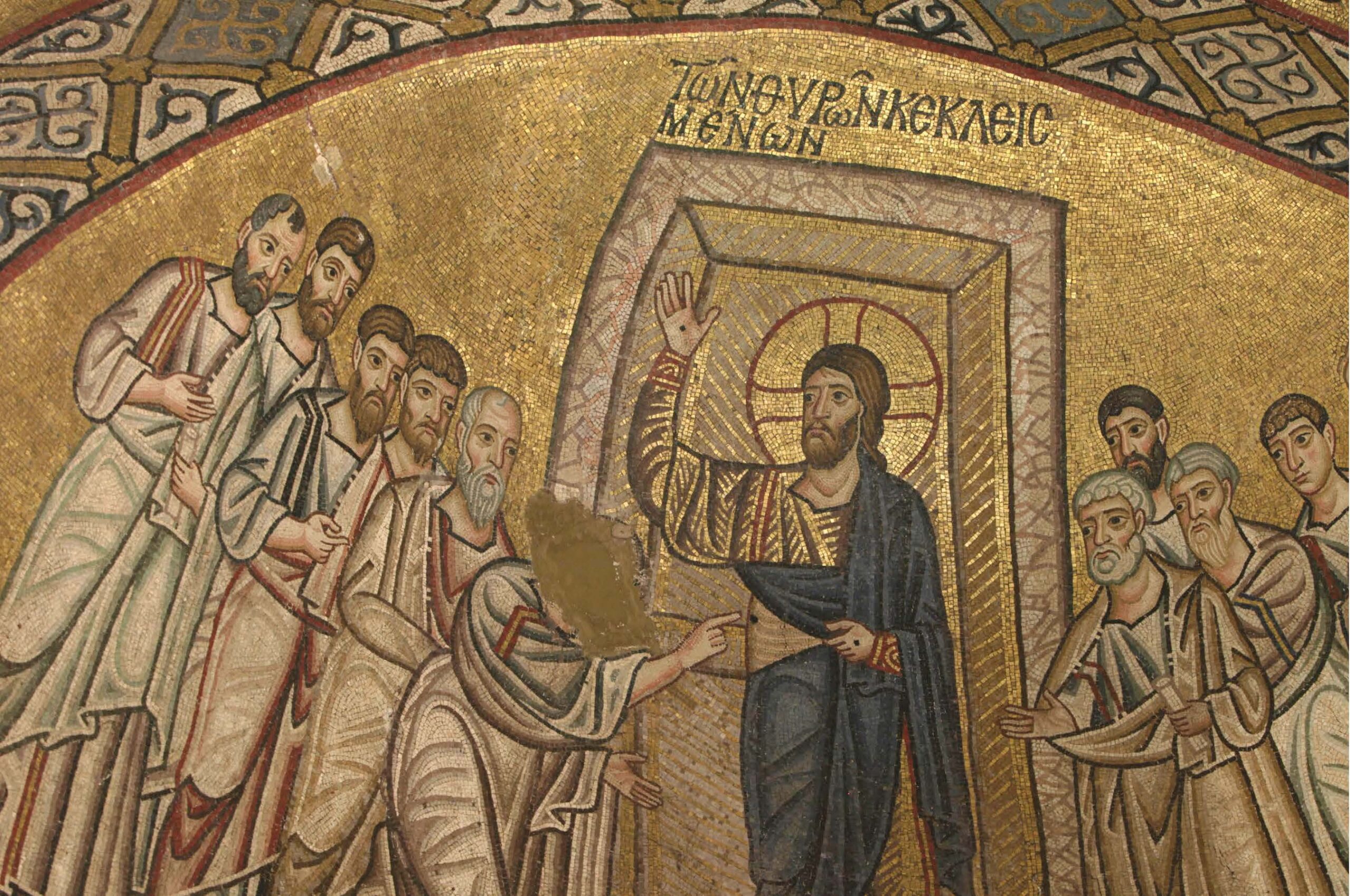
Figure 18.

His faith speaks through the language of the lover who wants to embrace and penetrate the beloved. [44] Later on, Thomas states in the same kontakion, stanza 16: “The side which I grasp, I enjoy.” Pleasure and full satisfaction drips from this tactile encounter. And the sensual pleasure in the body of Christ also expresses the notion of the pliability of the divine, descending, bending down, giving in, captured in the Greek word of συγκατάβασις. Just like the bending Christ washing the feet of the apostles across the narthex, so too the Master offering his body to the desirous touch of the apostle is manifestation of supreme condescension. This reversal or extreme lowering of the divine propels the magnitude of the Salvation purchased through this contrasting act of willing descent.

The wound is the entry that pulls together opposites of suffering and satisfaction. This paradoxical pairing is signaled by the Greek forming again a near-phonetic pair of πληγάς (plēgas) ‘sides’, referring to the wounds, and πηγάς (pēgas) ‘wells, springs.’ Christ’s suffering body becomes the delight, attraction, and desire of the faithful. Salvation streams from his suffering body and brings pleasure to the blessed. The paradox is iterated on another level as well with another wordplay of νύγμη (nugmē, ‘gash’, ‘wound’) and γύμνη (gumnē, ‘naked’). The damned are naked, but Christ reverses this. Through his blameless suffering, His wound (nugmē) offers Salvation as garment to naked (gumnē) humanity.
The mosaic of the Doubting Thomas at Hosios Loukas in the south conch, facing the Feet Washing, manifests the resplendent garments of Salvation. The chrysography on Christ’s blue tunic catches and reflects the light, and this aura is intensified by the gold striations on the closed door before which He stands. This closed door (the phrase is written out in the mosaic τῶν θυρῶν κεκλεισμένων, tōn thurōn kekleismenōn) is a metaphor of the inviolate, resurrected body that humanity will recuperate at the end of time. But the motif also speaks of the divinely human Christ who miraculously entered and left the body of Mary without breaking her virginity. And finally, the closed doors also capture the fear of the apostles, who even though they saw Christ resurrected, were afraid to go out and openly proclaim this miracle. Of this constellation of meanings, the closed door as the resurrected body dominates. The sticheron τῶν θυρῶν κεκλεισμένων sung repeatedly on the Sunday after Pascha stresses this salvific message of closed doors. [45] The poetry and music of this chant describe how Thomas ultimately drank doxa (δοξα, ‘glory’) from the side of Christ. Thus again, the imagination is stirred to conjure the chalice and envisions drinking the eikōn tou Theou.

In the narthex of Hosios Loukas, the two scenes of the Washing of the Feet and the Doubting Thomas are in a continual dialogue. And just like in the Washing of the feet, Christ speaks metaphorically that his body is the parchment on which the stylus/Cross writes Salvation, so too Thomas’s finger becomes a stylus in the kontakion of Romanos Melodos:

By touching Christ it became like the pen of a swiftly writing scribe,
writing for believers the place from where faith springs up.
From there, the thief drank and came to his senses again.
From there, the disciples watered their hearts.
From there, Thomas drew the knowledge of the things he sought.
First he drinks, then gives to drink. [46]

Placing the finger in the wound becomes an act of writing Salvation of streams of life-giving water given to the faithful to drink. If the Washing of the Feet strengthens the allusions to the bread/body, the scene of the Doubting Thomas paradoxically liquifies Christ’s flesh into a stream of salvific nectar, offered to the faithful. Furthermore, the visual appearance of the material surface of the mosaic enhances this sense of liquefaction (Figure 17). The rays of light in the chrysography of the garment and on the surface of the closed doors become visual metaphors of the pouring of light. Divine doxa/glory is seen in the rays of sunlight offering metaphorical life-giving water.

The Divine Plan of Salvation (οἰκονομία, oikonomia) is a circular process: Creation, Corruption, and Renewed-Creation. Adam was made in the image of God, εἰκὼν τοῦ θεοῦ (Gen. 1:26–27) but fell through temptation, losing his likeness to the divine and the capacity to look at the Lord “face to face” (ἐνώπιον, enōpion). Adam and Eve were exiled from paradise, and as a consequence death became their lot and by extension––the fate of all mortals. God then introduced Christ as his Son and his image. He took on a human form: a divine spirit incarnate in matter. Blameless and without sin, Christ willingly accepted sacrifice. He suffered and died on the Cross and in exchange, he purchased the salvation of the faithful. As a result, the saved could recuperate the image of God reuniting with their newly incorruptible bodies, regaining the capacity to look at the Lord “face to face” at the End of Time.
After iconoclasm this immersive experience of dwelling in the divine becomes more complex and perhaps even conflicted when the medallion icon of Christ appears in the apex of the dome. It creates distance, even dissonance, from the hitherto sonic and aural immersive environment. At the same time, this medallion icon concretizes the process of katanyxis as the splitting between conscience and soul; syneidos accusing the psychē and triggering the emotions of fear (phobos) and love (pothos). The icon of Christ interpellates the viewer. The corpus of liturgical poetry further helps the faithful articulate their emotions in interacting with the eikōn tou Theou inviting them to embody the model Biblical characters: to become the harlot, to fall on one’s knees and sense the divine feet in order to rise and drink from the chalice of divine mercy. The liturgical encounter of the ecclesiastical space trains its participants to live at the interstice of the macro- and microcosmos: where the dome meets the inverted cupola of the Eucharist chalice. At the same time, the visual program also elqoeuntly renders synkatabasis, the bending if the divine to touch and uplift humanity. The synergy between the figural representations and the liturgical poetry served as a stimulant to the faithful to become a witness and participant in the liturgical drama and work towards one’s Salvation.

Bibliography

Arentzen, T. 2017. “Voices Interwoven: Refrains and Vocal Participation in the Kontakia.” Jahrbuch der Österreichischen Byzantinistik 66:1–10.
Barber, C. 2001. “Mimesis and Memory in the Narthex Mosaics at the Nea Moni, Chios.” Art History 24/3:323–337.
Betancourt, R. 2020. Byzantine Intersectionality: Sexuality, Gender, and Race in the Middle Ages. Princeton.
Binning, R. 2018. “Christ’s All Seeing Eye in the Dome.” In Aural Architecture in Byzantium, ed. B. Pentcheva, 101–127. New York.
———. 2023. “Sacred Shivering.” Speculum 98/2:496–535.
Brightman, F. E. 1896. Liturgies Eastern and Western. Oxford.
Chatzidakis M. 1969. “A propos de la date et du fondateur de Saint Luc.” Cahiers Archéologiques 19:127–150.
Chryssavgis, J. 1985. “Κατάνυξις: Compunction as the Context for the Theology of Tears in St. John Climacus.” Κληρονομία 17/ 2:131–136.
———. 2002. “A Spirituality of Imperfection: The Way of Tears in Saint John Climacus.” Cistercian Studies Quarterly 37/4:359–371.
Demus, O. 1955. Byzantine Mosaic Decoration: Aspects of Monumental Art in Byzantium. Boston.
Dufrenne S., and P. Canart. 1988. Die Bibel des Leo Patricius, altes Testament, Reg. gr. I B: entstanden im 10. Jahrhundert in Konstantinopel. Zürich.
Frank, G. 2006. “Romanos and the Night Vigil in the Sixth Century.” In Byzantine Christianity: A People’s History of Christianity, ed. D. Krueger, 59–78. Minneapolis.
Giannouli, A. 2013. “Catanyctic Religious Poetry: A Survey.” In Theologica Minora: The Minor Genres of Byzantine Theological Literature, ed. A. Rigo, P. Ermilov, and M. Trizio, 86–109. Turnhout.
Indikopleustes, K. 9th c. Christian Topography. (Vat. gr. 669). Biblioteca Apostolica Vaticana. Vatican City. https://digi.vatlib.it/view/MSS_Vat.gr.699.
Jordan, R. 2000. The Synaxarion of the monastery of the Theotokos Evergetis II. Belfast.
Kallistos Ware, A. 1994. Lenten Triodion. South Canaan.
Kominko, M. 2013. The World of Kosmas. Illustrated Byzantine Codices of the Christian Topography. Cambridge.
Krueger, D. 2014. Liturgical Subjects: Christian Ritual, Biblical Narrative, and the Formation of the Self in Byzantium. Philadelphia.
Lash, E. 2014. On the Life of Christ: Chanted Sermons by the Great Sixth Century Poet and Singer St. Romanos. New York.
Maximos Constas, Fr. 2014. The Art of Seeing: Paradox and Perception in Orthodox Iconography. Alhambra, California.
Maas, P., and C. A. Trypanis. 1963. Sancti Romani Melodi Cantica: Cantica Genuina. Oxford.
McCrindle, J. W. 1897. The Christian Topography of Cosmas, an Egyptian Monk. London.
Mellas, A. 2020. Liturgy and Emotions in Byzantium: Compunction and Hymnody. Cambridge.
Migne, J. P., ed. 1857. Patrologia Graeca. Vol. 99. Paris.
N.A. 1897. Triodion Katanyktikon. Rome.
Oikonomides N. 1992. “The First Century of the Monastery of Hosios Loukas.” Dumbarton Oaks Papers 46:245–255.
Pentcheva, B. 2006. “The Performative Icons.” Art Bulletin 88/4:631–655.
———. 2010. The Sensual Icon: Space, Ritual, and the Senses in Byzantium. University Park, PA.
———. 2017. Hagia Sophia: Sound, Space, and Spirit in Byzantium. University Park, PA.
———. 2020. “The Glittering Sound of Hagia Sophia and the Feast of the Exaltation of the Cross in Constantinople” In Icons of Sound: Voice, Architecture, and Imagination in Medieval Art, 52–100. New York.
———, 2022. “Eternal Victory: Byzantine Territorial Expansion and Constantinopolitan Liturgical Splendor at Hosios Loukas (Steiris, Greece).” International Society for Orthodox Music 6:1–70. https://doi.org/10.57050/jisocm.113301.
Schibille, N. 2014. Hagia Sophia and the Byzantine Aesthetic Experience. Farnham.
Stornajolo, C. 1908. Le miniature della Topographia Cristiana di Cosma Indicopleuste, codice Vaticano Greco. Milan.
Trevisan, P. 1941. Scala Paradisi. S. Giovanni Climaco I. Turin.
Tronzo, W. 1994. “Mimesis in Byzantium: Notes toward a History of the Function of the Image.” RES. Anthropology and Aesthetics 25:61–76.
Wolska-Conus, W. 1968–1973. Cosmas Indicopleustès. Topographie chrétienne. 3 vols. Sources chrétiennes 141, 159, 197. Paris.

Footnotes

[ back ] 1. Demus 1955.
[ back ] 2. Chatzidakis 1969. Nicholas Oikonomides dated the mosaics to the late 1040s, Oikonomides 1992. I disagree with this position because the liturgical sources state clearly that both the architecture and the mosaics were completed for the anakomidē by 1011, Pentcheva 2022.
[ back ] 3. Brightman 1896:321–323, 402–403, also discussed in Krueger 2014:106–129.
[ back ] 4. Romanos Melodos, On the Second Coming, stanza 24 (Lash 2014:221–230, esp. 230).
[ back ] 5. Romanos Melodos, On the Second Coming, stanza 1 (Lash 2014:221).
[ back ] 6. Binning 2023.
[ back ] 7. Frank 2006; Arentzen 2017; Krueger 2014:29–66; Mellas 2020:71–112.
[ back ] 8. Krueger 2014:130–196; Mellas 2020:113–140.
[ back ] 9. Romanos Melodos. On the Second Coming, stanza 23 (Lash 2014:230).
[ back ] 10. Liturgy of St. Basil, Brightman 1896:400–411, esp. 402.
[ back ] 11. ὅς ἐστίν εικὼν τῆς σῆς ἀγαθότητος, σφραγίς ἰσότυπος, Brightman 1896:402.
[ back ] 12. Brightman 1896:402–403.
[ back ] 13. καὶ ἐκ παρθένου ἁγίας σαρκωθεὶς, ἐκένωσεν ἑαυτὸν, μορφὴν δούλου λαβών, σύμμορφος γενόμενος τῷ σώματι τῆς ταπεινώσεως ἡμῶν, ἵνα ημᾶς συμμόρφους ποιήςῃ τῆς εἰκόνος τῆς δόξης αὑτοῦ, Brightman 1896:403–404.
[ back ] 14. Pentcheva 2006; Pentcheva 2010:88–96.
[ back ] 15. Binning 2023:496–535.
[ back ] 16. Pentcheva 2017:76–98.
[ back ] 17. Ἔπεὶ καὶ ἐπὶ τύπου σταυροῦ, ὅσαιπερ ἂν περὶ αὐτοῦ σταυροῦ πέφανται. Οὐδαμοῦ δὲ περὶ τύπου καὶ εἰκόνος, εἰ καὶ ταύτον ἀμφότερα τῇ σημασίᾳ· ἀσυλλόγιστον γὰρ τὸ ζητεῖν ὡς συνόντων ἅμα δυνάμει ἐν τοῖς καθ᾽ ἡμᾶς τῶν αἰτιατῶν τοῖς αἰτίοις. Ἤ οὐχὶ πᾶσα εἰκὼν σφραφίς τίς ἐστι καὶ ἐκτύπωσις ἐν ἑαυτῇ φέρουσα τὸ κύριου εἶδος τοῦθ᾽ ὅπερ καὶ λέγεται; Σταυρόν τε γὰρ λεγόμεν τὸ ἀποσφράγισμα, ὅτι καὶ σταυρός· καὶ οὐ δύο σταυροί· καὶ Χριστὸν τὴν τοῦ Χριστοῦ εἰκόνα, ὅτι καὶ Χριστὸς καὶ οὐ δύο Χριστοί, Theodore Stoudites. Antirrheticus I.8 (Migne 1857: column 337C), underlined words are my emendations.
[ back ] 18. ἐσημειώθη ἐφ᾽ ἡμᾶς τὸ φῶς τοῦ προσώπου σου κύριε
[ back ] 19. Kominko 2013: 69, but does not recognize this medallion image as post-Iconoclast addition. For the text, see Wolska-Conus 1968–1973, for the Greek McCrindle 1897. Vat. gr. 699 and Stornajolo 1908:666.
[ back ] 20. Dufrenne and Canart 1988.
[ back ] 21. Andrew of Crete, The Great Kanon (Kallistos Ware 1994:370–417). For the Greek, Triodion Katanyktikon:448–493.
[ back ] 22. Λῃστὴς κατηγόρει, Λῃστὴς ἐθεολόγει σε· ἀμφότεροι γὰρ σταυρῷ συνεκρέμαντο· ἀλλ᾽ ὦ πολυεύσπλαγχνε, ὡς τῷ πιστῷ Λῃστῇ σου τῷ ἐπιγνόντι σε Θεὸν, καμοι ἄνοιξον τὴν θύραν τῆς ἐνδόξου βασιλείας σου, Triodion katanyktikon:490, English trans. Kallistos Ware 1994:413.
[ back ] 23. Κρατῆρα ἡ Ἑκκλησία ἐκτήσατο τὴν πλευράν σου τὴν ζωηφόρον, ἐξ ἧςὁ διπλοῦς ἡμῖν ἀνέβλυσε κροθνὸς τῆς ἀφέσεως καὶ γνώσεως, εἰς τύπον τῆς πάλαι, τῆς νέας, τῶν δύο ἅμα Διαθηκῶν, Σωτὴρ ἡμῶν, Triodion katanyktikon:474, English trans. Kallistos Ware 1994:393.
[ back ] 24. Schibille 2014: ch. 3; Pentcheva 2017:18–44, 121–149; Pentcheva 2020.
[ back ] 25. Binning 2023:496–535.
[ back ] 26. Krueger 2014:1–2, 8, 41, 73, 110.
[ back ] 27. Chryssavgis 1985; Chryssavgis 2002; Giannouli 2013; Krueger 2014:29–65, 130–196; Binning 2018; Mellas 2020:71–140.
[ back ] 28. Binning 2018:101–127 and Binning 2023:496–535.
[ back ] 29. ‘Ο παντεπόπτης ἐξ ἀπόπτου τοῦ τόπου / τοὺς εἰσιόντας πάντ(ας) ἐνθαδε βλέπει, / ψυχὰς ἐρευνᾷ καὶ κίνησιν καρδίας. / Βροτὸι, πτοεῖσθε [τὸν] κρ<ι>τ[ὴν τ(ὸν) τῆς δίκ[ης], discussed in Binning 2018:101–127.
[ back ] 30. καὶ προσκυνησάτωσαν αὐτῷ πάντες ἄγγελοι Θεοῦ.
[ back ] 31. Binning 2018:111, 119, and Romanos Melodos. On the Second Coming, stanza 18.
[ back ] 32. Maximos Constas 2014:102–106.
[ back ] 33. Καὶ ἐπὶ τῆς κτίσεως, καὶ ἐπὶ τῆς κατανύξεώς (50)
ἐστιν αὐτοκίνητος καὶ ἑτεροκίνητος. Ὅταν ἡ ψυχὴ, καὶ ὑμῶν μὴ σπευσάντων, μηδὲ ἐπιτηδευσάν-
των δακρυώδης καὶ κάθυγρος καὶ ἠπία γένηται,
δράμωμεν, ὁ γὰρ Κύριος ἀκλήτως ἐλήλυθε· σπόγγον
ἡμῖν διδοὺς λύπης θεοφιλοῦς, καὶ ὕδωρ ἀναψύξεως (55)
δακρύων θεοσεβῶν πρὸς τὴν ἐξάλειψιν τῶν ἐν τῷ
(808) χάρτῃ πταισμάτων, φύλαξον ταύτην ὡς κόρην ὀφθαλ-
μοῦ ἄχρις οὗ ὑποχωρήσῃ· πολλὴ γὰρ ἡ ἰσχὺς τού-
του, ὑπὲρ τὴν τοῦ ἐξ ἡμετέρας σπουδῆς καὶ ἐπινοίας
προσγινομένου· οὐχ ὅτε βούλεται ὁ πενθῶν,
οὗτος κάλλος πέφθακε πένθους· Trevisan 1941:264–265.
[ back ] 34. Χριστὸς ἐνηπίασε σαρκὶ προσομιλήσας μοι, καὶ πάντα ὅσα ὑπάρχει τῆς φύσεως, βουλήσει ἐπλήρωσε τῆς ἁμαρτίας δἰχα ὑπογραμμόν σοι, ὦ ψυχὴ, καὶ εἰκόνα προδεικνύων τῆς αὐτοῦ συγκαταβἀσεως, Triodion katanyktikon:489, English trans. Kallistos Ware 1994:411.

[ back ] 35. Τὸ σῶμα κατεῤῥυπώθην, τὸ πνεῦμα κατεσπιλώθην, ὅλος ἠλκώθην, ἀλλ᾽ ὡς ἰατρός Χριστέ ἀμφότερα, δία μετανοίας μοι θεράπευσον, ἀπόλυσον, κάθαρον, πλῦνον· δεῖξον, Σωτήρ μου, χιόνος καθαρώτερον.
Τὸ Σῶμα σου τὸ Αἷμα σταυρούμενος ὑπὲρ πάντων ἔθηκας, Λόγε· τὸ μὲν σῶμα, ἵνα ἀναπλάςῃς με, τὸ αἶμα, ἵνα ἀποπλύνῃς με· τὸ πνεῦμα παρέδωκας, ἵνα ἐμὲ προσάξῃς, Χριστὲ, τῷ σῷ Γεννήτορι, Triodion katanyktikon:472–473, English trans. Kallistos Ware 1994:392.

[ back ] 36. Jordan 2000:479. See also Tronzo 1994; Barber 2001
[ back ] 37. Jordan 2000:475–477.
[ back ] 38. ὤ μεγίστων Δεσπότου δωρεῶν, κοινωνοῦς ποιεῖται τῆς χάριτος τοὺς ἑαυτοῦ μαθητάς, καὶ μέρος ἔχειν μετ᾽ αὐτοῦ ἐπαγγέλλεται εἰς τὴν ἄρρητον δόξαν ὡς καὶ ἐν τῷ μυστικῷ ποτηρῴ ἔφησε καινὸν αὐτὸ πίνει μετ᾽ αὐτοῦ ἐν τῇ βασιλείᾳ τῶν οὐρανῶν, ἧς καὶ ἡμᾶς ἀξίωσον ὡς ἐλεήμων καὶ φιλάνθρωπος, Synaxarion of the Evergetis Monastery , Holy Thursday (Jordan 2000:474–475).
[ back ] 39. Σπεῦσον, σῶσον, ἅγιε, τὴν ποίμην σου, Maas and Trypanis 1963: no. 18, 131–141; English Lash 2014:127–138.
[ back ] 40. ὁ πρειβἀλλων τοῖς νέφεσι τὸν οὐρανὸν Ἱησοῦς, ὁ ἐν θρόνῳ δόξης συμβασιλεύων τῷ ἀφθάρτῳ Πατρί, σὺ λαβὼν λέντιον, τοῦτο περιεζώσω πρὸς νίψαι πόδας τῶν πηλίνων, ὅλος πῦρ ὑπάρχων, Λόγε, κἂν ἐσαρκώθης, Synaxarion of the Evergetis Monastery, Holy Thursday (Jordan 200:476–477).
[ back ] 41. Romanos Melodos. On Peter’s Denial, stanza 7, English, Lash 2014:132.
[ back ] 42. Synaxarion of the Evergetis Monastery, Holy Thursday (Jordan 2000:538–539).
[ back ] 43. Romanos Melodos. On the Apostle Thomas, stanza 14, English Lash 2014:189.
[ back ] 44. On the homoerotics of this scene, see Betancourt 2020:121–160.
[ back ] 45. Synaxarion of the Evergetis Monastery, Holy Thursday (Jordan 2000:536–537).
[ back ] 46. Romanos Melodos. On the Apostle Thomas, stanza 3, English Lash 2014:184.