Performing Holy Foolery in Late Byzantium: Philotheos Kokkinos’s Life of St. Sabas the Younger

  Mitrea, Mihail. 2025. “Performing Holy Foolery in Late Byzantium: Philotheos Kokkinos’s Life of St. Sabas the Younger.” In “Performance and Performativity in Late Antiquity and Byzantium,” ed. Niki Tsironi, special issue, Classics@ 24. https://nrs.harvard.edu/URN-3:HLNC.ESSAY:104135606.


Introduction

Holy foolery occupies a special place in Byzantine society, monasticism, and ascetic tradition.* It designates the way of life embraced by monastics who feigned madness (môria) in order to conceal their spiritual workings and attract insults and abuse, thereby sharing in Christ’s suffering and humiliation. Hagiographical compositions in honor of holy fools, ranging from the early prototypes, the renowned Symeon of Emesa (modern Homs, Syria) [1] and Andrew the Fool, [2] to fourteenth century examples (e.g. Nikodemos the Younger, Maximos Kausokalybites, and Sabas the Younger) and beyond, as well as other sources attesting to their activity, incorporate some recurring elements that describe this particular type of politeia. [3] Holy fools willingly assume a position of social marginalization and vulnerability, and suffer (self-)ostracization, deprivation, ill-treatment, humiliation and ridicule by adopting the guise of insanity. Under this pretense, they engage in eccentric and scandalous speech and extreme behaviors that (seemingly) transgress boundaries of decency and morality, such as nakedness, profanity, or aggression. In addition to veiling and advancing their spiritual progress and humility, such actions were aimed at edifying people and exposing and criticizing the faults and mores of society. For those who came in contact with holy men or women who pursued this remarkable path to perfection, one challenge was establishing whether the latter deliberately put on the mask of folly or were real madmen, charlatans who sought to profit from the reputation of holy fools, or people who actually lost their sanity while feigning insanity. The risk of the latter happening must have not been negligible and the practice widespread, since canon 60 of the Council of Trullo (691–692) issued a ban against it. Despite this ban, the phenomenon of holy foolery persisted throughout the centuries, albeit undergoing various alterations and mutations, as masterfully captured by Ivanov in his monograph on Holy Fools in Byzantium and Beyond. [4]
Given the element of dissimulation involved in holy foolery, assumed for deliberate purposes and to convey a certain message, performance studies offer a particularly relevant methodological lens for the analysis of this specific form of monastic life. [5] This chapter analyzes a fourteenth-century example of holy foolery from the Life of St. Sabas the Younger (BHG 1606) composed by Philotheos Kokkinos (ca. 1300–1378), [6] focusing on the hagiographer’s construction of a holy identity for his multifaceted and complex hero. It offers an analysis of Sabas’s particular social performance of holy foolery through the absence of speech, i.e. silence, and the ways he employed nonverbal communication (e.g. gestures, distance) to convey his identity and intentions. [7] Moreover, it examines Sabas’s (oftentimes strained) interactions with the crowds of admirers and followers, which enabled, as well as questioned and hindered, his performance of holiness.
The analysis draws on the theoretical framework developed by Jeffrey C. Alexander with regards to social performance, which he defines as the process by which social actors “display for others the meaning of their social situation.” [8] Although this framework originates in cultural sociology and has mainly been employed for the analysis of modern social and political performances, such as protests and political rallies, recent research has extended its use to literary studies. [9] According to Alexander, a successful performance effectively projects the meaning that social actors wish others to believe. When the performance is successful, the audience undergoes a “re-fusion,” whereby they identify with the actors and “accept their motives and explanations as a reasonable account.” [10] The success of a performance depends on its constitutive elements, namely: 1) the systems of collective representation, which provide the background of the performance; 2) the actors, who have different skills in projecting the intended meanings; 3) the observers/audience, who decode the message; 4) the means of symbolic production and mise-en-scène, including the space and objects used in the performance; and 5) the distribution of social power. [11]
This chapter is structured as follows: after briefly introducing Sabas the Younger, it offers an analysis of his performance of holy foolery, based on the hagiographical composition in his honor. In doing do, it situates his performance within the broader context of his monastic trajectory and his hagiographer’s hesychastic hagiographic program.

A late Byzantine holy fool

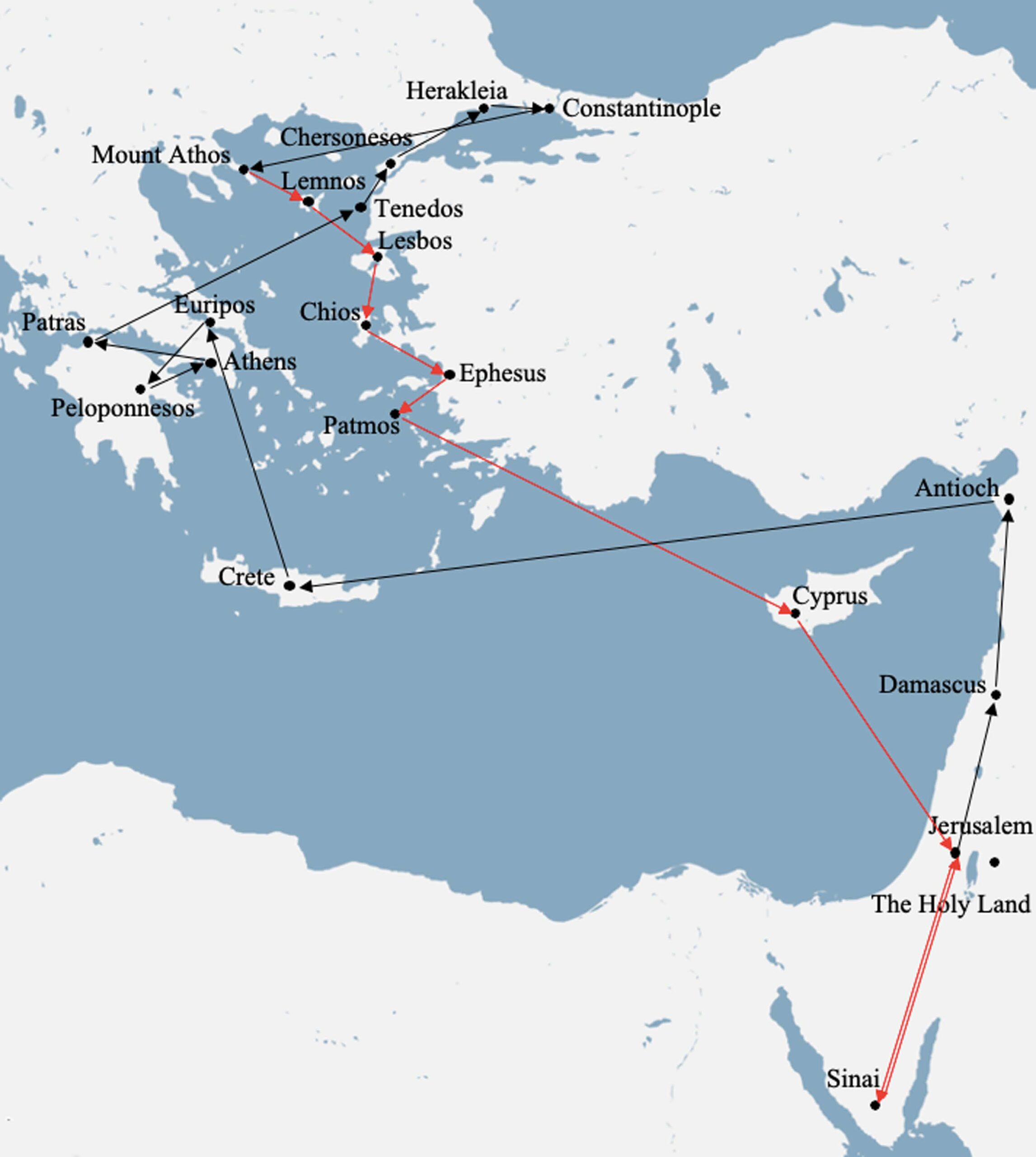
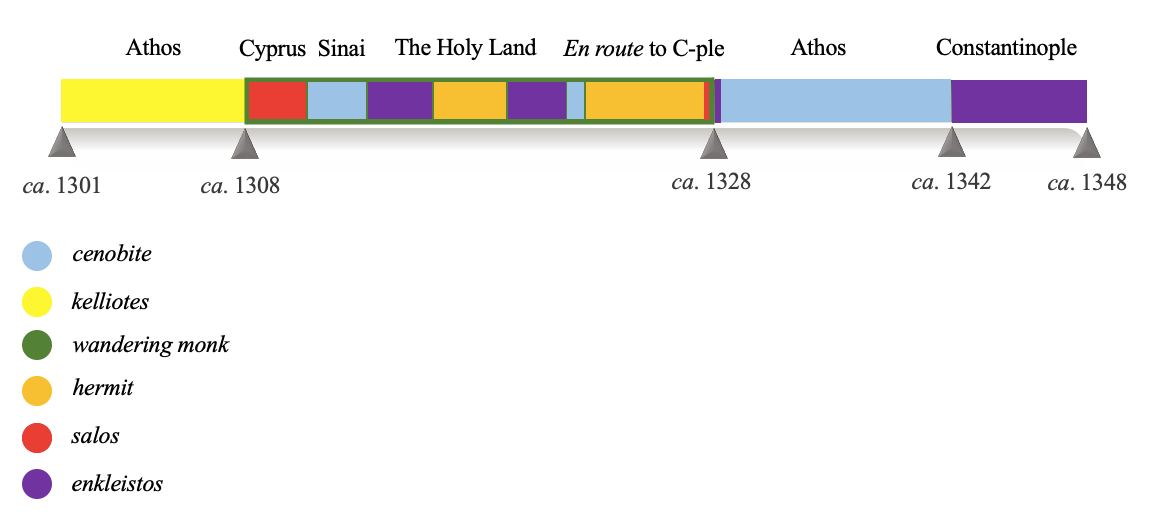
The prolific and gifted late Byzantine hagiographer Philotheos Kokkinos enriched the gallery of Byzantine holy fools with his vitae and literary representations of two of his contemporaries, Nikodemos the Younger from Berrhoia (ca. 1267–ca. 1307) [12] and Sabas (Tziskos) the Younger. [13] A renowned fourteenth-century ascetic, Sabas (Stephen by his baptismal name) was born around 1283 into an upper-class family of Thessaloniki. [14] At the age of 18, he entered Athos and embarked on an exceptional monastic career which spanned nearly five decades and took him on long travels within and beyond the borders of Byzantium (Figure 1). [15] His years as a monk were interspersed with exceptional feats of asceticism, which seem to have kindled a cult around him during his lifetime (in Cyprus), and later, in his sixties, earned him a nomination for the patriarchal throne of Constantinople, which he turned down. [16] His hagiographer and disciple, Philotheos Kokkinos, presents Sabas as a multifaceted and complex hero, who embraced all types of monasticism, from coenobitism on Athos to vagrant asceticism throughout the Holy Land and periods of reclusiveness, including spells of holy foolery predominantly in Cyprus (Figure 2).
Figure 1. Sabas the Younger’s twenty-year wanderings.
Kokkinos’s Life of St. Sabas the Younger has attracted significant scholarly attention and was mined for information ranging from historical details regarding his travels to, more recently, novelistic elements. [17] Studies have also focused on his display of holy foolery and have generally pointed out a much more toned-down element of provocation in his case compared to that of earlier holy fools. [18] Indeed, Sabas does not engage in morally questionable or shameful behavior, or, on the face of it, seek to draw much attention to him. Other than his physical appearance, which abides by the canon of conscious neglect specific to holy fools, the most provocative element about Sabas is oftentimes his lack of speech. He voluntarily assumes silence upon landing in Cyprus and maintains it for nearly twenty years. Kokkinos also indulges in other hagiographical conventions specific to accounts of holy foolery. He presents Sabas at the bottom of the social hierarchy, in a position of marginality and precariousness, suffering intense deprivation, violence, and banishment. Moreover, like others before him, Sabas uses his performance of holy foolery to criticize societal conventions and flaws, especially the political and religious power in Cyprus, a former Byzantine territory that, at the time of his sojourn, had been a Latin kingdom under the French dynasty of Lusignan for more than a century. [19]

Situating Sabas’s holy foolery within his monastic trajectory serves to better highlight his aims and performance of môria. He reaches Cyprus as a young man in his mid-twenties, after spending around seven years on Athos as a kelliôtês under the spiritual guidance of an elderly monk. Cyprus is his first major stop in a twenty-year long itinerary that takes him as far as the Holy Land and Sinai. Unlike Symeon of Emesa, who assumed the mask of folly when he was already un homme d’âge mûr, at the end of a long career as a hermit, Sabas embraces holy foolery at the beginning of the eremitic stage of his monastic trajectory. However, he only commits to this monastic way of life temporarily. After leaving Cyprus, he pursues many, if not all, other forms of monastic life: he is a cenobite at Saint Catherine’s Monastery in Sinai, a wandering monk throughout the Holy Land, a recluse in several caves (in the Holy Land and Thracian Herakleia) and monasteries (Mar Saba, Saint Diomedes, and Chora in Constantinople), and a hermit. Kokkinos includes an extensive narrative section in which his hero makes explicit his desire to follow every path to perfection, including holy foolery, as dangerous as it may be:
Since there are many abodes in the Kingdom of Heaven, the road of piety must be also divided in different pathways that lead there. Thus, it is appropriate for one to pursue this path, for another to walk another path, for a third one [to pursue] several of them, and for a fourth one [to embrace] all of them, if it is possible. [20]
Kokkinos, Life of St. Sabas 23.72–76 (Tsamis 1985:205)
Figure 2. Sabas the Younger’s monastic trajectory based on his Life (BHG 1606) composed by Philotheos Kokkinos.

More importantly, as I have argued elsewhere, Kokkinos’s overarching aim in composing a Life for his spiritual father is to present him as the paragon of the hesychastic way of life and turn his vita into a hagiographical argument in support of hesychasm. [21] Consequently, an underlying stream of hesychastic way of life runs through all stages of Sabas’s monastic life, including his holy foolery.

Performing holy foolery

Preparing his (extra-diegetic) audience/readers, Kokkinos explicitly outlines his hero’s aims of accomplishing extraordinary acts while in Cyprus and describes the preparations he undertook for his politeia as a holy fool. [22] With these aims in mind, Sabas wanders throughout the island for approximately two years, adopting the guise of a fool (môros) for Christ’s sake. He alternates between populated areas, where he performs his acts of holy foolery, and solitary settings, where he practices theôria and the contemplation of God. [23] Kokkinos mentions that in the beginning his hero goes largely unnoticed and unknown and even the people who meet him do not recognize him a second time. [24]

As expected, Sabas’s first act of holy foolery occurs in a public space and entails a physical transformation. While wandering through an urban settlement, we are told by Kokkinos that a local woman admires the beauty of Sabas’s body, which was white, untouched by the harshness of the elements and unmarred by the intensity of his ascetic struggles: “For he was at the beginning of his present [ascetic] struggle, and he had not yet become dark, as expected, by the immediate assaults of the air, nor by the solar and wintry strokes.” [25] To alienate her carnal desires and criticize more generally the worldly concern with outward appearance and “the smoothness of lust,” [26] Sabas performs his first act of pretended folly. Thus, in an ascetic feat of self-humiliation and a symbolic act intended to project his new identity as a fool, he throws himself into a pit of foul-smelling filth. In the evening, he emerges covered in mud and foul odor, his new costume, as it were, in support of his performance, [27] thereby neutralizing his body as a source of lustful temptation. Kokkinos describes Sabas’s public spectacle in detail, activating the imagination and (olfactory) senses of his (extra-diegetic) audience/readers:

For looking around here and there, he sees a pool full of filth and worms, runs and throws himself completely, as he was, down into that filth and rottenness. And so he sat there, as in a bath or on a flowery meadow and a fragrant and delicate rose-garden, in the middle of that enormous stench, until evening came and he just stepped out from there, completely blackened and full of dirt and stench. [28]
Kokkinos, Life of St. Sabas 20.15–21 (Tsamis 1985:197)

Sabas’s altered appearance becomes a vector for the transformation of the woman and lead to her metanoia. Kokkinos writes that she sheds tears and is healed from her previous lack of self-control. This makes the holy man’s performance successful, since his public, in particular the woman, internalizes the message he intended to convey and is edified:

he did not miss his goal and good intention at all. Some of those who saw him were astonished by his manliness, and admired him for his wonderful commitment more than they could say. The others added hot tears out of their souls to the things they said, and before all others the woman, who had been the reason for this event, reproached herself for her rashness and healed the lacking self-control of her eyes and the slip of her tongue with good tears and words of repentance, pledging caution for the future. [29]
Kokkinos, Life of St. Sabas 20.28–35 (Tsamis 1985:197–198)
After this first successful performance of holy madness, Kokkinos relates two other notable acts of holy foolery from Sabas’s part. These feature violent brushes with local Latins (called Italoi in the vita) and arguably function as a critique of the political and religious order in Cyprus. [30] A long-standing important economic and cultural hub connecting Western Europe to the eastern Mediterranean and a stepping stone on the pilgrim route to the Holy Land, Cyprus had been home to intense and extensive encounters of peoples and faiths, a zone of cross-cultural exchanges and interactions. [31] As already mentioned, at the time of Sabas’s sojourn, Cyprus was no longer under Byzantine rule. Following its conquest by the crusaders in 1191, it accommodated a Latin secular and ecclesiastical authority alongside the local population, “whose secular loyalties lay with the Byzantine empire and whose religious affiliation was to the Orthodox church.” [32]

In the first encounter, which takes place again in an urban setting, in the middle of an unnamed Cypriot city, Sabas crosses paths with a Latin nobleman, who makes an intimidating display of power through his pomp and retinue of personal guards. [33] The nobleman takes notice of Sabas’s scant and peculiar clothing and suspects him of being a spy who uses his rags as a deceptive disguise—a detail which hints to the political undertones of this narrative section of the vita. He therefore orders his guards to seize the holy man and asks him to introduce himself. Bound by his vow of silence, Sabas does not comply with this request. Moreover, he uses a reed to knock off the nobleman’s hat to the ground. Kokkinos explains that Sabas’s gesture of provocation is meant to convey to the arrogant Latin nobleman the message that worldly fame is transient and by no means superior to ashes and dust:

For stretching out the reed, which he used to hold in his hand, he hit the hat off (the Italian’s) head and threw it to the ground, and so the wise man taught the boaster smartly and jokingly, that his overwhelming and outstanding idle glory and pomp, which was to be seen around him, differed in no way from ashes and dust. [34]
Kokkinos, Life of St. Sabas 21.17–22 (Tsamis 1985:199)

According to the hagiographer, this message is unsurprisingly lost to the Latin nobleman, who perceives the gesture as an insult and consequently orders his guards to beat Sabas. Kokkinos vividly (and somewhat exaggeratedly) depicts the savage beating the holy man receives, which causes pieces of his flesh to fly from his body, crushes his bones, and reddens the ground with the streams of his blood—a hematic and spectacular scene that could easily contend with (and even inspire) those in Hollywood movies:

he [the Latin] ordered the bodyguards around him to flog him (Sabas) mercilessly with their rods. They stretched him out on the earth quicker than one could speak, and inflicted so many blows upon him as no man had ever inflicted to a man, not even adopting at all the mind of a wild animal. […] And his bones were smashed, his flesh was cut to pieces and thrown into the air, and the earth was reddened by the blood which flew down. [35]
Kokkinos, Life of St. Sabas 21.32–36, 38–39 (Tsamis 1985:199)

This scene starkly contrasts the Latin nobleman’s position of power to Sabas’s vulnerability. Kokkinos is careful to underline for his (extra-diegetic) audience the difference between the outward and inner station of the two characters. Although on the lowest rung of the social ladder, Sabas has a hidden noble character, while the Latin nobleman is presented as irrational, angry, and out of his mind (i.e. a madman), despite enjoying a high social status. [36]

Even though the holy man fails to convey his intended message to the nobleman, who cannot grasp past the surface meaning of the gesture, his performance successfully fuses the intra-diegetic audience, who come to his rescue and unanimously condemn the actions of the Latin. The violent spectacle of Sabas’s beating elicits a reaction from the part of the public and draws a number of Orthodox Cypriots, who come together to rescue him from the hands of his aggressors:

A little [time] and they would have killed him, unless some of our people became enraged by the frenzy of these false believers and gathered, everyone coming from another side, thus becoming like one person in their zeal, and hindered them from that unholy slaughter. [37]
Kokkinos, Life of St. Sabas 21.67–71 (Tsamis 1985:200)

Thus, the sight of Sabas’s beatings causes the members of the indigenous Orthodox Cypriots to be fused together, “everyone coming from another side,” as Kokkinos stresses, and act concertedly to save one of their own.

However, this positive reaction from the local population is short-lived, since Sabas’s fame had not yet spread throughout the island. He only reaches a level of widespread recognition after a process of gradual acquaintance with the local population. In fact, Kokkinos conveys the fickleness of the locals by writing that on another occasion Sabas becomes the victim of their violence without provocation. In a reversal of sentiment, a mob made up of people of all ages, which the hagiographer describes as “irrational” and “foolish,” slander the sensible holy man and drive him out of their town: “This silly man (lêros), deceiver (planos), fool (môros), of frantic senses, our worst omen, this common mischief of the city.” [38] This incident offers Sabas another opportunity to exercise and display his humility and patience.
The mise-en-scène for Sabas’s second violent brush with Latins is a monastic environment, specifically a congregation probably located in an urban setting that housed a mendicant order, most likely Dominicans or Franciscans. [39] Kokkinos describes this settlement as “a sort of a monastery,” that gathered people who “as if on the stage, played the role of monks in a spectacle (drama)” or “pretended to be something like monks.” [40] These expressions, which convey a lack of authenticity from the part of the people in question, betray an attitude of distrust and criticism towards Latins. As Kokkinos explains, his hero wanders inside the premises of this congregation in order to observe the way of life of its members. The holy man finds them in the refectory at mealtime and, after looking around, prepares to leave. However, not overlooking Sabas’s intrusion, the monks detain and start to question him. Since he cannot explain his actions due to his vow of silence, the Latins are free to project their expectations onto him. “The villains” (ponêroi), in Kokkinos’s words, accuse the holy man of theft and proceed to assault him, “one after another,” even more violently than the retinue of the aforementioned nobleman. [41]
After giving him up for dead, they take his seemingly dead body and, in an act of symbolic violence, throw it out of the monastery gates, as if it were an impure animal, as Kokkinos adds. The use of this comparison conveys the fact that the monks viewed and treated Sabas as a beast devoid of human qualities. If his previous performance of humility in the face of extreme abuse prompted a fusion of his audience, in this case, there is no immediate intra-diegetic audience, as his maltreatment is not witnessed by anyone. Moreover, not even the people who pass by his body outside the monastery gates stop to notice or offer him any help. [42] The lack of an intra-diegetic audience must be noted since this arguably serves to advance Sabas’s humility and spiritual progress. In line with the rhetoric (“of violence”) of the period, the graphic descriptions of these two violent encounters convey an image of Latins as bestially aggressive, as well as underline the breakdown in communication on the basis of different cultural backgrounds. [43]
After these two incidents, the holy man continues his vagrancy throughout Cyprus. However, Kokkinos highlights a shift in the locals’ perception of Sabas’s presence on their island, noting that they abandoned their previous “blindness” and now show him respect. [44] Interestingly, the holy man interrupts his wandering at one point and dwells for a short time in the house of a pious man, who offers him his garden as an appropriate place for hesychia. [45] At the fervent entreaties of his host, Sabas even breaks his vow of silence and reveals his name (“O friend, Sabas is my name” [46] ). This turns the pious Cypriote into a loud herald of Sabas’s name and fame, which gradually spreads from his own neighbors to the whole island. Thus, the utterance of his name marks a turning point in Sabas’s sojourn in Cyprus by prompting a vast increase in the holy man’s reputation, and even kindling a cult around him. Sabas has by now captivated the hearts and minds of the inhabitants of the island, who regard him as a holy man, touching his hands, feet, and clothes for blessing. Moreover, in addition to growing in number, his audience becomes more diverse, as even members of the Cypriot aristocracy seek his help. [47]
To escape his increasing fame, Sabas resorts once again to an act of môria (his last one in Cyprus), mirroring his first performance as a holy fool on the island. [48] Thus, at the end of his stay, he throws himself again into a pool of mud. The mise-en-scène of this performance is once again an urban setting. However, Sabas’s status had changed. Previously regarded as an unknown and nameless stranger, he is now seen as a renowned holy man, widely acknowledged and welcomed throughout the island. Given this new perceived identity by the Cypriots, Sabas chooses to feign madness by spending a whole day in a pit of filth, with his head covered and shedding endless tears. The news of this spectacle (drama) spreads rapidly and the whole city gathers to witness Sabas’s perplexing action; the hagiographer notes that everyone begins to cry and a general lamentation ensues, some asking filled with amazement: “What happened? What did he suffer? What is this sudden change of the wise man, the physician of our body and soul, who is full of every holiness and grace?” [49]
The end of the day brings the end of Sabas’s performance and “a frightening and extraordinary miracle:” [50] the holy man comes out of the pit completely untouched by filth, as if standing up from a couch or a clean and soft grass of a garden. With this description, the hagiographer reactivates the imagination and senses of his (extra-diegetic) audience/readers. Moreover, Kokkinos’s choice of ending the extensive account of his hero’s exploits in Cyprus with this scene, which mirrors his debut as a holy fool, is certainly not fortuitous. Sabas’s unpolluted body is a reflection of his pure soul and conveys the spiritual heights he achieved during his stay in Cyprus. Moreover, by presenting his miracle-making power over nature, the scene foreshadows his later miraculous feats. As mentioned, Kokkinos presents in detail the reaction of the intra-diegetic audience, which is puzzled by Sabas’s action, a reaction that conveys the fact that the audience regards Sabas as a holy man rather than a holy fool; in other words, the perception of his identity changed, especially after breaking his vow of silence and disclosing his name. Kokkinos adds that only a few people understand the real purpose and meaning of Sabas’s action, namely a display of humility and rejection of worldly fame.
Judging by the holy man’s aim of rejecting worldly glory, Sabas’s last performance of holy foolery in Cyprus can be considered a failure, since it has the opposite effect of actually increasing his fame, which by that time had spread well beyond Cyprus, reaching Constantinople and Mount Athos, as Kokkinos writes. [51] However, from the hagiographer’s perspective, the performance is successful, inasmuch as it fuses the intra-diegetic audience in their perception of Sabas as a holy man and conveys his hero’s miracle-making powers to the extra-diegetic audience. Ultimately, the desire to escape fame drives Sabas out of Cyprus and into a new stage of his monastic career, in which he accomplishes even more extraordinary feats (including resurrecting the dead [52] ) and reaches the apex of the hesychastic way of life through repeated raptures and visions of the divine. [53] Although the holy man would later display other “symptoms” of holy foolery [54] in the vicinity of Thracian Herakleia, where he spends some time as a recluse in a grotto, Kokkinos only mentions this in passing, glossing over any details. [55]

Conclusion

The late Byzantine holy man Sabas the Younger embarked on the path of holy foolery relatively early in his monastic career, just after finishing his novitiate on Athos, and suffered his first major ascetic struggles as a holy fool. Although of a less provocative and controversial nature than that of his more famous predecessors, Symeon of Emesa and Andrew the Fool, Sabas’s holy foolery abides by the hagiographical canon for this type of monastic lifestyle. He wanders scantily clad through the towns and villages of Cyprus, engages in acts of provocation, though admittedly of a more subdued nature, and willingly invites and suffers extreme abuse and violence as a consequence of his actions. While his repertoire of actions is not as vast as that of earlier-centuries holy fools, Sabas is successful in his performance of holy foolery. He exposes faults in the society around him, stimulates his audience to reassess their way of living and thinking, and contributes to their spiritual metanoia. Cyprus arguably offers an ideal setting for his môria, due to its substantial cultural background of holy foolery and its politically and religiously fragmented society. In this context, Sabas’s silent performance of holiness functions as a critique of the existing power structure, both political and religious.
Throughout the narrative, Kokkinos’s frequent explanations for and defense of Sabas’s actions serve to reassure his (extra-diegetic) audience of his hero’s sanity, the deliberative nature of his actions, and his spiritual aims and progress while adopting the guise of holy foolery. The concern for maintaining this “veneer of decorum” [56] is arguably explained by Kokkinos’s overarching aim of constructing a holy identity for his hero as a model of the hesychastic way of life—not least through his detailed narrative of Sabas’s twenty-year travels abiding by his vow of complete silence. To achieve this aim, the hagiographer infuses hesychastic elements throughout all the various types of monasticism that Sabas assumes, including holy foolery. As such, any doubts regarding Sabas’s sanity could have undermined not only his image as a hesychastic hero, but also Kokkinos’s ultimate goal of using Sabas’s vita as an instrumental and successful tool in the societal spread of hesychasm.

Bibliography

Alexander, J. C. 2004. “Cultural Pragmatics: Social Performance between Ritual and Strategy.” Sociological Theory 22(4):527–573.
———. 2006. “Cultural Pragmatics: Social Performance between Ritual and Strategy.” In Social Performance: Symbolic Action, Cultural Pragmatics, and Ritual, ed. J. C. Alexander, B. Giesen, and J. L. Mast, 29–90. Cambridge.
———. 2011. Performance and Power. Cambridge.
Angelides, Ch. 1993. “Η παρουσία των σαλών στη βυζαντινή κοινωνία.” In Οι περιθωριακοί στο Βυζάντιο, ed. Ch. A. Maltezou, 85–102. Athens.
Berger, A., and S. Ivanov, eds. 2018. Holy Fools and Divine Madmen. Sacred Insanity through Ages and Cultures. Münchner Arbeiten zur Byzantinistik 2. Neuried.
Bucossi, A., and A. Calia, eds. 2020. Contra Latinos et Adversus Graecos: The Separation between Rome and Constantinople from the Ninth to the Fifteenth Century. Bibliothèque de Byzantion 22. Leuven.
Congourdeau, M.-H. 1999. “Saints byzantins du XIVe siècle et spiritualité russe.” In La sainteté. Actes de la septième Université d’été d’histoire religieuse. Saint-Didier (Vaucluse), 9–12 juillet 1998, ed. G. Cholvy, 71–81. Montpellier.
———. 2006. “La Terre Sainte au XIVe siècle: la Vie de Sabas de Vatopédi par Philothée Kokkinos.” In Pèlerinages et lieux saints dans l’antiquité et le moyen âge. Mélanges offerts à Pierre Maraval, ed. B. Caseau, J.-C. Cheynet, and V. Déroche, 121–133. Paris.
Constantinou, S. 2014. “Holy Actors and Actresses Fools and Cross-Dressers as the Protagonists of Saints’ Lives.” In The Ashgate Research Companion to Byzantine Hagiography. Volume II: Genres and Contexts, ed. S. Efthymiadis, 343–362. Farnham.
Coureas, N. 1997. The Latin Church in Cyprus, 1195–1312. Aldershot.
———. 2010. The Latin Church in Cyprus: 1313–1378. Nicosia.
———. 2014a. “The Latin and Greek Churches in Former Byzantine Lands under Latin Rule.” In A Companion to Latin Greece, ed. N. I. Tsougarakis and P. Lock, 145–184. Leiden.
———. 2014b. “Religion and Ethnic Identity in Lusignan Cyprus: How the Various Groups Saw Themselves and Were Seen by Others.” In Identity–Identities in Late Medieval Cyprus, ed. T. Papacostas and G. Saint-Guillain, 13–25. Nicosia.
Dagron, G. 1990. “L’homme sans honneur ou le saint scandaleux.” Annales. Économies, Sociétés, Civilisations 45(4):929–939.
de Certeau, M. 1979. “Le silence de l’absolu. Folles et fous de Dieu.” Recherches de Science Religieuse 67(4):525–546.
Déroche, V. 1995. Études sur Léontios de Néapolis. Uppsala.
———. 2018. “The Doubts about the Saloi in the Middle and Late Byzantine Periods and Their Apologetic Reuse in Two Lives of Saloi.” In Holy Fools and Divine Madmen. Sacred Insanity through Ages and Cultures, ed. A. Berger and S. Ivanov, 65–84. Neuried.
Festugière, A.-J. 1974. “Étude sur la Vie de S. Sabas le Jeune qui simulait la folie.” In Léontios de Néapolis, Vie de Syméon le fou et Vie de Jean de Chypre, ed. and trans. A.-J. Festugière and L. Rydén, 223–249. Paris.
Gaul, N. 2019. “‘And the Whole City Cheered’: The Poetics and Politics of the Miraculous in the Early Palaiologan Period.” In Late Byzantium Reconsidered. The Arts of the Palaiologan Era in the Mediterranean, ed. A. Mattiello and M. A. Rossi, 7–30. London.
Harrigan, J. A., R. Rosenthal, and K. R. Scherer, eds. 2005. The New Handbook of Methods in Nonverbal Behavior Research. New York.
Hinterberger, M. 2011. “A Neglected Tool for Orthodox Propaganda? The Image of the Latins in Byzantine Hagiography.” In Greeks, Latins, and Intellectual History, 1204–1500, ed. M. Hinterberger and C. Schabel, 129–149. Leuven.
Hörander, W. 1993. “Das Bild des Anderen: Lateiner und Barbaren in der Sicht der byzantinischen Hofpoesie.” Byzantinoslavica 54:162–168.
Ivanov, S. 2006. Holy Fools in Byzantium and Beyond. Trans. S. Franklin. Oxford.
Jeffreys, E., and M. Jeffreys. 2001. “The ‘Wild Beast from the West’: Immediate Literary Reactions in Byzantium to the Second Crusade.” In Laiou and Parviz Mottahedeh 2001:101–116.
Kallistos of Diokleia. 1984. “The Holy Fool as Prophet and Apostle.” Sobornost 6(2):6–28.
Kislinger, E. 2008. “Von Drachen und anderem wilden Getier. Fremdenfeindlichkeit in Byzanz?” In Laetae segetes iterum, ed. I. Radová, 389–404. Brno.
Koder, J. 2002. “Latinoi — The Image of the Other according to Greek Sources.” In Bisanzio, Venezia e il mondo franco-greco (XIII–XV secolo), ed. C. A. Maltezou and P. Schreiner, 25–39. Venice.
Kolbaba, T. M. 2001. “Byzantine Perceptions of Latin Religious ‘Errors’: Themes and Changes from 850 to 1350.” In Laiou and Parviz Mottahedeh 2001:117–143.
Krueger, D. 1996. Symeon the Holy Fool: Leontius’s Life and the Late Antique City. Berkeley.
Laiou, A. E., and R. Parviz Mottahedeh, eds. 2001. The Crusades from the Perspective of Byzantium and the Muslim World. Washington, DC.
Lazarova, N. 2004. “Holy Fools in an Age of Hesychasm: A Comparison between Byzantine and Bulgarian Vitae.” Scripta & e-Scripta 2:355–390.
Mantzarides, G. 1986. “Οἱ «διὰ Χριστὸν σαλοὶ» στὰ ἁγιολογικὰ ἔργα τοῦ ἁγίου Φιλοθέου.” In Πρακτικὰ Θεολογικοῦ συνεδρίου εἰς τιμὴν καὶ μνήμην τοῦ ἐν ἁγίοις πατρὸς ἡμῶν Φιλοθέου ἀρχιεπισκόπου Κωνσταντινουπόλεως τοῦ Θεσσαλονικέως (14–16 Νοεμβρίου 1983), 87–97. Thessaloniki.
Messis, Ch. 2011. “Lectures sexuées de l’altérité. Les Latins et identité romaine menacée pendant les derniers siècles de Byzance.” Jahrbuch der Österreichischen Byzantinistik 61:151–170.
———. 2018. “The Palaiologan Hagiographies. Saints without Romance.” In Reading the Late Byzantine Romance. A Handbook, ed. A. J. Goldwyn and I. Nilsson, 230–253. Cambridge.
Mitrea, M. 2018. A Late-Byzantine Hagiographer: Philotheos Kokkinos and His Vitae of Contemporary Saints. PhD thesis, University of Edinburgh.
———. 2019. “Philotheos Kokkinos’s Hypomnêma on Saint Nikodemos the Younger (BHG 2307).” Studia Universitatis Babeș-Bolyai Theologia Orthodoxa 64(2):75–94.
———. 2021. “Spiritual and Imperial Authority in the Hagiographic Works of Philotheos Kokkinos.” In Religious Rhetoric of Power in Byzantium and South-Eastern Europe, ed. I. Biliarsky, M. Mitrea, and A. Timotin, 87–112. Brăila.
———. 2022. “Remarks on the Literary Representations of the ‘Other’ in Late Byzantine Hagiography.” In Byzantine Heritages in South-Eastern Europe in the Middle Ages and Early Modern Period, ed. A. Timotin, S. Pirivatrić, and O. Iacubovschi, 401–419. Heidelberg.
———. Forthcoming. “Hail, Glory of the Fathers! Patristic Sources and References in the Hagiographical Works of Philotheos Kokkinos.” In The Legacy of St. Gregory Palamas: Studies in Late Byzantine Theology, ed. T. A. Pino. Turnhout.
Nicol, D. M. 1985. “Instabilitas loci: The Wanderlust of Late Byzantine Monks.” Studies in Church History 22:193–202.
Rotman, Y. 2016. Insanity and Sanctity in Byzantium: The Ambiguity of Religious Experience. Cambridge, MA.
Rydén, L. 1981. “The Holy Fool.” In The Byzantine Saint, ed. S. Hackel, 106–113. London.
———. 1995. The Life of St Andrew the Fool. 2 vols. Uppsala.
Syrkin, A. Y. 1982. “On the Behavior of the ‘Fool for Christ’s Sake’.” History of Religions 22(2):150–171.
Talbot, A.-M. 2005. “Children, Healing Miracles, Holy Fools: Highlights from the Hagiographical Works of Philotheos Kokkinos (1300–ca. 1379).” Bysantinska Sällskapet Bulletin 24:48–64.
———. 2012. “Nikodemos, a Holy Fool in Late Byzantine Thessalonike.” In ΔΩΡΟΝ ΡΟΔΟΠΟΙΚΙΛΟΝ: Studies in Honour of Jan Olof Rosenqvist, ed. D. Searby, 223–232. Uppsala.
———. 2016. “Caves, Demons, and Holy Men.” In Le Saint, le moine et le paysan: Mélanges d’histoire byzantine offerts à Michel Kaplan, ed. O. Delouis, S. Métivier, and P. Pagès, 707–718. Paris.
Thomas, A. 2009. The Holy Fools: A Theological Enquiry. PhD thesis, University of Nottingham.
Tsamis, D., ed. 1985. Φιλοθέου Κωνσταντινουπόλεως τοῦ Κοκκίνου ἁγιολογικὰ ἔργα. Α´. Θεσσαλονικεῖς ἅγιοι. Thessaloniki.
Tsentikopoulos, D. A. 2001. Φιλόθεος Κόκκινος . Βίος και έργο . PhD thesis, Aristotle University of Thessaloniki.
Van Pelt, J. 2018. “Saints in Disguise: Performance in the Life of John Kalyvites (BHG 868), the Life of Theodora of Alexandria (BHG 1727) and the Life of Symeon Salos (BHG 1677).” In Storytelling in Byzantium: Narratological Approaches to Byzantine Texts and Images, ed. C. Messis, M. Mullett, and I. Nilsson, 137–157. Uppsala.
———. 2019. Saints in Disguise: A Literary Analysis of Performance in Byzantine Hagiography. PhD thesis, University of Ghent.
Zavagno, L. 2017. Cyprus between Late Antiquity and the Early Middle Ages (ca. 600–800): An Island in Transition. London.

Footnotes

[ back ] * I express my gratitude to Niki Tsironis for the opportunity to contribute to this volume and the anonymous reviewer for the insightful comments. I am also grateful to Elena-Cristina Mitrea for her feedback.
[ back ] 1. Krueger 1996.
[ back ] 2. Rydén 1995.
[ back ] 3. On the cultural and religious phenomenon of holy foolery from its inception in the Egyptian monasteries to its later developments and variations in Byzantium and beyond, see Ivanov 2006:220–243 (for the “decline” of holy foolery in late Byzantium). On holy insanity, see eds. Berger and Ivanov 2018 (esp. 5–84, 193–212); Rotman 2016; Constantinou 2014:343–356; Thomas 2009; Lazarova 2004:355–390; Déroche 1995:154–225; Angelides 1993:85–102; Dagron 1990:929–939; Kallistos of Diokleia 1984:6–28; Syrkin 1982:150–171; Rydén 1981:106–113; and de Certeau 1979:525–546.
[ back ] 4. See supra n. 3.
[ back ] 5. See e.g. Van Pelt 2018:137–157, 2019.
[ back ] 6. On Kokkinos and his literary corpus, see: Mitrea 2018; Tsentikopoulos 2001.
[ back ] 7. Nonverbal communication and behavior (e.g. movements, postures, head nods, hand gestures, facial expressions, touch), which makes for a significant part of everyday human interaction, have enjoyed considerable scholarly attention in a sweep of fields of research and disciplines (e.g. linguistics, sociology, education, anthropology, ethnology, psychology, medicine, literary studies, etc.), with an exponential increase in publications since the early 1980s. See eds. Harrigan, Rosenthal, and Scherer 2005:1–6.
[ back ] 8. Alexander 2004:529, 2006:32, 2011.
[ back ] 9. Gaul 2019.
[ back ] 10. Alexander 2004:529, 2006:32.
[ back ] 11. Alexander 2004:529–533, 2006:32–37.
[ back ] 12. PLP no. 20369. For the critical edition of Nikodemos’s short vita (titled Hypomnêma), see ed. Tsamis 1985:83–93; for an introduction and English translation, see: Talbot 2012:223–232; for an analysis, see Mitrea 2019.
[ back ] 13. PLP no. 27991. For the critical edition of Sabas’s lengthy vita, see: Tsamis 1985:161–325.
[ back ] 14. The main source for Sabas’s biography is the vita composed by his disciple, Philotheos Kokkinos. Apart from the biographical details provided by Kokkinos, Sabas is also mentioned in John VI Kantakouzenos’s Memoirs (Historiae III.34, 35); Mitrea 2018:126.
[ back ] 15. Congourdeau 2006:121–133; Nicol 1985:193–202; Rydén 1981:112–113.
[ back ] 16. Mitrea 2021:99–109.
[ back ] 17. Festugière 1974:223–249; Mantzarides 1986:87–97; Talbot 2005:48–64; Congourdeau 1999:71–81; Congourdeau 2006:121–133; Messis 2018:240–242 (corrigenda: Sabas did not die “at Mount Athos in 1329,” nor did he “settle in the monastery of Vatopedi until his death.” His demise occurred in Constantinople around 1347/8).
[ back ] 18. Ivanov 2006:225–232.
[ back ] 19. Coureas 1997, 2010, 2014a:145–184, 2014b:13–25.
[ back ] 20. English translations are mine unless otherwise noted.
[ back ] 21. Mitrea 2018:111–112, forthcoming.
[ back ] 22. Kokkinos, Life of St. Sabas 17.3–4 (Tsamis 1985:189): “he was about to undertake acts without precedent and above human nature.” The hagiographer dedicates an extensive narrative section of more than 8,000 words to Sabas’s stay in Cyprus, which amounts to sixteen per cent of the whole vita (ca. 50,000 words), i.e. twenty-six pages in the modern edition, Tsamis 1985:189–216.
[ back ] 23. Kokkinos, Life of St. Sabas 17.29–30 (Tsamis 1985:191): “he often spends [time] alone in the contemplation of God.”
[ back ] 24. Kokkinos, Life of St. Sabas 17.36–37 (Tsamis 1985:191): “he is unknown to nearly everyone, as if seen for the first time just now.”
[ back ] 25. Kokkinos, Life of St. Sabas 20.5–7 (Tsamis 1985:197).
[ back ] 26. Kokkinos, Life of St. Sabas 20.9–10 (Tsamis 1985:197).
[ back ] 27. Cf. Constantinou 2014:356–357.
[ back ] 28. English trans. Berger and Ivanov 2018:248–249.
[ back ] 29. English trans. Berger and Ivanov 2018:249.
[ back ] 30. These two confrontational episodes featuring Sabas and Latins in Cyprus have been already discussed by Hinterberger 2011:137–138; Ivanov 2006:225–227; Déroche 2018:76; and Mitrea 2022:406–410.
[ back ] 31. Zavagno 2017:65–66, 85, 100–101.
[ back ] 32. Coureas 1997:121.
[ back ] 33. Kokkinos, Life of St. Sabas 21.4–6 (Tsamis 1985:198): “He was sitting on a wild and robust horse accompanied by his entire bodyguard and (the signs of) outer splendor.” English trans. Berger and Ivanov 2018:250 (slightly modified).
[ back ] 34. English trans. Berger and Ivanov 2018:250.
[ back ] 35. English trans. Berger and Ivanov 2018:251.
[ back ] 36. Tsamis 1985:199.
[ back ] 37. English trans. Berger and Ivanov 2018:252 (modified). My emphasis.
[ back ] 38. Kokkinos, Life of St. Sabas 22.28–30 (Tsamis 1985:202). English trans. Berger and Ivanov 2018:253–254.
[ back ] 39. Kokkinos, Life of St. Sabas 24 (Tsamis 1985:206–209). On the urban presence of mendicant orders in Cyprus, see Coureas 1997:387.
[ back ] 40. Kokkinos, Life of St. Sabas 24.4–6, 12–13 (Tsamis 1985:206–207). English trans. Berger and Ivanov 2018:259.
[ back ] 41. Kokkinos, Life of St. Sabas 24.23–30 (Tsamis 1985:207). English trans. Berger and Ivanov 2018:259 (slightly modified): “They dealt him so many blows, in such an inhumane manner, that exceeded in this even the rage of their predecessor and coreligionist, the Italian. They smashed the limbs and the flesh of the athlete, who was lying on the ground, washing it with blood flowing out from (his wounds). They were not satisfied that one or two of them beat and then drop him; yet, they did not finally leave him alone until all of them, one after another, had participated in the slaughter.”
[ back ] 42. Kokkinos, Life of St. Sabas 24.37–39 (Tsamis 1985:207).
[ back ] 43. Messis 2011:151–170; Hörander 1993:162–168; Koder 2002:25–39; Kislinger 2008:389–404; Jeffreys and Jeffreys 2001:101–116; Kolbaba 2001:117–143; eds. A. Bucossi and A. Calia 2020.
[ back ] 44. Kokkinos, Life of St. Sabas 26.29–33 (Tsamis 1985:211).
[ back ] 45. Kokkinos, Life of St. Sabas 26.33–61 (Tsamis 1985:211–212).
[ back ] 46. Kokkinos, Life of St. Sabas 27.7–8 (Tsamis 1985:212).
[ back ] 47. Kokkinos, Life of St. Sabas 27.17–57; 28 (Tsamis 1985:212–215).
[ back ] 48. Kokkinos, Life of St. Sabas 29 (Tsamis 1985:215–216).
[ back ] 49. Kokkinos, Life of St. Sabas 29.11–14 (Tsamis 1985:215).
[ back ] 50. Kokkinos, Life of St. Sabas 29.20 (Tsamis 1985:215).
[ back ] 51. Kokkinos, Life of St. Sabas 28.22–30 (Tsamis 1985:214–215).
[ back ] 52. Kokkinos, Life of St. Sabas 51.12–52 (Tsamis 1985:258–259).
[ back ] 53. Kokkinos, Life of St. Sabas 34; 44 (Tsamis 1985:225–228, 240–244); Talbot 2016:714.
[ back ] 54. Talbot 2005:60.
[ back ] 55. Kokkinos, Life of St. Sabas 54.6–9 (Tsamis 1985:264).
[ back ] 56. Ivanov 2006:230.