Performing Orthodoxy in Byzantine Hymnography: Romanos the Melodist’s On the Three Children

  Gador-Whyte, Sarah. 2025. “Performing Orthodoxy in Byzantine Hymnography: Romanos the Melodist’s On the Three Children.” In “Performance and Performativity in Late Antiquity and Byzantium,” ed. Niki Tsironi, special issue, Classics@ 24. https://nrs.harvard.edu/URN-3:HLNC.ESSAY:104135602.


Introduction

The kontakia of the sixth-century hymnographer Romanos the Melodist were liturgical performances, sung at the night vigil in Constantinople. [1] Through the drama of dialogue they retold and expounded biblical stories, making their events vivid and tangible for a contemporary liturgical audience. [2] Many of these hymns reflect on New Testament events for which there was an established feast day in the liturgical calendar: the Nativity, the Baptism, or the Annunciation, for example. [3] As a deacon in a suburban church in Constantinople, Romanos brought these feast days to life for his congregation. By exploring the emotions and motivations of biblical (and extra-biblical) characters, Romanos illuminated biblical stories and encouraged introspection. [4] Complex ideas are made clearer by dialogue between characters: virtues are modeled, and vices exposed. Listeners are made active participants in this performance of faith as they join in to sing the refrain.
One hymn takes as its subject the story of the three Hebrew youths in the fiery furnace: Hananias, Misael, and Azarias (or Shadrach, Meshach, and Abednego, to give them their adopted Babylonian names) (Daniel 3). [5] This kontakion is unique in Christian late-antique hymnography in this focus. Although the narrative of the three children in the Septuagint has clear performative resonances, no other Greek Christian hymn on this topic survives from late antiquity. [6] Later Byzantine hymnographers took up the tale, perhaps influenced by Romanos’ hymn, and by the fourteenth century the fiery furnace was celebrated with a dedicated liturgical ritual. [7] But in the sixth century there was no such tradition. In this paper, I argue that On the Three Children is a performance of true faith, in which Romanos constructs the three youths as models of constancy to God in the face of powerful opposition and weaves his listeners into their story. I will explore the kontakion’s placement in later liturgical calendars—which record that it was set down for the first or second Sunday before Christmas—and examine how such a placement would help us understand the hymn’s purpose. [8] Finally, I suggest that we can imagine the kontakion may have been performed in the context of riots over what were seen as miaphysite changes to the Trisagion. I begin with an introduction to Romanos and his kontakion as a performative genre. I then turn to interpretations of the three youths in early Christianity before presenting my analysis of the hymn and its possible liturgical and performative setting.

Romanos and his kontakion as a performative genre

Romanos the Melodist was a deacon in a suburban church in Constantinople, which was dedicated to the Holy Theotokos. [9] Although born in Syriac-speaking Emesa and greatly influenced by Ephrem the Syrian and Syriac traditions of poetry and homiletics, Romanos wrote all his long liturgical hymns (kontakia) in Greek. [10] Nearly sixty of his kontakia survive. [11] Most of them are based around a biblical story and were written to be performed at a vigil the night before the Sunday service. [12]

The night vigil was a cathedral-rite service which involved hymn- and psalm-singing, bible readings, and prayers. It was a time of preparation for the feast day (or other Sunday service). Sometimes it was an all-night vigil, but more often would have been held in the early hours of the morning before dawn. It sometimes involved a procession through the streets. [13] Congregants were actively involved in the vigil, from its institution in the fourth century, by joining in the singing of hymns and psalms. Sozomen explains that the crowd was divided into groups to sing psalms antiphonally (HE VIII.8). We get a glimpse of the vigil setting in Romanos’ kontakion, On the Man Possessed by Demons (11.1):

Ὁ λαὸς ὁ πιστὸς ἐν ἀγάπῃ Χριστοῦ
συνελθὼν ἀγρυπνεῖ ἐν ψαλμοῖς καὶ ᾠδαῖς,
ἀκορέστως δὲ ἔχει τοὺς ὕμνους θεῷ·
ἐπειδὴ οὖν Δαβὶδ ἐμελῴδησε,
καὶ ἀναγνώσει εὐτάκτῳ γραφῶν ἐπευφράνθημεν,
αὖθις Χριστὸν ἀνυμνήσωμεν καὶ ἐχθροὺς στηλιτεύσωμεν·
αὕτη γὰρ γνώσεως κιθάρα·
τῆς δὲ γνώσεως ταύτης Χριστὸς ὁδηγὸς καὶ διδάσκαλος,
ὁ πάντων δεσπότης.

The people, faithful in their love of Christ,
come together to hold a vigil in psalms and songs,
and unceasingly keep up the hymns to God.
So since the psalm has been sung,
and we have rejoiced in the well-ordered reading of the scriptures,
hereafter we may celebrate Christ in song and denounce the enemies.
For this is the lyre of knowledge
and of this knowledge Christ is the guide and the teacher,
the Lord of all.

Romanos invites his listeners to join in the singing of his kontakion, having previously participated in the singing of psalms and listened to the bible readings. His hymn, or more likely the whole vigil, is styled as ‘the lyre of knowledge’. The musical metaphor reinforces the value of singing at these vigils: through singing, participants come to the knowledge of God to which Christ guides them. The kontakion, as part of the night vigil, is expressly a site of knowledge-creation about God and living the Christian life, and the listeners’ active performance is essential to gaining that knowledge.
The form of the kontakion is likewise intended to facilitate performance of and participation in the Christian life. This cathedral-rite vigil itself was created in opposition to Arian vigils, which had been very popular. [14] Within the cathedral-rite vigil, the kontakion functioned to perform orthodox faith in opposition to heresy. This performance of orthodoxy was largely done by staging biblical narratives. The majority of the kontakia are dramatizations of biblical stories, based around extended dialogues. Romanos gives voice to different characters and has them flesh out a problem through question and answer, or he explores their emotions or motivations around a particular action. These characterizations vivify the events and help listeners identify with biblical characters; they give authority to explanations of complex ideas or confusing events. [15] For example, in the hymn on the baptism of Jesus, John questions Jesus about why Jesus needs to be baptized, and Jesus counters objections and explains his reasons. [16] As the events unfold, the congregation also actively participates through the refrain, taking on the roles of various characters as the dialogue progresses and experiencing their emotions and introspection as they give voice to the character’s words. They call out “Saviour, save me” with the haemorrhaging woman and confess with Thomas “You are our Lord and our God.” [17]
The performative power of these hymns is strengthened by Romanos’ deployment of a liturgical time, so that each event happens anew on the day it is celebrated. We “all go with Peter to Kaiaphas’ courtyard” in On Peter’s Denial; on Good Friday the hymn opens with “Today the foundations of the earth trembled”; and in On the Prodigal Son, Romanos calls “let us now hasten and share in the supper.” [18] The events of the feast are performed anew in the kontakion, and its contemporary listeners take part in first-century events.
In sum, we may see Romanos’ kontakia as performative in their literary form: through their constructed liturgical temporality; in their explicit engagement of the congregation in their performance; in the dramatic context of the night vigil; and in the activation of the congregation’s minds, emotions, and senses. The performative nature of the kontakia mean that listeners can come to adopt favored dramatic personae and inhabit approved roles within the Christian community while rejecting other possibilities within the drama of salvation.

The three in Late Antiquity

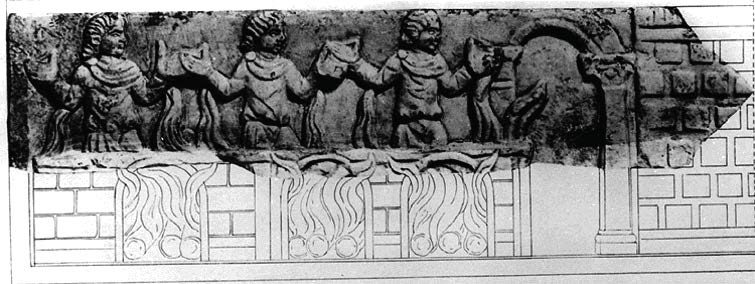
The story of the three men in the furnace had been variously interpreted and used by early Christian writers before Romanos. I provide a brief account of possible interpretations of the story before Romanos to clarify Romanos’ dramatic emphases and identify potential performative resonances. From the earliest Christian art, the three were associated with martyrdom, death, and resurrection. We have surviving images from the third to the fifth centuries of the three on sarcophaguses and in catacombs and other tombs. [19] They are depicted in these contexts as images of resurrection, sometimes alongside Noah. [20] These funerary settings are the most common places we find images of the three, where they often stand as orantes amongst the flames (see Figure 1). This pose highlights another important aspect of this narrative, which is the efficacy of prayer. We will return to this shortly.
The three also appear on reliquaries in late antiquity, as symbols of martyrdom, and their association with Christian martyrdom stems from Christianity’s beginnings. [21] Clement of Rome used them as examples of martyrs in his first letter (1 Clem 45.7), and several Christians writing during periods of Christian persecution (including Hippolytus, Cyprian, and Origen) used the three as exhortations to, or justifications of, martyrdom. [22] All these writers depict the three as proto-martyrs: Christian before Christ, and martyrs even though they were saved from their martyrdom. Hippolytus calls the three “athletes” as they fight against the state, and he has Daniel crown them with victory wreaths. [23] Their strength of faith and resolve to die rather than reject their God are seen as models for persecuted Christians. And yet the narrative was that Christians were being killed, so the salvation depicted in the story comes to mean eternal salvation: resurrection on the day of judgment. [24] The furnace becomes both a figure of eternal judgment and a paradigm of God’s salvific power: it is the eternal fire which consumes the damned (in the story, the bystanders and servants of the king), but it has no power to burn the righteous (the three Hebrew youths).
From the fourth century onwards, the three come to have a wider visual remit. As figures of salvation, they come to be associated with the salvific rites of the church: eucharist and, particularly, baptism. [25] The shower of dew which the angel of God sends through the furnace encourages the interpretation of the event as a symbol of baptism. Ephrem the Syrian refers to the Three being “bathed in the flood of flame” (Epiphany 8.5), and spells out the typology for his listeners: “In that flame baptism is figured” (Epiphany 8.6). [26] John Chrysostom talks about the three young men walking up and down “as if in a pool of water” rather than a fiery furnace (PG 56.211). [27] For Theodore of Mopsuestia the furnace is an image of baptism as a potter’s oven: baptism is a remodeling and refiring of the neophyte by the divine potter. [28]
These are the key themes which Romanos’ audience would have associated with the story of the three in the furnace. They were symbols of martyrdom and death more generally, and of the resurrection of the righteous at the eschaton. They were associated with baptism and eucharist, the ecclesial rites of salvation.
A final element of this story, which I suggest is especially significant in Romanos’ dramatization of the narrative, is the power of prayer. As they stand waiting to be thrown into the furnace, the three pray and bless God (Dan 3.25). Following this prayer or song of praise, the angel of God sends a cool breath through the furnace. For Gregory of Nyssa, praying together is the most efficacious way to pray, and he argues that the three youths were able to change the fire into the breath of dew by their combined and unified prayers. [29] For Niceta of Remesiana, it is a reminder that tuneful singing is the way to address God, since the three sang praises to God “as if with one mouth.” [30] Such literary descriptions may be augmented by the dominant visual tradition of early Christian interpretations of the three, since they are commonly depicted in the orans pose. We will see that Romanos’ concern is that straying into what he sees as idolatry and heterodoxy will close God’s ear to prayer. In the context of the ongoing Christological debates, the three may remind Romanos’ audience that unity is a requirement of appropriate—and efficacious—prayer and worship.

Performing faith

Romanos dramatizes the narrative in Daniel 3, in which three Hebrew youths living in Babylon refuse to worship a statue when commanded to by King Nebuchadnezzar. He is furious and has them thrown into the fiery furnace to their death, but they are saved by God. Their salvation causes a complete change of mind in the King, who declares their God to be the true God. The three Hebrew youths’ unwavering “Christian” faith in the face of persecution is the key message of the hymn. There is no sense in the hymn that the three are unaware of Christ or the Trinity. They are proto-Christians throughout, despite being called “Hebrews.” [31] Romanos emphasizes their faith and close bond to God through theological and olfactory images and various images of strength, and with contrasts.
Romanos bookends his narration and dramatization of the story with direct addresses (apostrophe), initially to God, and at the end, to his listeners. [32] The former sets the tone for the narrative, and the latter reinforces the key message of the hymn. In this first stanza, Romanos addresses God with the words of the refrain and expresses fear and anxiety. Unusually for Romanos, this first stanza both begins and ends with the refrain. As well as explaining and contextualizing the refrain, this repetition at the start of the hymn may have been designed to help the congregation remember what is, as compared with many of his other hymns, an especially long refrain. [33]

The Three Hebrews are placed in the context of other biblical stories and are held up as examples of God’s saving powers:

Τάχυνον, ὁ οἰκτίρμων, καὶ σπεῦσον, ὡς ἐλεήμων,
Εἰς τὴν βοήθειαν ἡμῶν, ὅτι δύνασαι βουλόμενος·
ἐκτεινόν σου τὴν χεῖραν ἧς πάλαι ἔλαβον πεῖραν
Αἰγύπτιοι πολεμοῦντες καὶ Ἑβραῖοι πολεμούμενοι·
μὴ καταλίπῃς ἡμᾶς, καὶ καταπίῃ ἡμᾶς
Θάνατος ὁ διψῶν ἡμᾶς καὶ Σατᾶν ὁ μισῶν ἡμᾶς·
ἀλλ’ ἔγγισον ἡμῖν καὶ φεῖσαι τῶν ψυχῶν ἡμῶν,
ὡς ἐφείσωποτὲ τῶν παίδων σου
τῶν ἐν Βαβυλῶνι ἀπαύστως δοξαζόντων σε
καὶ βληθέντων ὑπὲρ σοῦ εἰς τὴν κάμινον καὶ ἐκ ταύτης κραζόντων σοι·
«Τάχυνον ὁ οἰκτίρμων καὶ σπεῦσον ὡς ἐλεήμων
Εἰς τὴν βοήθειαν ἡμῶν, ὅτι δύνασαι βουλόμενος.»

Hurry, merciful one, and in your compassion hasten
To our aid, since you can do what you will.
Stretch out your hand which long ago the Egyptians who were fighting
and the Hebrews who were being assailed, put to the test.
Do not leave us, and do not let us be swallowed up.
Death thirsts for us and Satan hates us.
But come near to us and spare our souls,
As you once spared your children,
Those who in Babylon praised you without ceasing,
And did obeisance to you in the furnace and from there cried out to you,
“Hurry, merciful one, and in your compassion hasten
to our aid, since you can do what you will.”

1.1–12
This passage uses imperatives, repetition, and assonance to create a sense of anxiety or panic. The imperatives create the sense of urgency, the repetition of structures mimics the panicked, recurrent cries of someone in great distress, and the assonance heightens awareness of the repetition. Repeated use of “us” (in various forms: ἡμῶν, ἡμᾶς, ἡμῖν) helps to bring the panic home to listeners. The object of the fear and anxiety is unclear, although it could just be a general call for salvation. José Grosdidier de Matons has suggested a vague period of trouble, perhaps a war or fear of enemy attacks. [34] I suggest that the fear is rather of heresy, loosely badged as idolatry, and that the three youths model the firm constancy to orthodox belief that Romanos wants his listeners to embody. The three youths’ ceaseless praising and worship of God is their defining feature and should be for Romanos’ congregation too, and here they are going to perform it through the kontakion. The stanza immediately following this introduces the idol being erected in Babylon, which reinforces that this is the sort of wrong belief that should be an object of the fear expressed here.

In the second proem, Romanos emphasizes their role as exemplar to his listeners, this time with particularly Trinitarian imagery:

Οἱ τρεῖς τῇ Τριάδι δουλεύσαντες ἐν ὁμονοίᾳ,
Θυμὸν βασιλέως καὶ πρόσταγμα ἀπανθρωπίας
κατῃσχύνατε, ἅγιοι παῖδες, ἡμῖν ὑπογραμμὸν καταλείποντες,
πρόβολοι τῆς πίστεως γεννηθέντες.

The three of you, serving the Trinity in unanimity,
Were putting to shame the anger of the king and the commands of inhumanity.
Holy children, you were making a model for us,
begotten as guardians of the faith.

Pr. 2.1–4
The number of the Hebrew youths is made to recall the number of the persons of the Trinity and, by juxtaposing the king and the united three, Romanos underlines their close relationship with God, and their true Christian beliefs. They are three but also one, just like their God, and their unity is in their unwavering fidelity to God. By contrast, the king is aligned to anger and inhumanity. These contrasts are also an important part of Romanos’ characterizations, and we will return to his portrait of the king shortly.
Olfactory imagery contributes to an effective (and affective) performance, as listeners are encouraged to participate in a sensorily rounded performance of the story and their faith. Shadrach, Meshach, and Abednego’s faith is the redeeming perfume that rises above and counteracts the stench of wrong belief and practice. They even plead with God, since they know that the worship of Nebuchadnezzar’s statue will anger him: “Do not let the stream of idolatry provoke you … For we are incense in the midst of the mire” (3.4–7). [35] Idolatry is a stench, a foul stream, but is overpowered by the sweet scent of true faith.
Romanos uses building imagery to reinforce the strength of their faith, emphasizing the three-in-one at each point. The Hebrew youths are a three-story fortification, built on the firm rock of faith and unmoved by those trying to undermine the foundations (5.6–10); in their firm resolution they are likened to a three-angled tower which withstands the sharpened arrows (words) of the king’s advisers (8.2–5). They are “the strong ones” at other times (e.g. οἱ ῥωμαλέοι, 19.3), and the relationship between them and God is likened to a cord which faith binds tightly (19.7).

The approval of Shadrach, Meshach, and Abednego’s faith that Romanos expresses through this characterization and varied imagery stands in stark contrast to the characterization of King Nebuchadnezzar. As his advisers speak to the king about the Hebrews, Romanos says

… ὑφῆψαν τὸν βασιλέα
καὶ ὥσπερ πῦρ ἐν ἀκάνθαις ἐξεκαύθη ὁ θυμὸς αὐτοῦ·

… they inflamed the king,
and like a fire kindled in brambles, anger consumed him.

10.1–2

The king’s anger is hot, like the fire of the furnace, and eats away at him as if he were dry twigs. He becomes a savage beast, gnashing his teeth (10.3). He attempts to reason with Hananias, Misael, and Azarias and convince them to follow his commands, but they laugh (12.1–2) and argue their own case. Their arguments enrage him further:

Ἅμα ἤκουσε τούτων, ὁ ἄθλιος καὶ πανώλης
ὡς σίδηρος ἐπυρώθη καὶ φλογμὸν ἀπεσπινθήριζε,
κράζων, βράζων, ἀσθμαίνων …

As soon as he heard these things, the pitiful and all-destructive one,
like iron he became red hot and emitted sparks of fire,
crying, growling, panting …

15.1–3

The king becomes fiery, both consumed by blazing anger and emitting dangerous flames; he becomes animalistic, non-human. In this passage Romanos calls him ‘pitiful’ (ἄθλιος), worthy of pity for his idolatrous desire for worship. His anger is incredibly hot, and he wants the furnace to match it:

ταύτης τὸ πῦρ αὐξήσαντες τῷ θυμῷ μου ἰσώσατε·
ὁμοίως γὰρ ταύτης ἀνάπτομαι καὶ φλέγομαι,
ὅτι οὗτοι ἠθέτησαν ἐμέ·

Strengthening the fire of this [furnace], make it equal to my anger,
For like this [furnace] I am inflamed, and I burn,
because these men have disobeyed me.

15.6–8

Nebuchadnezzar’s anger stems from the disobedience of Hananias, Azarias, and Misael, but their concern is obedience to God. As far as they are concerned, the choice is made for them:

Μέγαν ἔχομεν πόθον πρὸς τὸν Θεὸν τῶν Ἑβραίων,
θερμότερον τοῦ πυρός σου καὶ καμίνου καυστικώτερον
. . . . . . . . . . . . . . . . . . . . . . . . . . . . . . . . . . . . . . . . . . . . . .
οὐκ ἔστι γὰρ οὗτος ὡς αὕτη ἣν ἐχάλκευσας,
ἀλλ’ ἐπάνω πέλει πάσης τῆς κτίσεως, ἀσιγήτως ὑμνούμενος·

We have a great longing for the God of the Hebrews,
who is hotter than your fire and more burning than your furnace
. . . . . . . . . . . . . . . . . . . . . . . . . . . . . . . . . . . . . . . . . . . . . .
For this one is not like that which you have forged,
but he is above the whole creation, being hymned continually …

14.1–2, 9–10

Romanos presents the three youths as unwavering in their devotion to God, as they contrast him with the king’s anger and the heat of the furnace. Given the numerous characterizations of anger as fire in the hymn, and the three’s concern earlier in the hymn to appease God by their scented faith, this imagery for God might suggest the strength of God’s righteous wrath if they were to reject him as well as his power over all creation. It is much more dangerous to work against God than it is to enter the furnace. They are not afraid to die, even as they sing to God (19.9–10; 20.1–4), but it is not an option to reject God. This is the key message, as far as Romanos is concerned. He drives home this point for his congregation in the final stanza (30.7–12):

Διό, ἀδελφοί μου, ὁρᾶτε μὴ λυπήσωμεν
τὸν δεσπότην καὶ δοθῶμεν ἐχθροῖς·
λυποῦμεν γὰρ τοῦτον ἐὰν αὐτὸν ἀφήσωμεν
καὶ τὴν πίστιν <τὴν> ὀρθὴν παρατρώσωμεν ἧς ἐκτὸς λέγειν ἄδεκτον·
Τάχυνον ὁ οἰκτίρμων καὶ σπεῦσον ὡς ἐλεήμων
εἰς τὴν βοήθειαν ἡμῶν, ὅτι δύνασαι βουλόμενος.

Come, my brothers, see that you do not grieve
The Master and be supporters of enemies.
For we grieve him if we neglect him
And do violence to orthodox belief, outside of which you cannot say,
Hurry, Merciful one and in your compassion hasten
to our aid, since you can do what you will.

This is the conclusion of the hymn and so Romanos’ final chance to reinforce the message of the hymn. As he depicts them, the three in the furnace had not a single moment of doubt about their faith, but Romanos is concerned for those amongst his listeners who might. He cautions against supporting ‘enemies’ (those of heterodox beliefs), but the emotional register has changed from anger to grief. Whereas throughout the hymn the dominant emotional image was of red-hot anger, here God’s response to human neglect of him and rejection of true faith is grief and, it seems, turning a deaf ear to their calls. Heterodoxy causes prayer to be ineffective.

The setting of On the Three Children

Later collections of the kontakia (called kontakaria) list the placement of hymns in the liturgical calendar. These collections were unfortunately made several centuries after Romanos’ death, so we can hope but cannot be certain that the assignment of a hymn to a particular date reflects its performance context in the sixth century. In the case of Romanos’ On the Three Children, there is disagreement between the various manuscripts, but most place it in the weeks before Christmas, some for the seventeenth of December when Daniel was celebrated, others for one of the Sundays before Christmas. [36] In some places in the West and in Jerusalem we have evidence of the three in the furnace being celebrated in Easter liturgies and the baptism of neophytes which took place at those services. [37] Given the associations with baptism we have discussed, this is not surprising.

At first glance Romanos’ hymn may not seem to point openly to a pre-Christmas setting. We might therefore be tempted to disregard the placement recorded in the kontakaria or assign it to a celebration of Daniel without reference to Christmas. But the kontakion does prefigure Christmas in the description of the furnace. The furnace is made so hot that people are terrified and die even at the mention of it (16.3–4), and yet when the three are thrown into it, the furnace becomes, not a site of destruction, but one of growth and protection, like the womb of the Theotokos (21.3–10):

Δέχεται οὖν ἐκείνη τὴν τρίκλωνον αὐτῶν ῥίζαν
καὶ οὐ φλέγει, ἀλλὰ φυλάττει φοβουμένη τὸν φυτεύσαντα·
ἀλλὰ εἰς πνεῦμα δρόσου ἡ φλὸξ μεταβληθεῖσα
θεῖον οὕτω διέψυχε τὰ στελέχη τὰ ἅγια.
Καὶ ἦν ἰδεῖν ξένον· τὸ πῦρ γὰρ ἐπελάθετο
τῶν ἰδίων καὶ γέγονε πηγή,
ἀρδεύουσα μᾶλλον ἢ καίουσα οὓς ἔλαβεν
καὶ φρουροῦσα ὥσπερ ἄμπελον τρίφορον, ἵνα δῷ τὸν καρπὸν αὐτῆς.

So [the furnace] received the three-pronged shoot of them
And did not burn, but guarded it, fearing the one who planted it.
But the flame turned into the divine breath of dew
So that it might cool the holy logs.
And it was strange to see. For the fire forgot
Its own [nature] and become a fountain,
Watering rather than burning those it received
And guarding, as if it were a vine, the thrice-bearing, so that it might give its fruit.

The three young men are a three-pronged seedling, planted in the womb of the furnace to grow. The fire forgets its own nature and nurtures (even cools!) rather than burns. These descriptions are reminiscent of the burning bush (Exodus 3:2) and the dew on the fleece (Judges 6:36–38), which were standard types for the virginal conception and incarnation. [38]

These images continue in the next stanza when the angel appears and makes the furnace into paradise for the three, so that “they walked on coals as on wild roses” (22.5). The angel then encourages the three to sing to the praise of the creator “because the fire gushes forth [like a fountain] and the furnace is dewy for those who believe in him and flee error.” (24.4–5) And by singing the three youths transform the furnace into a church (25.1–4): [39]

Στὴσαντες οὖν οἱ παῖδες χορὸν ἐν μέσῳ καμίνου,
οὐράνιον ἐκκλησίαν ἀπειργάσαντο τὴν κάμινον,
ψάλλοντες μετ᾽ ἀγγέλου τῷ ποιητῇ τῶν ἀγγέλων
καὶ πᾶσαν τὴν λειτουργίαν τῶν ἀσάρκων ἐκμιμούμενοι·

So the youths, standing as a choir in the midst of the furnace,
Made the furnace into a heavenly church,
Singing with angels to the creator of angels
And imitating faithfully the whole liturgy of the incorporeal ones.

The associations here are double: Romanos encourages listeners to see themselves as the three in the furnace, singing with them as they join in the refrain of the kontakion. And he simultaneously reminds them that their earthly liturgy is a participation in the Divine Liturgy, taking place in heaven. The furnace is transformed into the church, where the incarnation takes place, and the transformation takes place through faithful singing to God.

The meeting of the divine is made even clearer when Romanos gives voice to the thoughts of the three youths:

«Τί, φησίν, ἐστὶ τοῦτο; Οὐκ ἔστιν ἄγγελος οὗτος,
ἀλλὰ Θεὸς τῶν ἀγγέλων· ἐν ἀγγέλου μορφῇ φαίνεται
ὁ εἰς τὸν κόσμον μέλλων ἔρχεσθαι, καὶ σβεννύειν
τὴν τῶν εἰδώλων γέενναν ὥσπερ ἄρτι τὴν κάμινον.
Αὐτὸς καὶ νῦν ὤφθη καὶ τῶν μελλόντων γίνεσθαι
τὴν εἰκόνα ὑπέδειξεν ἡμῖν·
καθάπερ καὶ ἄρτι τὴν κάμινον ἐδρόσισεν,
οὕτως μέλλει ὡς ὑετὸς εἰς τὴν ἄγαμον καταρδεύειν τοὺς ψάλλοντας·

“What”, they say, “Is he? For he is not an angel,
But God of angels. He appears in the form of an angel,
He who is going to come into the world, and quench
The Gehenna of idols, as he has just now [quenched] the furnace.
And it is he who was seen now and the image of what is going
to be was shown to us.
As if just now he bedewed the furnace,
Thus he will be as rain on the virgin, [40] refreshing those who sing …”

26.3–10
Hananias, Misael, and Azarias thus see God in the angel in the furnace, and recognize in him the one who will become incarnate. The passage combines the images of the burning bush (Exodus 3:2) and the dew on the fleece (Judges 6:36–38). Many late antique writers, including Romanos, used one or both of these Old Testament images as a symbol of the incarnation, so listeners would have been familiar with them. [41] In On the Nativity I Romanos has the Magi declare that they left the fire that consumes everything (the Chaldean fire) to gaze on the bedewed fire, that is, the newborn Christ-child (πῦρ παμφάγον λιπόντες, πῦρ δροσίζον θεωροῦμεν, | παιδίον νέον, τὸν πρὸ αἰώνων Θεόν: 10.13.9–10). [42] In the hymn on the baptism of Christ, John the baptizer is afraid when he sees Christ in the Jordan, perceiving him as ‘the river in the desert, the dew in the furnace, and the rain on the virgin’ (τὸν ἐν ἐρήμῳ ποταμὸν καὶ δρόσον ἐν καμίνῳ καὶ ὄμβρον ἐν παρθένῳ, 16.4.1). In this passage Romanos emphasizes the miracle of the incarnate God, whom John is afraid to baptize, by using three Old Testament miracles. The first two are clear: the river which God made to flow out of stones in the desert (Numbers 20:2–13) and the dew in the furnace of Babylon (Daniel 3:49–50). The third image is probably a reference to the rain on the fleece (Judges 6:37), although here Romanos uses ‘virgin’ instead of ‘fleece’. [43] These two other hymns which focus on the incarnation and epiphany set the scene for On the Three Children’s use of ‘rain on the virgin’ as a symbol of God becoming human in the person of Jesus Christ.

These images of the furnace, foreshadowing the incarnation, suggest that the hymn fits well into the lead up to Christmas, whether part of a feast of Daniel or not. In addition, Romanos is at pains to emphasize the two natures of Christ as prefigured by the angel of God in the furnace. The children see the angel in two forms:

καὶ ὁτὲ μὲν θεῖος, ἄλλοτε δὲ ὡς ἄνθρωπος
ἑωρᾶτο, καὶ ποτὲ μὲν ἐκέλευε, ποτὲ δὲ συνικέτευεν·

And at one time was seen as divine, and at another as a man,
And sometimes commanded and sometimes supplicated.

25.9–10

They hymn him, saying:

Ὁ πρὸς ἡμᾶς καὶ ἄνω καὶ ἐν ἑκάστῳ τόπῳ
ἄφθαστε καὶ κρατούμενε, χωρητὲ καὶ ἀχώρητε,
. . . . . . . . . . . . . . . . . . . . . . . . . . . . . . . . . . .
ἐφ’ ἡμῖν παρακλήθητι·

You who are with us and above, and in each place,
Inaccessible and present, finite and infinite,
. . . . . . . . . . . . . . . . . . . . . . . . . . . . . . . . . . .
intercede for us …

27.5–6, 10

They thus emphasize the two natures of the incarnate being they see in the furnace, whom they do not name but who is clearly intended to be understood as the person of Christ. [44] Not only they, but the king also recognises the two natures of the being in the furnace. Nebuchadnezzar comes to gloat over the ashes of his enemies and sees instead the fire chained and the three dancing free. He is afraid and puzzled over the appearance of a fourth man:

Τρεῖς ἐρρίψαμεν ἔνδον καὶ τέσσαρας αὐτοὺς βλέπω,
καὶ τοῦ τετάρτου ἡ ὄψις συνταράσσει τὴν καρδίαν μου·
οὔτε γὰρ οἶδα τίνι συγκρίνω τὸν τοιοῦτον·
εἴπω ὅτι βροτός ἐστιν; Ἀλλ’ υἱὸς Θεοῦ πέφυκεν·
δικαίως ἡττήθη τὸ πῦρ, οὔτε γὰρ ἴσχυσεν
ἀντιστῆναι πρὸς πύρινον ἡ φλόξ·

We threw three men within and I see four,
And the appearance of the fourth troubles my heart.
For I do not know who could compare to such a one.
Could I say that he is a mortal? But he is a son begotten of God.
Rightly did the fire yield, for the flame was not powerful enough
To withstand the fiery one.

29.3–8
Nebuchadnezzar is troubled by the disjuncture between his decrees and what he sees in the furnace, and even more by the sight of the extra man in the furnace. He says his heart is ‘thrown into disorder or confusion’ (συνταράσσει) by the appearance of the fourth being, who is once again described as more fiery than the fire itself. After this Nebuchadnezzar acknowledges the truth of the Hebrew youths’ faith and worships their God and his proclamation is that “all who are on my earth agree with me.” The idolatrous barbarian king of Babylon is converted (in spite of himself: 30.1) to the faith of those three Hebrew youths. This would seem to be a moment of victory for Christianity over idolatry, and yet the hymn does not conclude with triumphal rejoicing but rather with a fearful plea to reject enemies and maintain orthodox belief.

Conclusion

Romanos’ On the Three Children is a performance of faith and a rejection of heresy and idolatry. The models of faith provided are Hananias, Misael, and Azarias, strong young Hebrew men, characterized as steadfast Christians, who maintain their beliefs in the face of powerful opposition and the threat of death by fire. Romanos has the congregation join in their direct address to God at the end of every stanza. Romanos uses their number as a way to emphasize their belief in a trinitarian God. It is their singing and prayer which calls God to their side, in the form of an angel or ‘son of God’. Their deliverance is figured as the incarnation: the furnace is the womb in which divine and human come together in a wondrous paradox, emphasizing Mary as Theotokos and Christ in two natures. The Babylonian King, Nebuchadnezzar, is faithless and violent and his anger is likened to the fire of the furnace. Yet even he is enlightened at the end of the hymn and his official decrees are in favor of Hananias, Misael, and Azarias’ beliefs.

As we have seen, these elements lend themselves to a pre-Christmas hymn, but they might also hint at a particular performance context. On the fourth of November 512, the emperor Anastasius enforced (by imperial edict) the use of a miaphysite version of the Trisagion hymn: [45]

ἅγιος ὁ θεός, ἅγιος ἰσχυρός, ἅγιος ἀθάνατος, ὁ σταυρωθεὶς δι᾽ ἡμᾶς, ἐλέησον ἡμᾶς.

Holy God, Holy Strong, Holy Immortal, who was crucified for us, have mercy on us.

The inclusion of the phrase ‘who was crucified for us’ was the cause of riots throughout Constantinople for several days and of ongoing conflict, particularly in the western regions of the empire, until Anastasius’ death in 518. [46] The phrase suggests that the divine nature suffered on the cross, and therefore was viewed as heretical by adherents of the Council of Chalcedon. It is possible that Romanos’ hymn was written in the aftermath of this public riot and in opposition to what he saw as heretical changes to the liturgy introduced by the emperor, who is implicitly cast as the king in the kontakion.
One further theme in the hymn which might reinforce such an idea is Romanos’ highlighting of the three youths’ opposition to the king. This emphasis sits apart from many post-Constantinian interpretations of the story of the three in the furnace. Once Christianity became an official religion of the empire, the theme of disloyalty to the state which writers living under persecution previously highlighted seemed irrelevant. For John Chrysostom, for example, the import of the story is more in the proof of piety and pursuit of virtue than in opposing non-Christian rulers. [47] But Romanos maintains this emphasis on conflict with the king, highlighting it by the discussions and debates he creates between the king and advisers (6.5–12; 8.5–9.12), the three and the king (11.1–15.12), and between the advisers, the three, and the king (17.5–20.12). In fact, a large proportion of the hymn is taken up with these dialogues.
None of the themes and images I have highlighted here is conclusive proof that Romanos wrote his hymn in opposition to Anastasius’ changes, and I am not so bold as to make a dating argument based on speculative evidence. But the hymn does argue for maintaining strong faith in the face of powerful temptations to change, and Romanos’ apostrophes at the beginning and end color the whole story with fear about the efficacy of prayer. As far as Romanos is concerned, the prayers of the idolatrous and heretical do not reach the ears of God. As a result, his overwhelming concern in On the Three Children is to help his listeners perform a truly orthodox faith.

Bibliography

Primary texts

Beck, E. 1959. Des heiligen Ephraem des Syrers Hymnen De Nativitate (Epiphania). 2 vols. Louvain.
Bonwetsch, G. and M. Richard. 2011. Hippolyt. Band 1, TI 1 Kommentar zu Daniel. Berlin.
Hansen, G. 2004. Sozomen. Historia Ecclesiastica: Kirchengeschichte. 4 vols. Turnhout.
Grosdidier de Matons, J. 1964–1981. Romanos le Mélode: Hymnes. 5 vols. Sources chrétiennes 99, 110, 114, 128, 283. Paris.
Maas, P., and K. Trypanis. 1963. Sancti Romani Melodi Cantica: Cantica Genuina. Oxford.
Mango, C., and R. Scott. 1997. The Chronicle of Theophanes Confessor: Byzantine and Near Eastern History, AD 284–813. Oxford.
Mann, F., D. Teske, and H. Polack. 1996. Gregorii Nysseni Sermones, Pars III. GNO 10.2. Leiden.
Migne, J.-P. 1862. Patrologiae Cursus Completus. Series Graeca. Vol.56, John Chrysostom. Paris.
———. 1863. Patrologiae Cursus Completus. Series Graeca. Vol. 44, Gregory of Nyssa. Paris.
Radde-Gallwitz, A., trans. Forthcoming. “Gregory of Nyssa, Oration on the Savior’s Nativity: Introduction and Translation.” In The Cambridge Edition of Early Christian Writings, Vol. 3, Christ: Through the Nestorian Controversy, ed. M. DelCogliano. Cambridge.
Thurn, H. 2000. Ioannis Malalae Chronographia. Corpus fontium historiae Byzantinae. Series Berolinensis 35. Berlin.
Tonneau, R., and R. Devresse. 1949. Les homélies catéchétiques de Théodore de Mopsueste: Reproduction phototypique du MS. Mingana Syr. 561. Vatican City.
Turner, C. 1923. “Niceta of Remesiana II.” The Journal of Theological Studies 24.95:225–252.

Scholarly works

Arentzen, T. 2017. The Virgin in Song: Mary and the Poetry of Romanos the Melodist. Philadelphia.
Baldovin, J. 1987. The Urban Character of Christian Worship: The Origins, Development, and Meaning of Stational Liturgy. Rome.
Barkhuizen, J. 1986. “Narrative Apostophe in the Kontakia of Romanos the Melodist, with Special Reference to his Hymn ‘On Judas’.” Acta Classica 29:19–27.
———. 2005. “Romanos Melodos: Kontakion 8 ‘On the Three Children’.” Acta Patristica et Byzantina 16.1:1–28.
Bucur, B. 2016. “Christophanic Exegesis and the Problem of Symbolization: Daniel 3 (the Fiery Furnace) as a Test Case.” Journal of Theological Interpretation 10.2:227–244.
———. 2018. Scripture Re-Envisioned: Christophanic Exegesis and the Making of a Christian Bible. Leiden.
Chan, M. 2020. “Dissonant Testimony: The Transformation of Music in the Greek Versions of Daniel 3.” Word & World 40.3:255–262.
Corrigan, K. 2009. “The Three Hebrews in the Fiery Furnace: An Early Byzantine Icon at Mt. Sinai.” In Anathemata Eortika: Early Christian, Byzantine and Armenian Studies in Honor of Thomas F. Mathews, ed. J. Alchermes, H. Evans, and T. Thomas, 93–103. Mainz.
Dulaey, M. 1997. “Les trois Hébreux dans la fournaise (Dn 3) dans l’interprétation symbolique de l’Église ancienne.” Revue des sciences religieuses 71.1:33–59.
Frank, G. 2010. “Romanos and the Night Vigil in the Sixth Century.” In Byzantine Christianity, ed. D. Krueger, 59–78. 2nd ed. Minneapolis.
Gador-Whyte, S. 2017. Theology and Poetry in Early Byzantium: The Kontakia of Romanos the Melodist. Cambridge.
Ginter, A. 2017. “The Trisagion Riots (512) as an Example of Interaction between Politics and Liturgy.” Studia Ceranea 7:41–57.
Grillo, J. 2019. “‘The Entire Place had become Fire’: Heavenly Worship in Greek Daniel 3.” The Catholic Biblical Quarterly 81:613–626.
Grosdidier de Matons, J. 1977. Romanos le Mélode et les origins de la poésie religieuse à Byzance. Paris.
Haarer, F. 2006. Anastasius I: Politics and Empire in the Late Roman World. Cambridge.
Irwin, K. 1985. The Liturgical and Theological Correlations in the Associations of Representations of the Three Hebrews and the Magi in the Christian Art of Late Antiquity. PhD diss., Graduate Theological Union.
Jensen, R. 2000. Understanding Early Christian Art. London.
Krueger, D. 2014. Liturgical Subjects: Christian Ritual, Biblical Narrative, and the Formation of the Self in Byzantium. Philadelphia.
Ladouceur, P. 2006. “Old Testament Prefigurations of the Mother of God.” St Vladimir’s Theological Quarterly 50.1–2:5–57.
Lingas, A. 1995. “The Liturgical Place of the Kontakion in Constantinople.” In Liturgy, Architecture and Art of the Byzantine World: Papers of the XVIII International Byzantine Congress (Moscow, 8–15 August 1991) and Other Essays Dedicated to the Memory of Fr. John Meyendorff, ed. C.C. Akentiev, 50–57. St. Petersburg.
Louth, A. 2005. “Christian Hymnography from Romanos the Melodist to John Damascene.” Journal of Early Christian Studies 57.3:195–206.
Moss, C. 2013. The Myth of Persecution: How Early Christians Invented a Story of Martyrdom. London.
Noga-Banai, G. 2008. The Trophies of the Martyrs: An Art Historical Study of Early Christian Silver Reliquaries. Oxford.
Schouler, B. 2005. “L’Ethopée chez Libanios ou l’évasion esthétique.” In ΗΘΟΠΟΙIΑ: La Représentation de caractères entre fiction scolaire et réalité vivante à l’époque impériale et tardive, ed. E. Amato and J. Schamp, 79–92. Salerno.
Taft, R. 2006. Through their Own Eyes: Liturgy as the Byzantines Saw it. Berkeley.
Trakatellis, D. 1994. “ΛΟΓΟΣ ΑΓΩΝΙΣΤΙΚΟΣ: Hippolytus’ Commentary on Daniel.” In Religious Propaganda and Missionary Competition in the New Testament World. Essays Honoring Dieter Georgi, ed. L. Bormann, K. Del Tredici, and A. Standhartinger, 527–550. Leiden.
Tucker, W. 2012. “The Early Wirkungsgeschichte of Daniel 3: Representative Examples.” Journal of Theological Interpretation 6.2:295–306.
Walton, A. 1988. “The Three Hebrew Children in the Fiery Furnace: A Study in Christian Iconography.” In The Medieval Mediterranean: Cross-Cultural Contacts, ed. M. Chiat and K. Reyerson, 57–66. St. Cloud, MN.
White, A. 2015. Performing Orthodox Ritual in Byzantium. Cambridge.
Wiśniewski, R. 2018. The Beginning of the Cult of Relics. Oxford.

Footnotes

[ back ] 1. On the night vigil as the setting for Romanos’ hymns, see Frank 2010, Lingas 1995, Louth 2005, Gador-Whyte 2017:14–17.
[ back ] 2. On dialogue in Romanos’ hymns, see Arentzen 2017, especially chapters 1 and 4,
[ back ] 3. See, for example, On the Nativity I (SC 10), On the Baptism of Christ (SC 16) and On the Annunciation I (SC 9). The edition used throughout is the Sources chrétiennes: Grosdidier de Matons 1964–1981. I have also consulted the Oxford edition: Maas and Trypanis 1963. The translations are mine unless otherwise stated.
[ back ] 4. On personal introspection in Romanos’ hymns, see Krueger 2014:29–65.
[ back ] 5. SC 8: Grosdidier de Matons 1964:343–403.
[ back ] 6. Grosdidier de Matons 1964:343–344. The two surviving Greek versions of Daniel contain extra poetic sections. On the use of music in the two Greek versions of Daniel, see Chan 2020.
[ back ] 7. On the development of the Service of the Furnace, and Romanos’ part in it, see White 2015:125–131.
[ back ] 8. Grosdidier de Matons 1964:343–345.
[ back ] 9. On the biography and hagiography of Romanos and their various sources, see Grosdidier de Matons 1977:159–198.
[ back ] 10. Gador-Whyte 2017:7–9.
[ back ] 11. The editors of the Oxford edition included fifty-nine hymns in their ‘Cantica Genuina’ volume (Maas and Trypanis 1963). The Sources chrétiennes includes fifty-five (Grosdidier de Matons 1964–1981).
[ back ] 12. On the night vigil as the setting of Romanos’ kontakia, see Frank 2010, Lingas 1995, Louth 2005.
[ back ] 13. On which, see Baldovin 1987:182–189.
[ back ] 14. On the creation of the night vigil in opposition to the Arian vigil, see Baldovin 1987:182–184, Taft 2006:32–33.
[ back ] 15. On characterization, or ethopoeia, and its ability to vivify and create emotional responses in listeners, see Schouler 2005.
[ back ] 16. SC 16.4–13.
[ back ] 17. Σῶτερ, σῶσόν με (SC 23); Κύριος ὑπάρχεις καὶ Θεὸς ἡμῶν (SC 46).
[ back ] 18. ἄγωμεν πάντες, εἰ δοκεῖ, ἅμα τῷ Πέτρῳ | εἰς τὴν Καϊάφα αὐλὴν σὺν αὐτῷ (SC 34.1.5–6); Σήμερον ἐταράττετο τῆς γῆς τὰ θεμέλια (SC 36. Pr 1.1); Ἔνθεν σπουδάσωμεν νυνὶ καὶ μετάσχωμεν τοῦ δείπνου (SC 28.2.1). These are just three of many possible examples.
[ back ] 19. Jensen 2000:79. See also Walton 1988:57–58.
[ back ] 20. Jensen 2000:82, 159.
[ back ] 21. For example, there is a fifth-century silver reliquary (Capsella of Brivio) which has the three youths in the furnace on the back, the raising of Lazarus on the lid, and the adoration of the Magi on the front: Wiśniewski 2018:151; Noga-Banai 2008:38–61. Noga-Banai also treats two other silver reliquaries which depict this scene, albeit with varying iconography: Noga-Banai 2008:27–30.
[ back ] 22. Tucker 2012:296–301; Jensen 2000:81–82.
[ back ] 23. Hippolytus, Commentary on Daniel: ἔμψυχοι ἀθληταὶ (2.19, lines 28–29); ὁ μακάριος Δανιὴλ τὴν τρίτην φωνήν, θαυμάσας τούτους ὡς καλοὺς ἀθλητὰς τῇ πίστει ἐστεφάνωσεν (2.22, lines 15–17): Bonwetsch and Richard 2011:96, 100. On Hippolytus’ commentary, his emphasis on opposing the state, and how he deals with martyrdom, see Trakatellis 1994:534–541.
[ back ] 24. The precise number of actual persecutions of Christians in this early period is unknown but is probably much smaller than Christian rhetoric of the time suggested. See Moss 2013, especially Chapter 4.
[ back ] 25. Walton 1988:58–59. These are all cathedral-rite associations primarily, but they were also used at times as models of endurance for monastics. On which, see Corrigan 2009.
[ back ] 26. Beck 1959 (vol.1):77.
[ back ] 27. Καθάπερ ἐν κολυμβήθρᾳ ὑδάτων.
[ back ] 28. Dulaey 1997:57. Theodore of Mopsuestia hom. cat. III.13 (Tonneau 1949:428–429).
[ back ] 29. Greg. Nyss. De orat. Dom. 1 (PG 44, 1124 C–D).
[ back ] 30. Niceta of Remesiana. De util. hymn. 13: Turner 1923:240.
[ back ] 31. This was a standard way of approaching this story for early Christian theologians, homilists, and hymnographers. For a survey of how these writers used the three, see Dulaey 1997.
[ back ] 32. On apostrophe in Romanos, see Barkhuizen 1986; Gador-Whyte 2017:190–193.
[ back ] 33. Barkhuizen 2005:3.
[ back ] 34. Grosdidier de Matons 1964:345.
[ back ] 35. ὁ τῆς εἰδωλολατρείας ὀχετὸς μὴ παροξύνῃ σε … ἐσμὲν γὰρ ἐν μέσῳ βορβόρου τὸ θυμάσμα.
[ back ] 36. Grosdidier de Matons 1964:343–345. See also Barkhuizen 2005:2.
[ back ] 37. Dulaey 1997:46.
[ back ] 38. For this imagery in Romanos, see Gador-Whyte 2017:128–131. On the use of these images in early church writers (and their continuing use in Orthodox liturgy), see Ladouceur 2006:19–22 (burning bush), 23–26 (dew on fleece). Also, see further below.
[ back ] 39. Grillo 2019.
[ back ] 40. ἡ ἄγαμος literally means ‘the (female) unmarried one’, but I have used ‘virgin’ here because Romanos clearly means Mary. He also uses it elsewhere to refer to Mary: SC 9.3.2, SC 12.7.2. It is used of Mary in the Akathistos hymn (6.3) and once by Gregory of Nyssa (Or. in diem nat. Christi, 249: Mann 1996). For introduction and translation, see Radde-Gallwitz forthcoming.
[ back ] 41. Ephrem the Syrian was probably the first Christian writer to use the burning bush image for the virginal conception and incarnation: Bucur 2018:78. Romanos’ contemporary Leontius, presbyter of Constantinople, is fond of contrasting couplets, and in this case contrasts the fire of hell with the rain on the virgin (which is human salvation): ὅτι οὐκέτι πῦρ ἐπὶ Σόδομα βρέχει, ἀλλ’ ὑετὸς ἐπὶ τὴν παρθένον δροσίζει· (Homily 9.91–92). Hesychius of Jerusalem’s concern is about noise! The incarnation is quiet, just as the rain falling on the fleece was quiet: καὶ καταβήσεται Ὁ Χριστὸς ἐπὶ τὴν παρθένον ἡσύχως· ὁ γὰρ ὑετὸς ἐπὶ πόκον ἐρίου κατιὼν τὸν ψόφον οὐ ποιεῖ (οὐκ ἀποτελεῖ). (Commentarius brevis 6). Proclus of Constantinople plays on the link between fleece and Christ as the lamb of God: εὐλογητὸς ὁ Θεός, ὁ οὐρανόθεν ὡς ὑετὸς ἐν τῷ παρθενικῷ πόκῳ κατελθὼν καὶ ἐκ τῆς ἀμνάδος Μαρίας ἀμνὸς γεννηθείς. (Homily on the crucifixion, 1.2).
[ back ] 42. On conflations of the Magi with the three in the furnace, particularly in visual art from the period, see Irwin 1985.
[ back ] 43. Grosdidier de Matons 1965:241n2.
[ back ] 44. I interpret this as a vision of the two natures, rather than the polymorphic Christology suggested by Bucur 2016:233–234.
[ back ] 45. On the development of the hymn and background to the riot, see Ginter 2017.
[ back ] 46. See Malalas (16.19), who says the crowd killed an “Eastern” monk and carried his head on a pole, claiming him as the enemy of the Trinity. He also places the events later, sometime after 515 See also Theophanes AM 6005. See also Haarer 2006:156–157.
[ back ] 47. Tucker 2012:302–303.