Performing the Bible at Dura: A Panel of Elijah and the Widow of Sarepta as tableau vivant

  Crostini, Barbara. 2024. “Performing the Bible at Dura: A Panel of Elijah and the Widow of Sarepta as tableau vivant.” In “Performance and Performativity in Late Antiquity and Byzantium,” ed. Niki Tsironi, special issue, Classics@ 24. https://nrs.harvard.edu/URN-3:HLNC.ESSAY:104135601.


Abstract

An analysis of the panel of the resurrection of the son of the widow of Sarepta by the prophet Elijah on the West Wall of the synagogue at Dura Europos (c. 230 CE) shows that this scene is conceived as a tableau vivant, where the gestures and poses of the characters construct their message by pointing to implied spoken words. Their dialogue can be retrieved from 1 Kings 17, but later dialogic dramatizations extant in Syriac poetry demonstrate how audiences were familiar with the scene through its re-enactment in various versions. Moreover, the iconography suggests a parallel with Euripides’ play, Alcestis, underscoring the dramatization of its primary message: resurrection as the sign of true prophecy. The synagogue functioned as a public space for performance, and its paintings provide witness to this type of activity and were likely inspired by it.

Durene images as tableaux vivants

Failure to pin down the subjects of the Dura synagogue paintings, executed in the first decades of the third century CE, to a precise biblical text has left scholars in need of explanations, so far only partially found in piecemeal references to midrash and piyyutim that provide sources for illustrative detail. [1] These contributions to the understanding of the paintings are valuable, because they point in the direction of orality and underscore fluidity in the biblical canon, but they have not replaced the overall impression that the murals are inspired by the Bible and tied to it like illustrations to a text.
By concentrating on one panel of the synagogue’s West Wall, this paper explores the performative oral potential of that visual representation by considering how the painting was based on the lived experience of the biblical story as tableau vivant. The performative potential of this image shifts even more radically away from texts, exposing how our interpretations of religious imagery are still strongly influenced by medieval conceptions on the relation between text and image that subordinated the visual to the written in the aftermath of eighth-century iconoclasm. [2] Rather than translate text into paintings, the artists’ inspiration was more likely found in real life, or rather in the life of real performers. This hypothesis in turn suggests that the Dura synagogue was a place for performance.

In its more recent revival, the art of tableaux vivants has been considered a “very intellectual amusement” that plays with the ambiguity between living and not living, between being still and moving, being silent yet gesturing implied utterings. [3] The panel painting of the resurrection of the son of the widow of Sarepta by the prophet Elijah is both thematically and formally consonant with such a definition (Figure 1). The episode dramatizes the threshold between life and death, revealing its porous consistency through Elijah’s power, negotiated through his God. Aesthetically, the composition foregrounds dialogue between the characters, implying the audience’s knowledge of the intended spoken words. It is a speaking image, evoking, in synthetic form, the staging of the episode and its emotional drama.
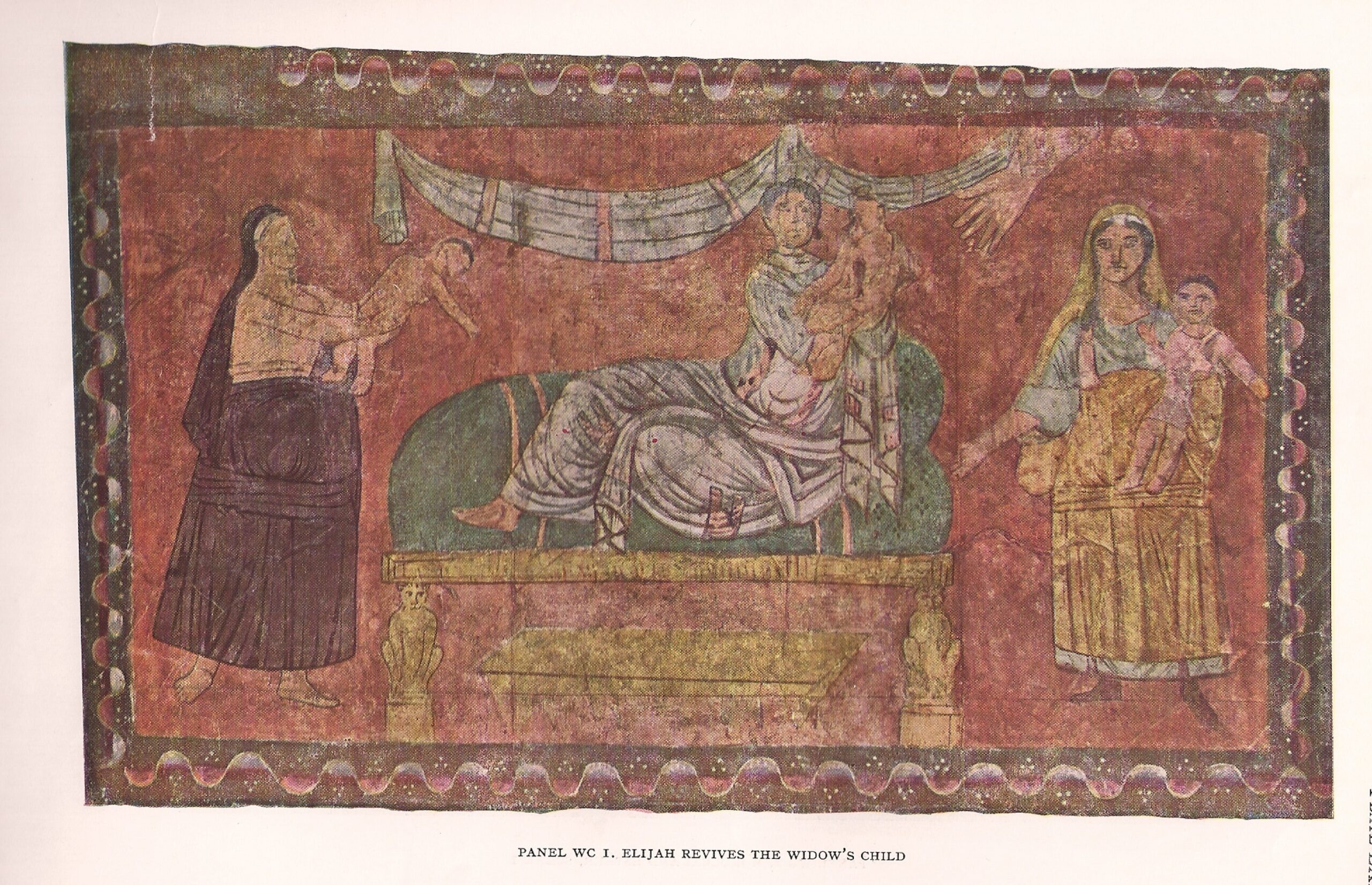
Figure 1. Elijah resurrects the son of the widow of Sarepta. Fresco panel, Synagogue West Wall (WC1). Dura Europos, Public domain, via Wikimedia Commons.
Similarly, Lucinda Dirven described the paintings at the Durene Mithraeum as tableaux vivants. [4] Dirven suggests that the subjects represented are actual portraits of adepts who impersonated the divinity and other characters in re-enactments of, for example, sacred banquets as part of initiation ceremonies, in which role-play was integral to the epistemological journey of the initiate. Christianity inherited this emotional core from the mystery cults, developing liturgical forms of re-enactments of the life of Christ, such as the Washing of the Feet, or events of the Passion. [5] This form of cult was transmitted through a Jewish Babylonian tradition, in turn adapting Mesopotamian cultic practices like festival celebrations of the Babylonian creation myth. [6] The relation between images and sacred performance is also found in Greek art. [7] The location of the synagogue at Dura makes the convergence of such practices highly likely. In my forthcoming book, I will consider a more extensive sample of the synagogue’s iconography and discuss further how to understand play-acting in a religious context.
Syriac late ancient culture where Dura flourished was pervaded by theatrical life. [8] Laura Lieber has eloquently shown the dramatic potential of early Jewish poetry, forming a continuum with Syrian Christian poetry which used the same rhetorical tools and was structured around similar performative patterns. [9] Appropriately to Dura’s multicultural and multilingual population, Lieber’s characterization of performance as “a common, ‘non-partisan’ element in late ancient culture—neither high nor low, neither pagan nor Christian nor Jewish,” [10] touches on the essence of the workings of this town in a Graeco-Roman, Syrian and Mesopotamian (Babylonian) context.

Concepts embodied in performance

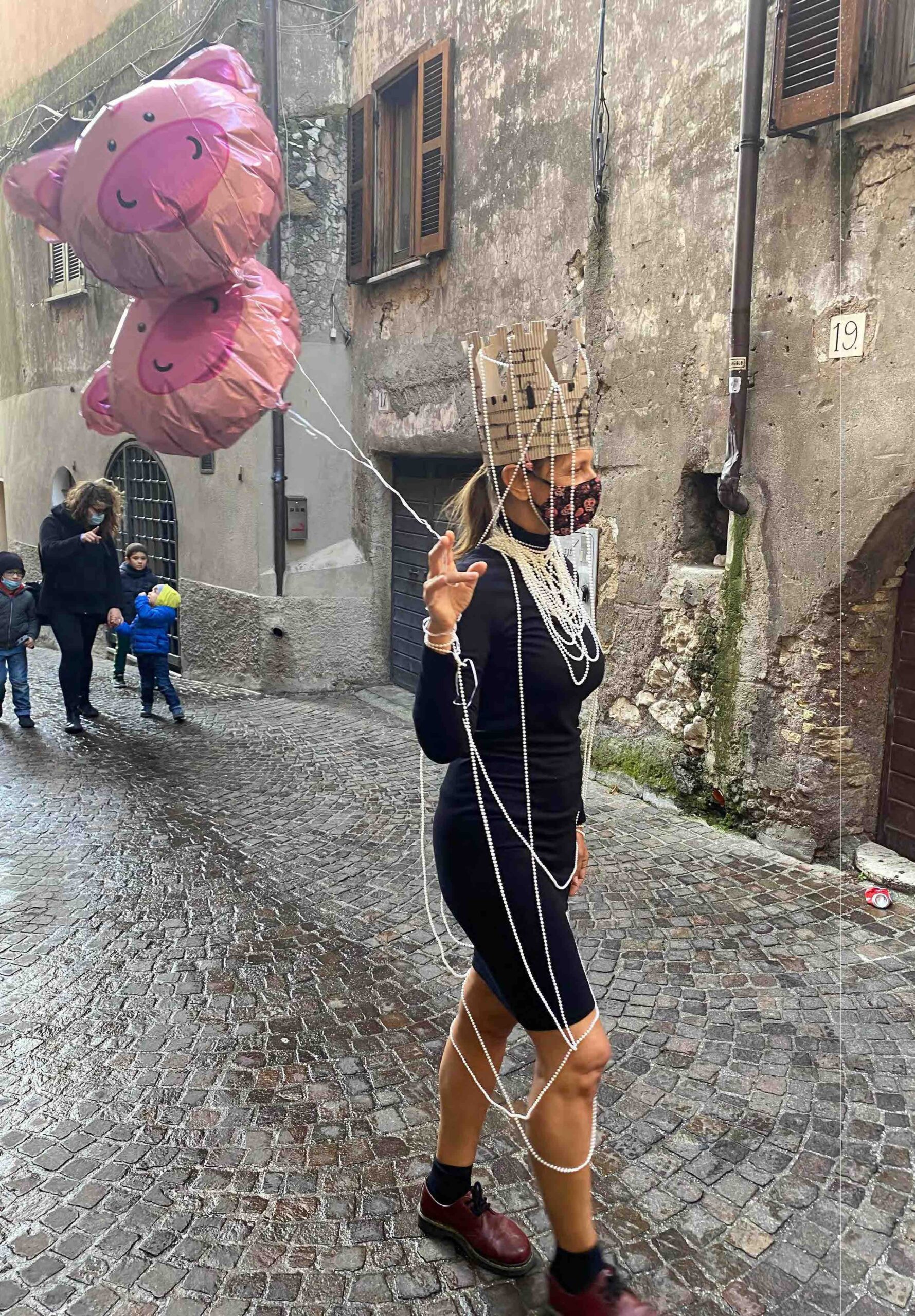
Performance artist Daniela Beltrani describes her work with the motto “When ideas become action.” [11] Her work Intelligenti pauca (2020) is an interpretation of the Gospel verse, “Do not throw your pearls to pigs!” (Matthew 7:6). Those who understand need few words, or even none: the artist walks wrapped in pearls around the streets of Rome, with a walled crown on her head like an ancient Tyche and two floating pink Peppa-pig balloons (Figure 2). Beltrani’s performative rendering presupposes a verbalization of the action by reference to the well-known Gospel text. It encapsulates that idea physically, making it approachable to a wider public. Similarly, I argue that the fresco panel depicting the resurrection of the son of the widow of Sarepta by the prophet Elijah functions as a visualization of the concept of renewed life. Like the ancient equivalent of a photograph, it immortalizes and memorializes a staged tableau vivant, midway between theater and performance art, through which the message propagated to an enlarged community of viewers.
Figure 2. Daniela Beltrani, Intelligenti pauca (2020). Photo credits: Daniela Beltrani.

Within the cycle of panels, its position on the West Wall confers prominence to the representation. Nonetheless, this panel has so far received only scant attention in scholarship. I propose that the artist was inspired by the actual staging of this episode and that its impact on the viewers depends on their approach to it as a performative act, rather than as a narrative text. Moreover, the iconography chosen presupposed a viewer’s cultural horizon that encompassed acquaintance with the rhetoric of Greek tragedy in order to fully decode the message encapsulated by the image. Engaging with such aspects beyond the written biblical text enriches our understanding of the dynamics of the compositional scheme, both from the point of view of the original composition, and from that of its reception through activities conducted within the synagogue space. The latter, then, can be properly considered a place for wider outreach that likely included both visual art and different types of live performance as key strategies of communication. Embodied performance could reach a wider audience and its visuality cut across linguistic barriers to effectively deliver its message of hope. In Lieber’s definition:

Theatrical refers to an author’s or work’s evident sense of audience engagement with a performed work in a public venue. This definition … encompasses both performative and receptive elements of the work—that is, the perspective of both actors and audiences, the importance of both role-playing and gaze. Theatricality becomes a way of engaging religious performance with an eye towards successfully engaging the listeners. [12]

The compositional scheme of the panel

The panel of the resurrection of the child of the widow of Sarepta by the prophet Elijah (WC1) purportedly illustrates the episode narrated at 1 Kings 17:17–24. The action progresses in three distinct moments: to the left, the widow, dressed in black, mourns her child’s death; at the center, the prophet is reclining on his couch-bed and holds the child next to him, looking to the hand of God that comes down from heaven; to the right, the widow, dressed in yellow, is proudly holding her resurrected child upright on her left arm. Like a comic strip without speech bubbles, [13] the three vignettes are symmetrically arranged by the repetition of the standing widow either side of the reclining prophet. Her framing function and the larger central space assigned to the figure of the prophet Elijah may appear to signal that the woman is fulfilling a subordinate, marginal role in the storyline. This impression, however, contrasts with the movement of the narrative, which pushes steadily towards the right and culminates in the widow’s confident standing posture and bright clothes. The progress of the narrative is stringed together by the rhythmical threefold repetition of the baby’s pink body.
In his report on the synagogue, Carl Kraeling described this narrative movement from left to right as conveying the story “with utmost clarity and simplicity.” [14] By contrast, Weitzmann and Kessler complained that the depiction lacks key narrative details such as the woman handing the child to the prophet, the prophet’s upstairs room and his stretching over the child to effect his resurrection, and, finally, his handing back the child to his mother after the miracle. In their opinion, the artist pursued the aesthetic ideal of producing a symmetrically balanced composition for which he paid the “high price” of “sacrificing a good deal of iconographic clarity.” [15] Such contrasting opinions invite a closer look at the dynamics of this representation.

Representational dynamics

There is no doubt that the artist’s distillation of the narrative is highly effective. The choice of actors, their gestures and poses, create a tableau vivant. Rather than demand of this representation a literal rendition of each phase of the biblical text, itself in fact often elliptical, one may read the sequence as pointedly highlighting the words spoken by each character. In place of providing detailed figuration for their actions, the tableau singles out the speech-acts as conveying the essence of the story and, with it, the message intended for the viewers. This can be visualised precisely by adding speech bubbles to the image (Figure 3).
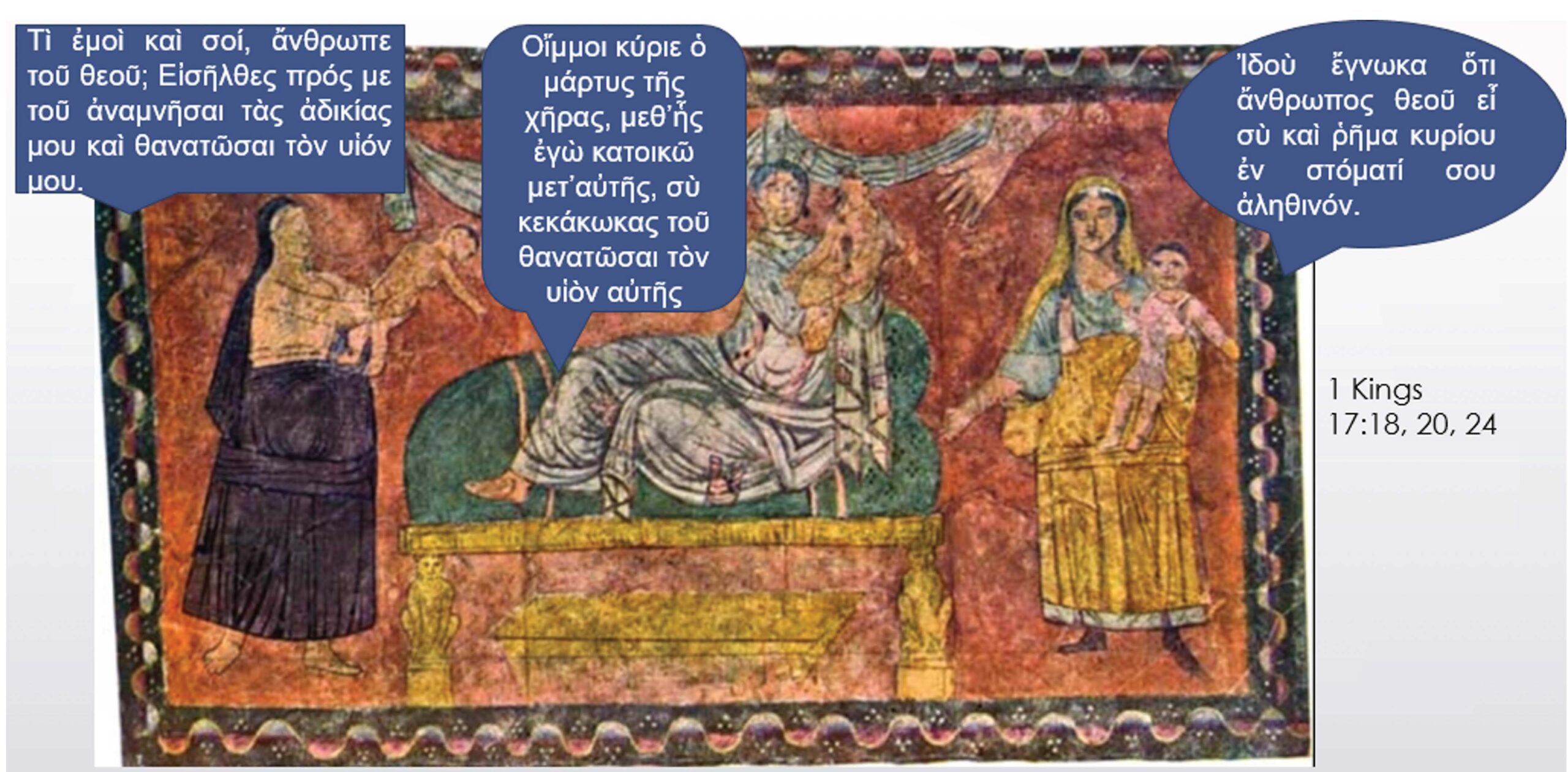
Figure 3. Elijah resurrects the son of the widow of Sarepta. Fresco panel, Synagogue West Wall (WC1). Dura Europos, Public domain, via Wikimedia Commons. With speech bubbles restoring speech to the characters from 1 Kings 17:18, 20, 24.

The mourning widow with the dead son

To the left, the beginning of the drama unfolds. The widow’s son, the text says, became ill until “there was no breath left in him” (1 Kings 17:17). The text does not specify where the widow and her son are at this point, presumably in her house, nor where the prophet is with respect to them. It is left to the reader’s imagination to construct the scene where the dialogue takes place. Perhaps Elijah just came in through the door and his appearance prompted the woman’s reaction: “So she said to Elijah: ‘What have I to do with you, O man of God? Have you come to me to bring my sin to remembrance, and to kill my son?’” (1 Kings 17:18). [16] These words are a strong accusation against Elijah. The woman’s devastation is plain. Her black dress should not be interpreted as her normal attire as widow, since she appears dressed in “a short-sleeved white chiton with a red border at the hem and a reddish brown overgarment” [17] in a previous scene. Rather, the dark robe and veil mark the woman’s fresh encounter with death. Her bare breast, moreover, performs the dramatic action of a mourner, underscoring her role as nourisher and her current despair at the failure of sustaining her son’s life. [18] From the beginning of this narrative, the woman emerges as protagonist. The pose in which she holds her baby facing towards the prophet calls out the words she addressed to him.
In the speech that the Dura visual narrative highlights she addresses the prophet in familiar language. The expression Τὶ ἐμοὶ καὶ σοί translates to “What is this to me and to you,” drawing on a bond between the woman and this “man of God.” The same expression is used in the first chapter of Mark by the unclean spirit in his encounter with Christ (Mk 1:24). It signals confrontation, but also a parity of status in the communication and rings with an understanding of conditions of emergency. In her distress, the widow of Sarepta denounces her son as a sin. This revelation would be surprising if the baby had been conceived with a husband who subsequently died. It is more likely that this child was the fruit of a one-off intercourse. [19] The son’s death reminds the woman of her sin because it deprives her of the only positive outcome of it, the company and hope of the son himself. Elijah’s coming has brought a bitter justice to her life by provoking the son’s death. The widow’s accusation to him is therefore many-sided. Not only has the prophet broken his promise to her host to act as her protector, but he has also forfeited his role as provisional master of her household.

The prophet in the upper room

Moving right to the center of the panel, the prophet Elijah is represented already reclining on his couch in the upper room of the widow’s house. The panel clearly focuses on his dialogue with God in the solitude of this space and brings the viewer’s attention to this moment of bargaining for the child’s life. The hand of God above the prophet’s head demonstrates that it is this conversation that is depicted. But, even according to the biblical text, Elijah’s words to God are not simply an impassioned prayer for the son’s life. They are an accusing diatribe that mirrors the widow’s lament. The mother blamed Elijah, and, in his turn, Elijah blames God for the death of the widow’s son. God is responsible for everything: “O lord my God, have You also brought tragedy on the widow with whom I lodge, by killing her son?” (1 Kings 17:20). [20]
The phrasing of the Greek is more awkward than this smooth translation. The strong emotion is expressed using the exclamation Οἴμμοι found in Greek tragedy; [21] it shows Elijah almost stammering, in the pleonastic repetition of μεθ’ἧς … μετ’αὐτῆς, “with her… with her,” said twice. The Greek words stress the ambiguous situation of the prophet’s living at the woman’s expense in her household. Note that God is “witness to the widow” (ὁ μάρτυς τῆς χῆρας), an expression lost in translation (“Look to this widow”) that surely carries the weight of responsibility for God’s protecting hand over her. What was God’s plan in sending Elijah to live there, and then why did He cause this embarrassing situation in which the beloved son of his benefactress died, despite the inexhaustible food resources the prophet had miraculously provided? In this speech, Elijah foregrounds God’s relationship to this woman, a widow, a man-less woman even while Elijah is living with her. The child may be restored to life through Elijah, but not because of him.
Other midrashic versions of this episode do not paint Elijah’s role in a positive light. According to a Jewish legend related by Kraeling, God was not at first willing to grant Elijah’s prayer to restore the child to life, because Elijah had reserved for himself power over the elements and withdrawn rain from Israel, causing a great drought to punish King Ahab and his wife Jezebel for worshipping idols. Elijah obtained the grace from God only by promising to give up his power over the weather. [22] Elijah is also considered an extremist in some Greek texts concerning him. His intransigence is not fully appreciated even by God himself, and his story demonstrates a process by which he is tamed into a more forgiving attitude. The death of the widow’s son formed part of these lessons in humanity directed at eliciting compassionate feelings from the rigidly upright prophet, representing in fact their culmination, after which he relented from imposing his destructive drought upon Israel and Phoenicia. [23]
These traditions remind us that the status of Elijah was not taken for granted, but rather a subject for discussion. Although the panel need not have taken into consideration midrashic traditions, even when their influence has been noted elsewhere in the fresco cycle, [24] the debated status of this prophet remains a caveat against reading his centrality in this panel as one would his vita icon. Although he features at the center, this panel is not primarily about the prophet. Moreover, its having been displaced out of chronological sequence with respect to the prophet’s deeds represented on the South Wall further alerts the viewer that this image is not simply telling a story. Like Beltrani’s performance art, the panel is about a concept, and through a narrative (that became biblical) it aims to represent an idea: that of the verification of a prophet through the miracle of resurrection.

The widow proclaims the resurrection of her son

A climax of recognition is embodied in the widow’s appearance to the right side of the prophet, the culmination of the panel’s movement from left to right. By the sign of her own resurrected son, she proclaims her knowledge of Elijah’s divine mission as a prophet: “Now by this I know that you are a man of God, and that the word of the Lord in your mouth is the truth” (1 Kings 17:24). [25] The widow rejoices at holding her son in her arms; he is alive again, but her witness goes beyond rejoicing for herself or even congratulating Elijah. What she validates through her speech is the prophetic sign of salvation—that of bodily resurrection—which places her at the forefront of the process of recognition for what comes from God and is truthful. The widow is not just selfishly happy, but she is serene because of this proclamation. The Word spoken by the true prophet is a word of life, and a message of resurrection.
Intriguingly, it is the woman’s gesture with her extended right arm that is placed in parallel to the hand of God directly above it. Both hands are open palm outwards, a gesture of benevolence and acceptance at once. It is the widow, more than Elijah, who acts as purveyor of good news. Her role is itself that of a prophetess, who, through participating fully in human experience as a mother, nourisher, and widow, has obtained the wisdom necessary for recognizing truth. [26]
That viewers of the panel took away a message of resurrection as the primary referent for the sequence of vignettes is clear from a Middle Persian graffito scratched on the fresco’s surface. It says, “Praise to the gods, praise; since life, life eternally has been given!” Steven Fine comments on how this inscription is “assertively performative.” [27] Though placed on Elijah’s thigh, this speech-act encapsulates the entirety of this performative sequence.
Decoded as a tableau vivant, this panel comes alive through imagining a spoken representation where the words of the characters, expressed in their poses and gestures, are made to flow out. The implicit words evoked through nonverbal communication, particularly hand gestures, are thus understood as conveying the primary message. [28] The episode of the resurrection of the son of the widow of Sarepta is not primarily a sequence that follows written narrative, but rather the visually dynamic embodiment of a message that is effectively relayed even through the stills of a painted vignette.

Greek tragedy and biblical narrative

The idea that the panel should both evoke and be based on a mise-en-scène of the biblical episode pivots on the importance of regaining the oral dimension of the scene, but there are other elements in the representation that contribute to strengthening a performative hypothesis. While a narrative with interactive dialogue would depict the widow and the prophet directly facing each other, the frontality of these characters emphasizes instead the interaction between painted subject and viewer. Dialogue between protagonists is accompanied by a conversation with the spectator. Words are proclaimed for all to hear, not just whispered in intimate conversation.

A relation between Greek tragedy and biblical narrative has been occasionally noted. Parallel occurrences of tragic events, such as the blinding of Zedekiah and that of Oedipus, have been analysed. [29] The overwhelming presence of dialogue in biblical narrative—and even silence—alerted scholars to another aspect of its theatrical dimension. As Kenneth Craig wrote for 1 Samuel:

The narrator does, of course, have the option to tell the story straight—what happens, why, what the characters think, how their actions square with the narrator’s evaluative system, and so forth. The option that the narrator chooses, namely, to bring speaking characters on stage, produces an orchestration of voices, a systematic interplay of perspectives. [30]

Craig may be speaking figuratively, but his choice of words is significant. In his view, this narrative choice—much like a theatrical staging—opens multiple possibilities of interaction “between narrator and characters, narrator and readers, and readers and characters.” [31] Because of such complexity, the Bible offers particularly rich possibilities of involvement. As Craig concludes, “[i]t is this process of reconstructing the story’s perspectival parts into a coherent whole that makes the Bible such exciting reading and marks one of its artistic claims to notice.” [32]

Elijah as Alcestis

The most compelling element in the comparison between the panel and a supposedly staged performance is found in Elijah’s recumbent pose center-stage. Richard Brilliant has remarked on the similarity between Elijah’s pose and other examples of Roman art from funerary contexts, in Palmyra, on Etruscan sarcophagus lids and in “Sleeping Ariadne” sculptures. [33] Weitzmann and Kessler point out that this “conventional hieratic pose” is “comparable to the deceased in banquet representations, chiefly funerary ones,” while the presentation also hinted at a similarity with “a reclining Adonis or Dionysus or some other pagan deity.” [34] The same authors further consider the similarity of composition between the panel and the organization of narrative space on Alcestis sarcophagi. Presumably, what drew their attention to these examples in the first place must have been the most obvious parallel, that between Elijah and Alcestis herself, both central reclining figures. [35] Weitzmann and Kessler emphasize a process of “conflation” in which a story is reduced to a synthesis of significant characters rather than unraveled stage by stage in successive scenes.
Apparently, the motif of Alcestis on sarcophagi underwent a flurry of popularity precisely in the first decades of the third century. [36] Rather than any generic similarity to a reclining god, then, it is plausible to suggest that a visual parallel between Elijah and the Euripidean Alcestis was created to encapsulate the essence of the panel’s message vis-à-vis premature death and the hope of returning to life. Negotiations between humans and gods concerning survival, seen in a tragicomic fashion, are also shared by the two stories. It is possible that the label “Elijah” written on his figure was intended to disambiguate not only a potential confusion with a similar episode of resurrection of a child by Elijah’s disciple, Elisha (2 Kings 4:18–37), [37] but also to dispel the potential ambiguity between this feminine-looking Elijah and the Euripidean heroine Alcestis. The intertext of the Alcestis insinuated by the visual presentation (including the tripartite division of the panel) offers more than an iconographical model. It contributes radically to the intercultural decoding of the image as a powerful message of resurrection and hope. [38]
Reference to the play by Euripides highlights the painful and uncertain threshold between life and death, thereby transforming the biblical scene into tense family drama. Evidence of Alcestis in Roman catacombs strengthens the likelihood of its currency as an imaged concept. [39] Like Alcestis, Elijah shifts between life and death holding up the widow’s son to a deus ex machina who literally extends a helping hand from above. The interplay between figurative and dramatic subjects is also underscored by this comparison.

Dialogue as a mark of performance

The invention of imaginary dialogues based on biblical storylines demonstrates a multi-faceted engagement with the mechanisms of interpretation. Such practice was particularly lively in the Syrian church and specifically included pieces on Elijah and the widow of Sarepta. One exchange after the death of the widow’s son renders the woman’s accusations to the prophet even more explicit than those reported by the biblical text. “Give me back my only child […] for he was slain because of you!”, she says, to which Elijah answers: “Never has anyone been killed by me, and here you are calling me a murderer. Do you suppose that I am God, to be able to revive your only son?” [40] In this version, Elijah’s prayer to God is impassioned but more self-concerned. In the solitude of his upper room, the prophet explicitly asks God all the questions we would like to see answered:

“Why, Lord, have you requited with this loss
this widow who has received me?
Why did you send me to her,
why did you bring her son forth from her womb? Lord, I call upon you with feeling,
I beg of your mercy;
listen, Lord, to the prayers of your servant
and return the soul of this boy.” [41]

At this point the hand of God speaks, as it were, and the deal is signed: God will release the soul of the child when Elijah lets go of the key to the heaven, allowing rain to fall again. The conclusion of this memre does not attribute more direct speech to the woman, but only describes her as rejoicing and giving praise to God. While this poetic version contains a narrative frame, however minimal and reduced to “stage directions,” another Syriac fragment offers pure dialogue. [42] One might envisage these pieces acted out in different voices, as the performance of later kontakia by Romanos the Melod are now imagined. [43]

Although it is possible to “fill in” the voices of the characters directly from the biblical text in the Dura panel, it is clear from these later examples that this narrative came alive as dialogue in different forms. The episode was thus familiar to a broad audience as a spoken text, featuring a vigorous verbal exchange not devoid of pathos and dramatic tension. It is possible, therefore, that different people might interpret the visual panel according to the tradition they were most familiar with. In any case, there is a good chance that the way these dialogues became popular was through some form of simple staging.

Stage Props

Perhaps the clearest sign that the panel represents a form of concrete presentation is indicated by the furnishings of the scene. These include the clothes, Elijah’s couch, and a curtain hanging from the ceiling. God’s hand, colored pink like skin and clearly showing the right hand from the position of the thumb, could also be considered a stage prop. One may note that the hand is hanging down from the ceiling at the same point where the curtain is held up, as if the two shared a common hooking device discreetly hidden behind the picture frame.
The widow’s dress and veil change color, as we have noted, from black to yellow, signaling in this way the transition in her mood as a telltale sign of the outcome of the story. But her fashion does not change: both dresses display a loose horizontal band marking the hips, below which the skirt flows down to her ankles, leaving only her feet visible. While the woman’s bust is naked like her baby in the first scene, both hers and the baby’s upper torso are dressed in the conclusion: a pale green oversized shirt for the woman, a sleeveless pink short dress for the baby. While the Sareptian woman is dressed in local color, the prophet displays the Graeco-Roman style of philosopher’s himation (or Jewish tallit) with abundant white drapery and pink stripes. [44] It is hard to see whether he wraps the baby in part of his flowing robe, or whether he has a separate piece of cloth to hold him in. [45]
The prophet’s couch or bed plays a major role in the scene. It is a stately piece of furniture, not just a utilitarian device. [46] Kraeling remarks on its exceptional looks. [47] The structure is yellow, suggesting a gilt frame of wood (or bronze) mimicking, at least, a gold couch. [48] Luxury manufacture is also displayed in the figurative moldings of the legs and in the superabundant pillows. This couch has full back support, a feature introduced by the Romans, [49] and is richly upholstered with a geometrically patterned (lozenges formed by four dots) dark-green covering. These soft furnishings do not appear detached from the bed, so that the four narrow pink bands across look more like integral elements in the decorative scheme of the fabric than superimposed with the function of holding it together. [50]

Such a sumptuous bed may have been invented by the painter following the concept of creating a suitable support for a holy man, even though a gold bed was an unlikely presence in the widow’s house. But a detail suggests that the representation was inspired by a real object: a yellow platform, matching the structure of the bed, is placed on the floor below the couch in such a way as to suggest depth and perspective in the otherwise mainly flat and frontal scene. This object was probably a long footstool, at once a practical aid in climbing upon the tall seat and a symbol of status (cf. Figure 4).
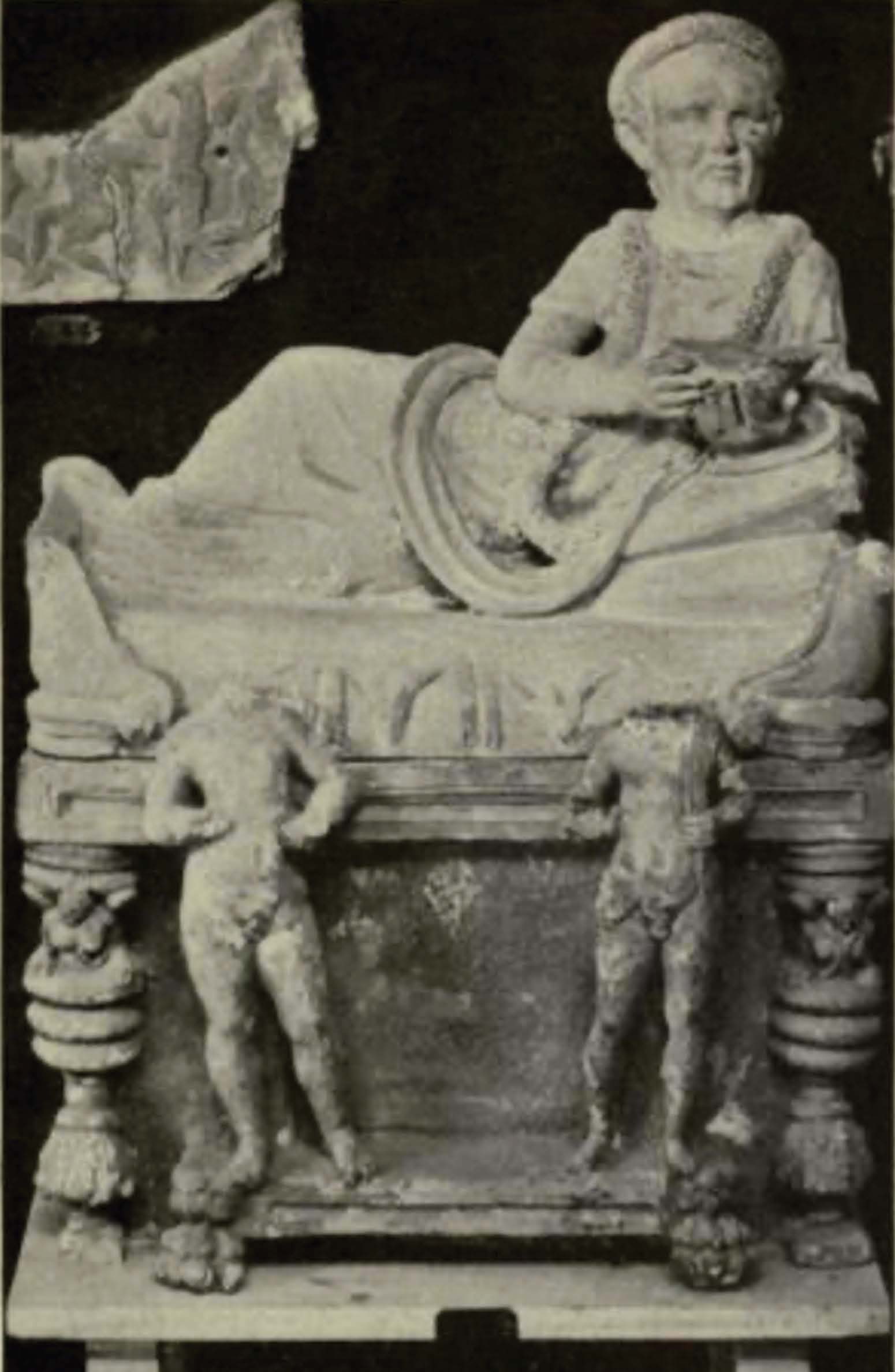
Figure 4. Funerary urn displaying a reclining man on an elaborate couch with pedestal below. From Ransom 1905, figure 14 (Museo Kircheriano, Rome).
Finally, a curtain hanging in two unequal descending loops is suspended above Elijah, the midpoint gathering placed just behind his head, while the extremities are fixed in correspondence with either couch ends. The curtain is of a pliable material, perhaps white linen, ornamented with the same pink stripes across as the couch and Elijah’s robe. This curtain-type is named aulaeum, designating not only a canopy found in homes and private spaces, but also a theater curtain placed front stage. [51] It is found elsewhere at Dura, notably in the Aaron panel, [52] but its presence above Elijah has gone unremarked. According to Eberlein, the definition of space through this suspended hanging may indicate abstraction from a real context, as in the manuscript example of the meal of Dido scene from the Aeneid. [53] One should also consider if, analogous to awnings in Roman theaters but on a smaller scale, their function could have been that of improving the acoustics of the room by diminishing the vertical dispersion of voice from the speaker below the curtain. [54] It is possible, then, to pinpoint a specific theatrical connection in the design of this hanging, besides the more generic impression of theatricality conveyed by curtains.

Conclusion

I have argued that the panel of Elijah resurrecting the son of the widow of Sarepta can best be conceived as a tableau vivant whose source is not the narrative transmitted by the written text of the Bible, but rather a work of art involving staged oral performance. The intellectual interpretation of the scene for the visitors to the synagogue passes through the reconstruction of enacted dialogue, impressed in the viewers’ minds from the experience of its staging in different forms and contexts. It extends its message by appeal to a broader dramatic visual culture that encompasses Euripides’ classic play on the theme of resurrection, the Alcestis, as envisaged on contemporary funerary monuments. Both this dramatic scene and the Euripidean play hover midway between tragedy and farce, just like the reception of Elijah’s character in Jewish and Christian oral traditions envisages him at the same time as both a saint and a trickster. Besides the similar tripartite compositional synthesis of the Alcestis sarcophagi, the panel depicts a dramatic staging of the biblical episode with that theatrical work among its intended intertexts.
Capturing the unuttered words of a tableau vivant presupposes a shared common culture. One purpose of the cultic experience was precisely to create such an emotional community by arousing feelings in the audience through drama. [55] Participation in the staged event was prolonged by its depiction on the walls of the cultic building, hooking on the fresco the collective memory of both message and participatory performative event.
Suggesting that this type of sacred theatrical approach belonged to a synagogue is not as unthinkable as might at first seem. Even at a cursory glance, this interpretative methodology bears extension to neighboring panels, as I will detail in my forthcoming book. More generally, the structure and ambiance of the synagogue space was suited to house such shows. A seated area was provided by a stone bench along the walls. Significantly, the first row of images behind the seating is composed of a fake-marble dado with clipeate faces or masks. [56] The fourteen masks represent four male and ten female characters. [57] The Thespian choice of decoration could be envisaged as framing in a fitting manner the activity in this space.
Drama was a sacred art form the Greeks used to celebrate special festivals and to articulate both complex ideas and powerful emotions. [58] I have suggested that it is from religious enactments that the Dura panels drew their inspiration. Dura’s signature as a vibrant Greek-speaking and multicultural Hellenistic community takes fuller shape with this realization. [59] The observation is entirely fitting not only to the high cultural level of this center, as attested by the extant manuscript fragments, [60] but also to the general tenure of life in second- and third-century Syria, where performance and theater defined every aspect of public and personal life. [61]
Performance theater provides a solid ground for the origin of the images and elucidates the process of reception by which images speak to their viewers. Above all, it projects the religious images onto a full-blooded cultural environment conscious of the manifold powers of visuality. [62] While the goal of depiction is the enunciation of a concept or idea, rather than the telling of a story for its own sake, the visual language that idea is cast in interacts with a complex cultural baggage that problematizes and even questions that very formulation by engaging the viewers’ emotional and critical faculties, like a tableau vivant. In this light, the proclamation of the widow who receives her revived son by exclaiming, “Now by this I know that you are a man of God, and that the word of the Lord in your mouth is the truth” (1 Kings 17:24), is not a mesmerized cultic utterance but a pondered statement about life’s tragic circumstances, and the challenge of reality on this world-as-a-stage. [63]

Bibliography

Andrade, N. J. 2013. Syrian Identity in the Greco-Roman World. Cambridge.
Barone, F. P. 2008. “The Image of Prophet Elijah on Ps. Chrysostom, The Greek Homilies.” ARAM 20:111–124.
Baughan, E. P. 2013. Couched in Death. Klinai and Identity in Anatolia and Beyond. Madison.
Berg, B. 1994. “Alcestis and Hercules in the Catacomb of via Latina.” Vigiliae Christianae 48:219–234.
Bino, C. 2015. Il dramma e l’immagine. Teorie cristiane della rappresentazione (II–XI sec.). Florence.
Birk, S. 2013. Depicting the Dead: Self-Representation and Commemoration on Roman Sarcophagi with Portraits. Aarhus.
Bradford Welles, C., et al. 1959. Inscriptions, Parchments. and Papyri. Vol. 5.1 of The Excavations at Dura-Europos conducted by Yale University and the French Academy of Inscriptions and Letters: Final Report. New Haven.
Brilliant, R. 1973. “Painting at Dura and Roman Art.” In Gutmann 1937a:23–30.
Brock, S. P. 1989. “A Syriac Verse Homily on Elijah and the Widow of Sarepta.” Le Muséon 102:93–113.
———. 2020. “Elijah and the Widow of Sarepta: A Fragmentary Dialogue.” ARAM 32:1–7.
Chaniotis, A. 2007. “Theatre Rituals.” In The Greek Theatre and Festivals: Documentary Studies, ed. P. Wilson, 48–66. Oxford.
———. 2013. “Staging and Feeling the Presence of God: Emotion and Theatricality in Religious Celebrations in the Roman East.” In Panthée: Religious Transformations in the Roman Empire, ed. L. Bricault and C. Bonnet, 169–189. Leiden.
Chapman, M. 1996. “‘Living Pictures’: Women and Tableaux Vivants in Nineteenth-Century American Fiction and Culture.” Wide Angle 18:22–52.
Corbeill, A. 2004. Nature Embodied: Gesture in Ancient Rome. Princeton.
Craig, K. 1994. “Rhetorical Aspects of Questions Answered with Silence in 1 Samuel 14:37 and 28:6.” Catholic Biblical Quarterly 56:221–239.
Crostini, B. Forthcoming. “Empowering Breasts: Women, Widows and Prophetesses with Child.” In Motherhood and Breastfeeding in Late Antiquity and Byzantium, ed. A. Skouroumouni and S. Constantinou. London.
D’Ambrosio Alfano, F. M., et al. 2015. “Velaria in Ancient Roman Theatres: Can They Have an Acoustic Role?” Energy and Buildings 95:98–105.
Diebold, W. 2019. “‘Not Pictures but Writings was sent for the Understanding of our Faith’: Word and Image in the Soissons Gospels.” In Die Handschriften der Hofschule Kaiser Karls des Großen, ed. M. Embach, C. Moulin, H. Wolter-von dem Knesebeck, 17–36. Trier.
Dirven, L. 2015. “The Mithraeum as Tableau Vivant: A Preliminary Study of Ritual Performance and Emotional Involvement in Ancient Mystery Cults.” Religion in the Roman Empire 1:20–50.
Eberlein, J. K. 1982. Apparitio regis—revelatio veritatis: Studien zur Darstellung des Vorhangs in der bildenden Kunst von der Spätantike bis zum Ende des Mittelalters. Wiesbaden.
Exum, J. C. 1992. Tragedy and Biblical Narrative: Arrows of the Almighty. Cambridge.
Fine, S. 2011. “Jewish Identity at the Limus: the Earliest Reception of the Dura Europos Synagogue Paintings.” In Cultural Identity in the Ancient Mediterranean, ed. E. S. Gruen, 303–320. Los Angeles.
———. 2013. “How Do You Know a Jew When You See One? Reflections on Jewish Costume in the Roman World.” In Fashioning Jews: Clothing, Culture, and Commerce, ed. L. Greenspoon, 19–27. West Lafayette, IN.
Gaster, T. H. 1961. Thespis: Ritual, Myth, and Drama in the Ancient Near East. Garden City, NY.
Goldstein, J. A. 1995. “The Judaism of the Synagogues.” In Judaism in Late Antiquity, vol. 2, Historical Synthesis, ed. J. Neusner, 109–159. Leiden.
Gutmann, J., ed. 1973a. The Dura-Europos Synagogue: A Re-evaluation (1932–1972). Missoula.
———. 1973b. “Programmatic Painting in the Dura Synagogue.” In Gutmann 1937a:137–154.
———. 1983. “The Illustrated Midrash in the Dura Synagogue Paintings: A New Dimension for the Study of Judaism.” Proceedings of the American Academy for Jewish Research 50:91–204.
Hawk, L. D. 1996. “Saul as Sacrifice: The Tragedy of Israel’s First Monarch.” Bible Review 12:20–25.
Hezser, C. 2017. Rabbinic Body-Language: Non-Verbal Communication in Palestinian Rabbinic Literature of Late Antiquity. Leiden.
Jacobsen, T. 1975. “Religious Drama in Ancient Mesopotamia.” In Unity and Diversity: Essays in the History, Literature, and Religion of the Ancient Near East, ed. H. Goedicke and J. J. M. Roberts, 65-97. Baltimore.
James, L. 2007. “Introduction: Art and Text in Byzantium.” In Art and Text in Byzantine Culture, 1–12. Cambridge.
Johnston, S. I. 1999. Restless Dead: Encounters between the Living and the Dead in Ancient Greece. Berkeley.
Joosten, J. 2003. “The Dura Parchment and the Diatessaron.” Vigiliae Christianae 57:159–175.
Kaizer, T. 2009. “Religion and Language in Dura-Europos.” In From Hellenism to Islam. Cultural and Linguistic Change in the Roman Near East, ed. H. M. Cotton, R. G. Hoyland, J. J. Price and D. J. Wasserstein, 235–254. Cambridge.
Kraeling, C. H. 1956. The Synagogue. Vol. 8.1 of The Excavations at Dura-Europos conducted by Yale University and the French Academy of Inscriptions and Letters: Final Report. New Haven.
Laderman, Sh. 1997. “A New Look at the Second Register of the West Wall of Dura Europos.” Cahiers Archéologiques 45:5–18.
Lehtipuu, O. 2017. “To Remarry or Not to Remarry? 1 Timothy 5:14 in Early Christian Ascetic Discourse.” Studia Theologica 71:29–50.
Lieber, L. S. 2014. “Setting the stage: The Theatricality of Jewish Aramaic Poetry from Late Antiquity.” The Jewish Quarterly Review 104:537–572.
———. 2015. “Theater of the Holy: Performative Elements of Late Ancient Hymnography.” Harvard Theological Review 108:327–355.
Marconi, C. 2012. “Mirror and Memory: Images of Ritual Actions in Greek Temple Decoration.” In Heaven on Earth: Temples, Ritual, and Cosmic Symbolism in the Ancient World, ed. D. Ragavan, 425–446. Chicago.
Martin, C. E. 2015. Baring the Breast in Homer and Attic Tragedy: Death, Dunning and Display. MA thesis, University of South Africa.
Moormann, E. M. 2021. “The Murals of the Synagogue at Dura Europos and an Expression of Roman Koine.” In Principles of Decoration in the Roman World, ed. A. Haug and M. T. Lauritsen, 141–161. Berlin.
Neis, R. 2013. The Sense of Sight in Rabbinic Culture: Jewish Ways of Seeing in Late Antiquity. Cambridge.
Nielsen, I. 2002. Cultic Theatres and Ritual Drama. Aarhus.
Nordgren, L. 2015. Greek Interjections: Syntax, Semantics and Pragmatics. Berlin.
Parani, M. 2018. “Mediating Presence: Curtains in Middle and Late Byzantine Imperial Ceremonial and Portraiture.” Byzantine and Modern Greek Studies 42:1–25.
Perdicoyanni-Paléologue, H. 2002. “The Interjections in Greek Tragedy.” Quaderni Urbinati di Cultura Classica n.s. 70 8.
Rahlfs, A. 1935. Septuaginta, id est Vetus Testamentum graece iuxta LXX interpretes. Stuttgart.
Ransom, C. 1905. Couches and Beds of the Greeks, Etruscans, and Romans. Chicago.
Richter, G. M. A. 1926. Ancient Furniture: A History of Greek, Etruscan, and Roman Furniture. Oxford.
Roncace, M. 2005. Jeremiah, Zedekiah, and the Fall of Jerusalem. New York.
Schenk, K. L. 2010. “Temple, Community, and Sacred Narrative in the Dura-Europos Synagogue.” Association for Jewish Studies Review 34:195–229.
Sommer, B. D. 2000. “The Babylonian Akitu Festival: Rectifying the King or Renewing the Cosmos?” Journal of Ancient Near Eastern Studies 27:81–95.
Sterbenc Erker, D. 2009. “Women’s Tears in the Ancient World.” In Tears in the Graeco-Roman World, ed. T. Fögen, 135–160. Berlin.
Weitzmann, K., and H. L. Kessler. 1990. The Frescoes of the Dura Synagogue and Christian Art. Washington, DC.
Wharton, A. 1995. Refiguring the Post Classical City: Dura Europos, Jerash, Jerusalem and Ravenna. Cambridge.
Wood, S. 1978. “Alcestis on Roman Sarcophagi.” American Journal of Archaeology 82:499–510.
Zanker, P. 1995. The Mask of Socrates: The Image of the Intellectual in Antiquity. Berkeley.

Footnotes

[ back ] 1. Gutmann 1973:144–145; Gutmann 1983:91–204; Wharton 1995:38–43; Laderman 1997:5–18; Schenk 2010:195–229.
[ back ] 2. Diebold 2019:17; James 2007 (2010):1–9.
[ back ] 3. Chapman 1996:22.
[ back ] 4. Dirven 2015. I came across this article well after I had written mine, and I incorporate it here in the last revision of this paper.
[ back ] 5. Bino 2015:212–216.
[ back ] 6. Gaster 1961:62; Jacobsen 1975:73–74; Sommer 2000:82, 94–95.
[ back ] 7. Marconi 2012.
[ back ] 8. Andrade 2013.
[ back ] 9. Lieber 2014; Lieber 2015.
[ back ] 10. Lieber 2014; Lieber 2015.
[ back ] 11. https://www.danielabeltrani.art/intelligenti-pauca.html (consulted January 2023).
[ back ] 12. Lieber 2014:539.
[ back ] 13. Moormann 2021:147 characterizes the images in the synagogue in general in this way.
[ back ] 14. Kraeling 1956:143.
[ back ] 15. Weitzmann and Kessler 1990:108.
[ back ] 16. Τὶ ἐμοὶ καὶ σοί, ἄνθρωπε τοῦ θεοῦ; Εἰσῆλθες πρός με τοῦ ἀναμνῆσαι τὰς ἀδικίας μου καὶ θανατῶσαι τὸν υἱόν μου. All Greek biblical quotations from Rahlfs 1935; translations NRSV.
[ back ] 17. Kraeling 1956:136.
[ back ] 18. Sterbenc Erker 2009:140 and n. 12; Corbeill 2004:67–68, 86–90, 102–106; Martin 2015.
[ back ] 19. On the broader semantic range of the Greek and Latin words for widow, see: Lehtipuu 2017:29.
[ back ] 20. Οἴμμοι κύριε ὁ μάρτυς τῆς χῆρας, μεθ’ἧς ἐγὼ κατοικῶ μετ’αὐτῆς, σὺ κεκάκωκας τοῦ θανατῶσαι τὸν υἱὸν αὐτῆς. My italics in translation.
[ back ] 21. Perdicoyanni-Paléologue 2002:54, 56–57, 62–63, 65; Nordgren 2015.
[ back ] 22. Kraeling 1956:147, with reference to different versions.
[ back ] 23. Barone 2008:116 (In Eliam Propheta sermo, PG 56, 583–586), 118 (In Martham, Mariam et Lazarum).
[ back ] 24. Gutmann 1983.
[ back ] 25. Ἰδοὺ ἔγνωκα ὅτι ἄνθρωπος θεοῦ εἶ σὺ καὶ ῥῆμα κυρίου ἐν στόματί σου ἀληθινόν. My italics.
[ back ] 26. Crostini forthcoming develops this idea further.
[ back ] 27. Fine 2011:312.
[ back ] 28. Corbeill 2004; Hezser 2017:168–174. I thank Vladimir Ivanovici for this reference.
[ back ] 29. Hawk 1996:56.
[ back ] 30. Craig 1994:233; cited by Roncace 2005:156. My italics.
[ back ] 31. Roncace 2005:156.
[ back ] 32. Roncace 2005:156.
[ back ] 33. Brilliant 1973:27.
[ back ] 34. Weitzmann and Kessler 1990:108.
[ back ] 35. Weitzmann and Kessler 1990:109; Wood 1978.
[ back ] 36. Birk 2013:99.
[ back ] 37. Kraeling 1956:144, 149.
[ back ] 38. Alcestis was the only labeled figure among the daughters of Pelias on the sculpted chest of Cypselus according to Paus. 5.17.11. See: Johnston 1999:95.
[ back ] 39. Berg 1994.
[ back ] 40. Brock 1989:109, lines 133–134 and 137–138.
[ back ] 41. Brock 1989:109–110, lines 148–150.
[ back ] 42. Brock 2020.
[ back ] 43. Lieber 2015:341–346.
[ back ] 44. Zanker 1995:232; Goldstein 1995:113; Hezser 2017:4, 44–45.
[ back ] 45. Fine 2013:23–24 maintains that Moses has a tzitzit in addition to the himation; Hezser 2017:45.
[ back ] 46. Baughan 2013:15–17 on the various uses of klinai, translated as beds or couches.
[ back ] 47. Kraeling 1956:145.
[ back ] 48. Ransom 1905:39–42, 40n6 about gilt furniture in Egypt and Greece, 55–56.
[ back ] 49. Richter 1926:133.
[ back ] 50. Kraeling 1956:145; Ransom 1905:71.
[ back ] 51. Eberlein 1982:109–112 describes the aulaeum as a “horizontal drapery, which resembles a raised theatre curtain”; cf. fig. 4a (Hippocrates); Parani 2018:20.
[ back ] 52. Eberlein 1982:110, fig. 37.
[ back ] 53. Eberlein 1982:110, fig. 36: MS Vat. lat. 3867, fol. 100v (Aen. I, 697).
[ back ] 54. D’Ambrosio Alfano 2015.
[ back ] 55. Chaniotis 2013.
[ back ] 56. Kraeling 1956:246–250, figs. 63–69 (drawings in text), pl. XXVIII–XXIX (photos).
[ back ] 57. Kraeling 1956:247, fig. 63 and 64.
[ back ] 58. Chaniotis 2007.
[ back ] 59. For this approach, see Kaizer 2009, Andrade 2013:211–241.
[ back ] 60. Bradford Welles 1959; Joosten 2003.
[ back ] 61. Andrade 2013:261–274.
[ back ] 62. Neis 2013:97–112.
[ back ] 63. On Jewish tragic vision, see: Exum 1992:1–15; on the widespread metaphor of the world-as-a-stage, Andrade 2013:272.