Affective Affinities in Eastern Mediterranean Poetry and Music: An Online Performance

  Cholevas, Michalis, Andrew Watson, and Anna Apostolidou. 2025. “Affective Affinities in Eastern Mediterranean Poetry and Music: An Online Performance.” In “Performance and Performativity in Late Antiquity and Byzantium,” ed. Niki Tsironi, special issue, Classics@ 24. https://nrs.harvard.edu/URN-3:HLNC.ESSAY:104135597.


Abstract

The paper discusses the conception and preparation of the performance that took place on the opening day of the 2021 conference “Performance in Late Antiquity and Byzantium,” where we presented two poems by Giorgos Gotis (“Easter at Olympia” and “All Souls’ Day”), as translated by Andrew Watson, who also recited his rendering of the poems. Musician and performer Michalis Cholevas set the poetry of Gotis within the musical language of the Eastern Mediterranean makam modes (the equivalent of ήχοι in Byzantine music) and used the modality of improvisation in reflecting the traditions of Late Antiquity and Byzantium in their hybrid character and multicultural exchanges. In Gotis’s poetry we capture glimpses of ancient sculptures and monuments, as well as symbolic landmarks of Byzantine piety around death rituals, which are inscribed and still traceable in practices of faith in modern-day Greece. In this conjunction of words and music, the artists attempted to illustrate the underlying performative qualities of poetry and musical (pre-structured) improvisation as it arises from the long and diffused tradition of lands, where the civilization of the ancient worlds was transformed into what we have come to see as the various cultural idioms of Byzantium.

Introduction

Transporting the experience of a live performance into text is a rather awkward matter. The event itself, as informed by the coexistence of performers and audience, music and verse, within a specific disciplinary context, such as an academic conference, cannot be replicated or ever rendered in adequate exactitude. Therefore, we have chosen to offer the multimedia content of the performance for interested viewers (Easter at Olympia, All Souls’ Day) and limit this paper’s discussion to a description of the rationale and process that proceeded the preparation of our participation in the conference.
Our approach was inspired by the poetic work of Giorgos Gotis and the emotional environment his poems initiate, both in Greek and in English. Following the content and the emotive route of each poem, the two performers, Andrew Watson and Michalis Cholevas, attempted to create a shared space wherein both language and sound would stand as equal components in the proposition of a narration.

Translation (in) Process

Andrew Watson first translated the two poems by Giorgos Gotis for a conference given in Oxford in July 2018, where the poet himself read the originals and Andrew read his own translations. Later that year they also read a selection (in both Greek and English) at an evening of music and poetry in Athens. Thus Andrew had an opportunity to review his translations on more than one occasion, and did so again for the online conference “Performance in Late Antiquity and Byzantium” in April 2021. Though we had a number of Gotis poems to choose from, the two we finally settled on presented themselves as the most appropriate, both in theme (the fusion of ancient and Christian Greek worlds in “Easter at Olympia,” the more private Orthodox spirituality evoked in “All Souls’ Day”) and in the powerful, restrained emotion of both poems, which lent themselves naturally to musical accompaniment.
In the case of “All Soul’s Day,” Andrew had originally translated the title (Σάββατο των Ψυχών) literally as “Saturday of Souls”—the name of day appointed by the Greek Orthodox Church for the remembrance of departed loved ones. The day is marked by many traditional rituals and practices, such as visiting and cleaning graves, weeding the surrounding earth, lighting candles, reciting prayers, possibly renewing photographs that have deteriorated over time. [1] In most respects it is equivalent to the feast of All Souls in the Western Church, though celebrated on a very different date of the year. When Andrew came to consider the poem again for the present conference, he reconsidered his original translation: though exact, the term “Saturday of Souls” gets little recognition among a non-Greek audience, whereas most people would make appropriate associations with the term “All Souls’ Day”—it provides a corresponding emotional introduction to the content of the poem.
Both poems are pervaded by the sense of loss. In Olympia it is in the passing of gods, ancient and present, each yielding in turn to the one who follows. The poem opens with a reference to the Epitaphios funeral procession on Good Friday, the self-sacrifice of the Christian God, and follows with allusions to other more ancient gods that have passed from the earth, though preserved in stone and marble. [2] The poem is infused with the sense of melancholy reflection, of a world filled with shadows and ghosts, and this lent itself naturally to interrupting the reading with musical interludes that give expression to the deep emotion the words evoke—emotions that are in many ways beyond the expressive power of words alone.
In “All Souls’ Day” the loss is more personal—the loss of loved ones who passed on to the next world, and the fleeting, elusive contact we can perhaps make with them. In fact, the suggestion in the poems is that the rituals we employ to make sense of loss and to maintain our connection with the departed perhaps only have meaning to us, because to the dead “these days … mean nothing.” In Olympia the gods’ presence is felt everywhere, but perhaps they now only exist in our imaginations—in the feelings a place like Olympia arouses in us. The musical investment of both poems gives expression to this world of gods and spirits that the poet imagines around him, but never actually sees. In fact, both poems end not with gods or souls but with the natural world: in Olympia (which begins with wildflowers) the poem ends with trees and the flowing river—concrete realities in this world of remembered deities. At the end of All Souls’ Day the souls of the dead have departed and we are left only with the earth and the blackbird’s song: the supernatural world in only a sonic manifestation.

It is notable that both poems separately refer to the possibility that both gods and souls of the dead may simply be ideas that respond to human need and that have no concrete existence in themselves. [3] In “Olympia” there are the following lines toward the end of the poem:

Old gods bring new gods
and the old world brings a new one
on the path laid by
each man’s need.

In “All Souls’ Day” a similar point is made:

Though we need these days
to them they mean nothing.

Perhaps the only purpose of these myths of divinities or souls of the departed is to bring comfort to human beings who suffer a sense of abandonment in this natural world.

The haunting melancholy sounds of the yayli tanbur perfectly express the uncertain presence of the gods and spirits who hover around our world, always elusive and intangible. It is their presence that the tanbur seems to convey as it weaves in and out of the lines of poetry. Thus Andrew deliberately chose to make his own reading of the poetry as undramatic as possible—simply reciting the lines in a restrained, meditative, but unemotional, manner. The emotional charge in the performance was to be conveyed by the musical accompaniment which thus gives expression to the profound feelings both poems allude to.

Preparation and Analytic Course

The joint performance was composed along the two axes of time and intensity, and the two collaborators worked towards locating the appropriate points of alternation between word and sound, thus triggering consecutive sections of emotional experience. Departing from the concepts of connotation and togetherness of music and lyrics, which can also be traced in other examples of makam-oriented symbolism, as in the works of Kemal Batanay, [4] we strived to create an intermediate space between music and text and allow the audience to find multiple entries into the emotional process offered by Gotis’s poetry.
First we read the poems in Greek, so as to get a grip of the content as well as the rhythmic and structural elements of the verse, and then we focused exclusively on the English translation in order to identify the movement of the emotional intensity of each poem. After identifying the overall emotional curve, we then broke down each poem into smaller entities, in order to render this curve legible to the audience through an interchange between recitation and musical improvisation.
If the recitation of poetry alone engaged the audience in a sentimental curve, we found that the addition of music could potentially intensify this curve and create both the precondition of a fuller immersion into the performative experience as well as a subtle layer of narration regarding the content and progress of the poetic imagery—an alternative and multisensory storytelling device.
The main element that the sound added to the reading of the poems is a melismatic kinship with the cultural texture of the lyrics, with the employment of makams and the instrument yayli tanbur on the one hand, and an emotional navigation of the audience on the other hand. We paid special attention to keep the duration and intensity of the performance at a level that would not manipulate, or drive the listener swiftly to a state of exaltation; equally, we struggled not to create a guided hearing that would predefine the audience’s perception and experience. Our goal was to provide different listening entry points into our understanding of Gotis’s poetry, while remaining tuned to the movement of the poems’ intensity.

Performance Context

The fact that this staging of the poems was generated in the context of a conference, and not a musical performance per se, had an impact on the reflexive character of the process. Being aware that we would at some point engage in a discussion with the audience, and other musicians and/or academics, we paid particular attention to keeping track of our own emotional ruminations and to recording our mutual analytic process. Moreover, the fact that the performance would take place online and the two performers would not be physically present in the same place made us think about the physical space that each of us would occupy and the material surroundings of the performance. [5] Drawing concepts from the work on online collaborative learning, we staged our joint effort according to the model of a community of inquiry, [6] which is based on mutual respect, trust, and commitment to a common goal, but without sacrificing the autonomy and individuality of participants, and we attempted to enhance the component of “social presence” that is paramount in this approach. For example, Michalis Cholevas’s choice to record in a living room filled with icons of etchings of orthodox saints (oeuvres of the celebrated engraver Giannis Gourzis), in a candlelit room in a notably evocative atmosphere, aimed at enhancing his emotional preparation and attaining fuller immersion into the process of improvisation. Attending to the matching of the two performers’ physical surroundings and ambiance, we attempted to minimize geographical distance between London (UK) and Athens (Greece) and forge a notional space that coincided more with the atmosphere of the poem and its long notional genealogies and less with the “actual” material spaces that the performance set off. In this sense, it could be argued that the pursued intersubjectivity of this specific performance is inscribed in recent discussions about performativity, denoting all “the describable and analyzable aspects of a performer’s or group’s competence or accomplishment while performing, including the sounds, movements, and gestures that the artist(s) produce.” [7]
In addition, the selection of πρώτος ήχος (makam Huseyni) as the soundscape for the poem “Easter at Olympia” was intentional so as to express the connecting lines that Michalis Cholevas drew between the poem and his own experiences and memories from the Easter period in Greece, echoing the orthodox hymns of Good Friday, the epitaph mourning hymn Η ζωή εν τάφω, and other musical tokens of what Delaney terms the efficacy of an “embracing context,” when referring to the cultural potency of religion, even among self-proclaimed agnostics, in cultures where religiosity and national ideology often overlap. [8]

Crafting Melodic Promenades

The concept of movement was paramount in preparing for the improvisation in two distinct ways. The poems and their recitation were emotionally moving in their own standing, and our intention was to trace the unfolding of this particular motion in each poem. Equally, we acknowledged the movement of each makam seyir (“outlined melodic promenade,” motion/progression/walking). [9] We found that the interaction between music and verse allowed for a subtle subtext to emerge, on the basis of a mutual complementarity and not just a musical “illustration” of the reading. The specific makams were deliberately selected by Michalis on account of their customary melismatic unfolding. [10] The aim was to use the inherent emotive properties of each seyir, both in the sense of its sound color as well as its particular movement, intervallic structure, and its corresponding melodic gravity properties.

In the makam tradition, largely developed in the Ottoman Empire and maintaining powerful affinities with arabic maqams and Byzantine ήχοι, there are three predominant shapes of melodic development found in the melodic shape of both compositions and taksim (improvisation) performances: a) ascending; b) ascending-descending; and c) descending (see Graph 1).
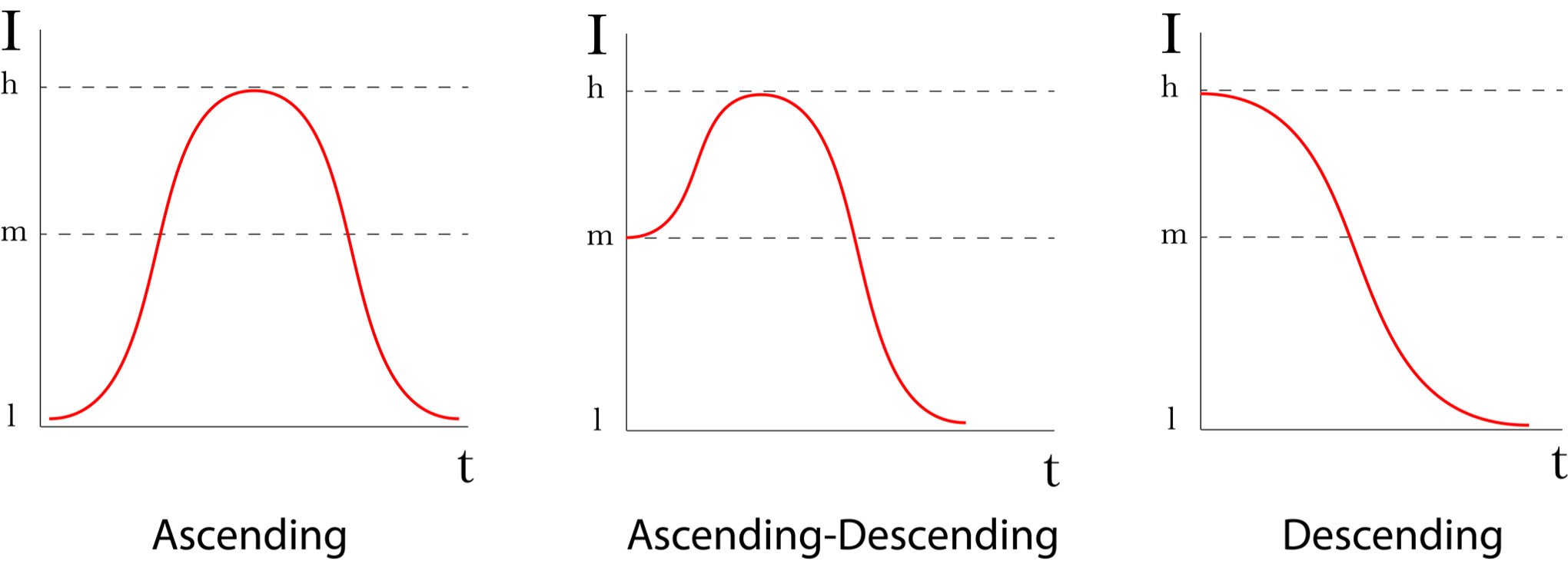
Graph 1. Three types of melodic development (seyir) and intensity in Makam modes.
An interesting common property of those melodic development curves is that their epilogue is always on the bottom of the pitch range. “What goes up must come down”—that is to say that the audience should depart with a feeling of gratification but not overexcited.
These three types describe the pitch range and direction and their (almost) one-to-one correspondence to melodic intensity and gravity. Since the character of this musical genre is heterophonic and the range of melody is limited to 1–2 octaves, melodic direction and distribution play a significant role in the organization of music phrases into a full piece. With no harmony to create vertical alternations of dissonance and consonance, music uses melodic mechanisms to generate movement: the buildup of phrases that explore small sub-octave structures, interwoven in an elegant manner (the emotional continuity through slow and gradual modulations in makam structures is an important prerequisite of the style). The slow exploration of a limited number of pitches through the seyir constitutes the backbone of music storytelling. In that limited span, the top part of the range usually signals high intensity while phrasing in the low end of the makam pitch spectrum marks the preparation for a conclusion. Although other elements such as dynamics, speed, ornamentation, dynamic pitches, and articulation play a role in the creation of melodic gravity, phasing and its direction are the main factors of melodic development.
Therefore, the choices that informed our performance were made on the basis of our position that the function of modal microtonality in makam music, with its strong affinities with Byzantine music traditions (including the dominant and celebrated ones as well as those historically and culturally obscured), greatly coincides with the affective impact of Gotis’s poems. Nonetheless, there were evident differences in the ways that we approached the performance of each poem, allowing for the liberty that is inherent in the contingent genre of makam taksim.

Distinctive Intensity Curves I: Easter at Olympia

In the case of “Easter at Olympia,” the music has a rather principal role at the beginning of the performance, and the introductory improvisation is intended to: a) introduce the soundscape of the specific makam (Huseyni) and convey the atmosphere of the first stanzas of the poem in their powerful iconography of Mediterranean springtime, which coincides with the Easter period; and b) lay the groundwork for Andrew Watson’s recitation and prepare the audience for the emotional route that the poem foregrounds. According to the analytical process described above, we identified the overall curve of the poem and generated a suitable structure of the music performed.
Then we defined a flexible sequence that, much like the seyir, would pave the way for the unfolding of the improvisation. Note in this example how the first phrase introduces the middle and low tonal part with the intention to bring Andrew Watson to the lower part of the emotional curve for the beginning of the recitation of the poem, in accordance with the ascending-descending character of Makam Huseyni (Graph 2).
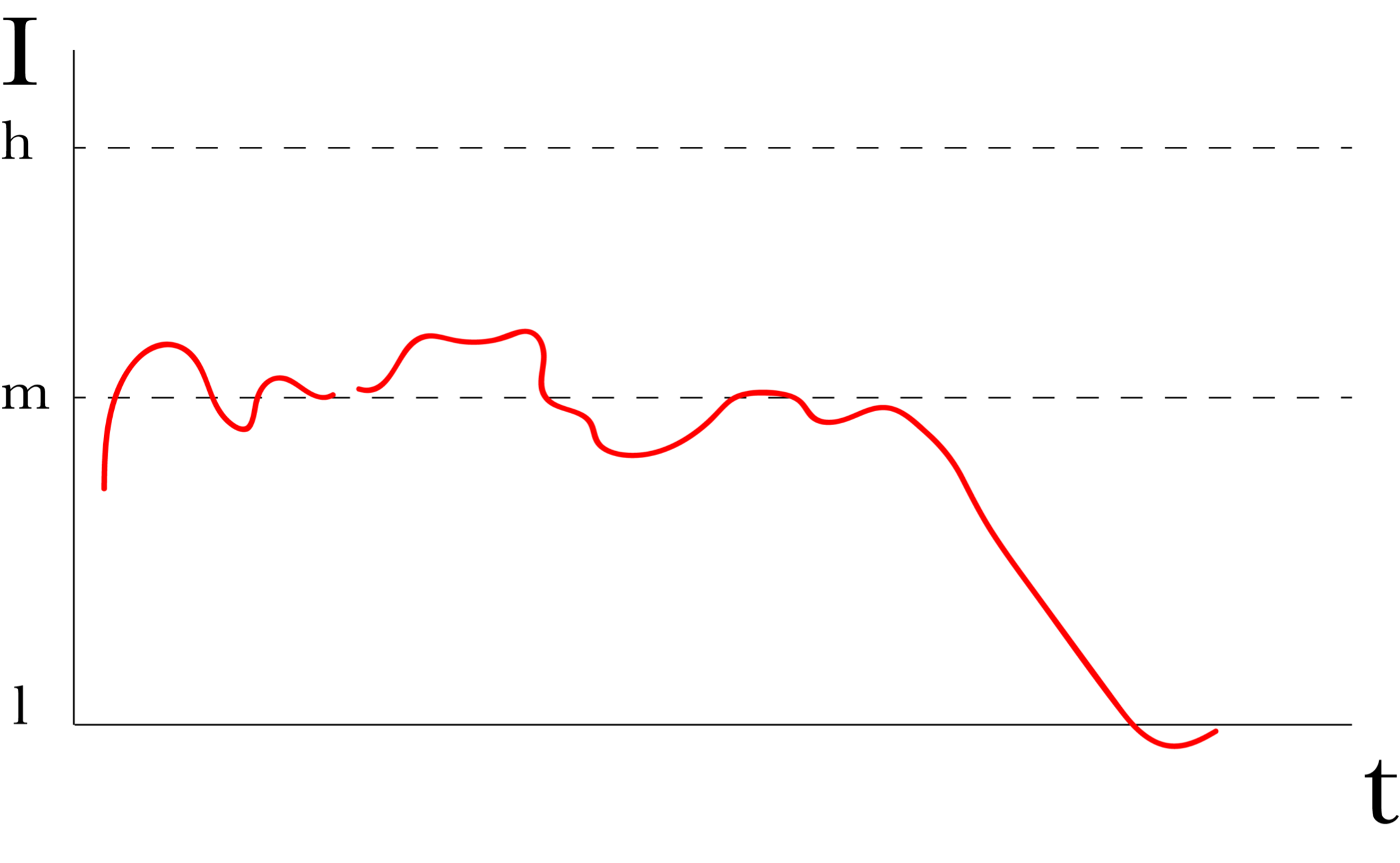
Graph 2. Introductory musical phrase for “Easter at Olympia.”

The second phrase moves the intensity to the highest part of the spectrum, in an attempt to capture the high intensity of what the performers identified as a point of great emotional and imagery concentration in this particular poem (Graph 3).
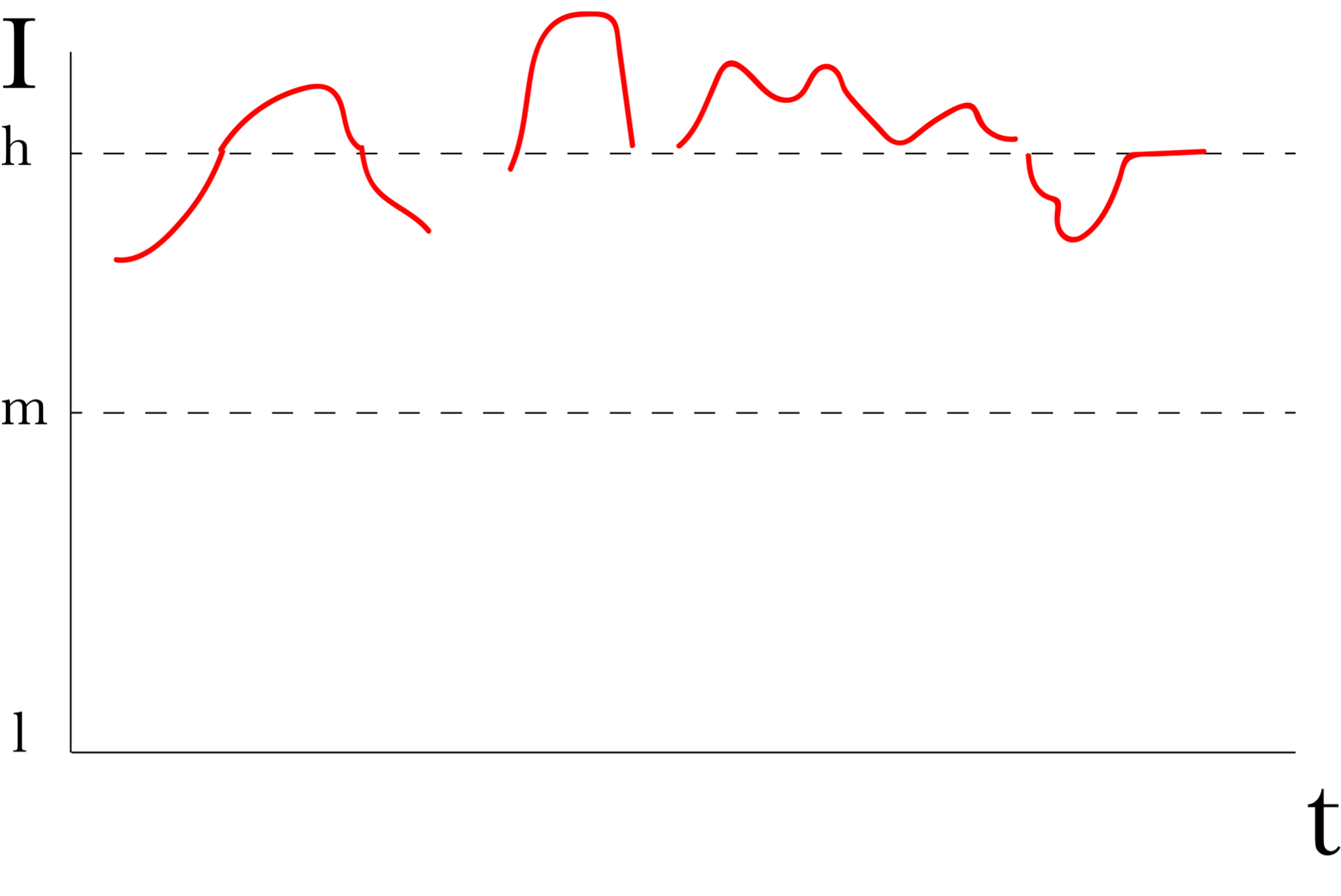
Graph 3. Second musical phrase for “Easter at Olympia.”
The second phrase is followed by an interplay between poetry and music, signifying a need for the voice and the taksim soundscape to coexist in a common aural space. The third yayli tanbur phrase is maintaining that middle level of intensity and prepares for the elevation that follows immediately after (Graph 4).
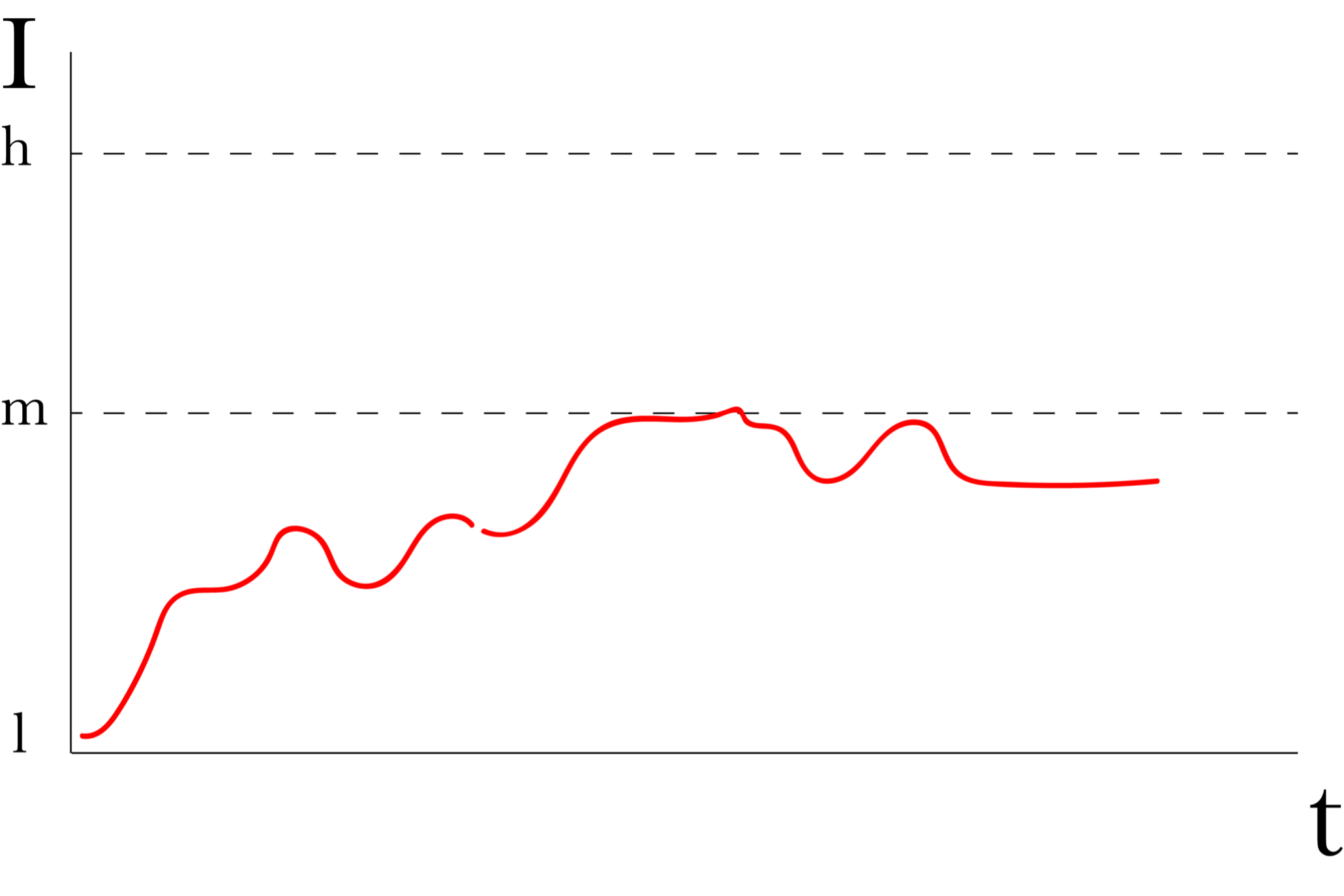
Graph 4. Third musical phrase for “Easter at Olympia.”
Here the performers try to accentuate the phrase “raise them [the gods] up onto the pediment in the sky,” so the intensity curve gradually ascends and stays up resonating with the poem’s iconography with the fourth phrase (Graph 5).
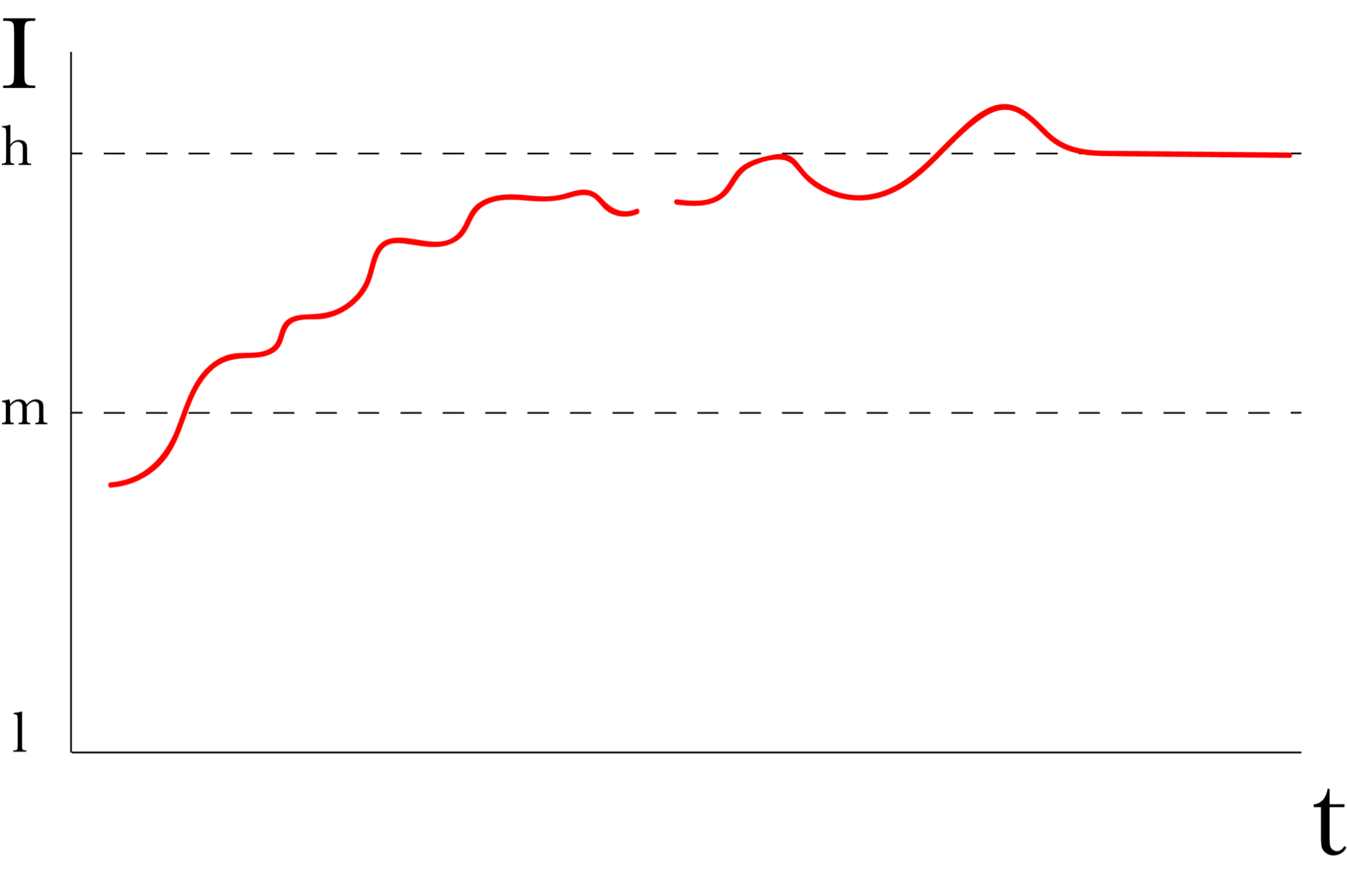
The following phrase is a half cadence on the highest part of the spectrum, sustaining the intensity from the previous one (Graph 6).
The concluding phrase is performed in order to prepare for the closing with a feeling of relaxation, even relief and regeneration, as the last stanzas imply, and therefore the music is gradually descending to the tonic, the lowest part of the intensity curve (Graph 7).
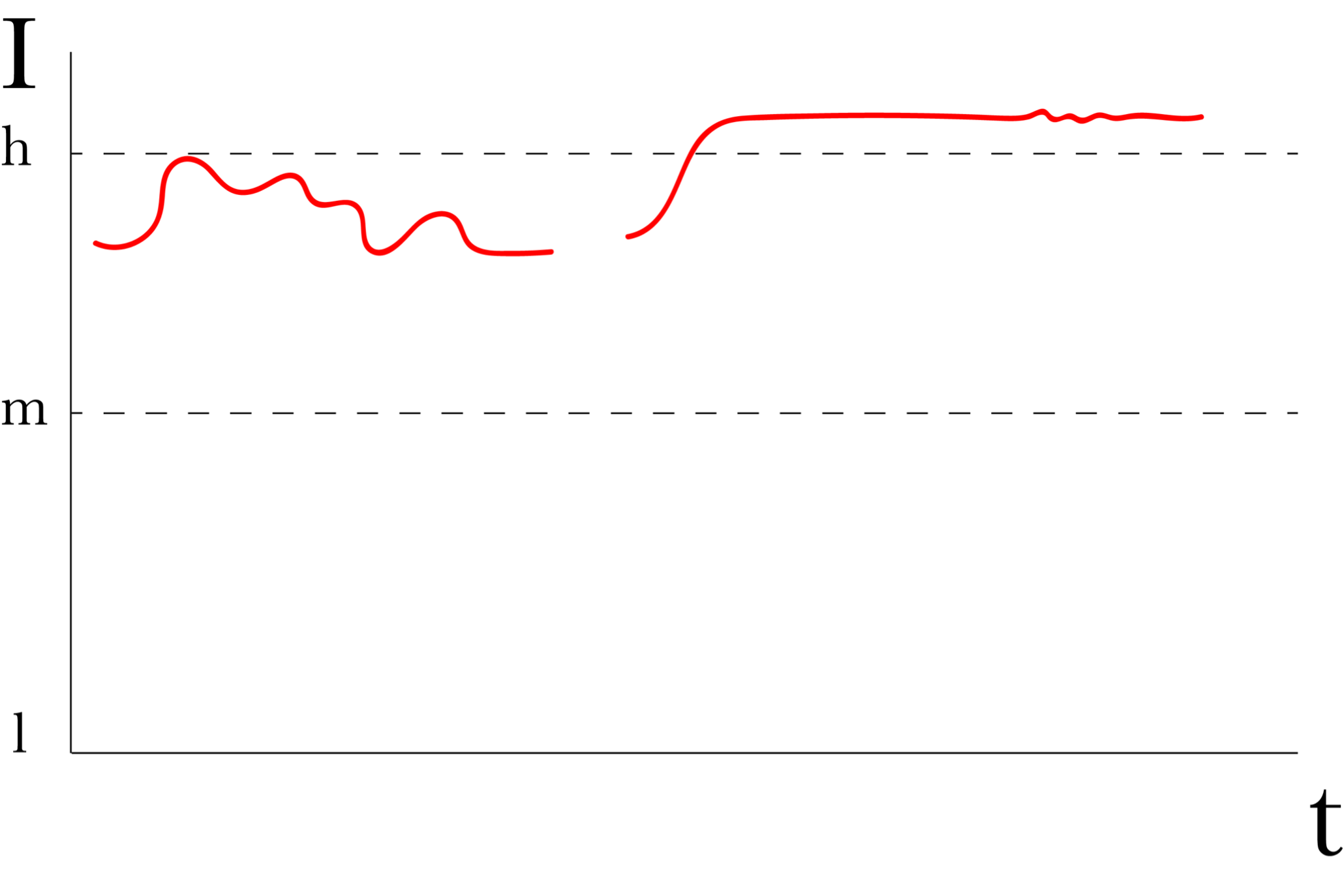
Graph 5. Fourth musical phrase for “Easter at Olympia.”
Graph 6. Fifth musical phrase for “Easter at Olympia.”
Graph 7. Concluding musical phrase for “Easter at Olympia.”

Distinctive Intensity Curves II: All Souls’ Day

In the performance of the poem “All Souls’ Day,” we have a clear antiphony between musical sound and language, which results in a dialogical form wherein one sound form enhances the content of the other in a climactic sequence. It is worth noting that the length of phrases was carefully attended to; musical phrases were large enough to introduce a certain feeling, but no larger, to avoid breaking the sense of continuity in Andrew Watson’s recitation.
In this performance the short opening musical phrase sets the tone for the verbal narration with a gentle introduction that remains in the background; the taksim stays present in the background and intensifies the experience of the listener through a gradual ascendance. In the intervals between verses or large pauses that the staged narration allows for, it is the yayli tanbur that occupies a leading role. This dialogue marks the transition from a gradual culmination towards a tranquil closure, which enfolds the completing stanzas of the poem.
In this case, Makam Segah is in Michalis’s view a bridge between the two large makam families, diatonic and chromatic, [11] which constitute two seemingly distinct families of colors. Depending on the use of its intervals it can convey the feelings of a bright music color or it can transmit the power of a dark and strong one. Moreover, its ascending character offers the possibility of a musical journey with equally ascending and descending parts. This fluctuating element and the ability of Segah’s character to function as a pontifex between distant entities resembles the connection between the living and the dead, which felt like a suitable choice for the specific theme. The route we followed for this recitation is indicated in the following graphic representations.
Specifically, the opening phrase had the intention to set a suspended mysterious feeling that leaves a lot to the listener’s imagination, introducing the main gravitational center of the section’s mood (Graph 8).
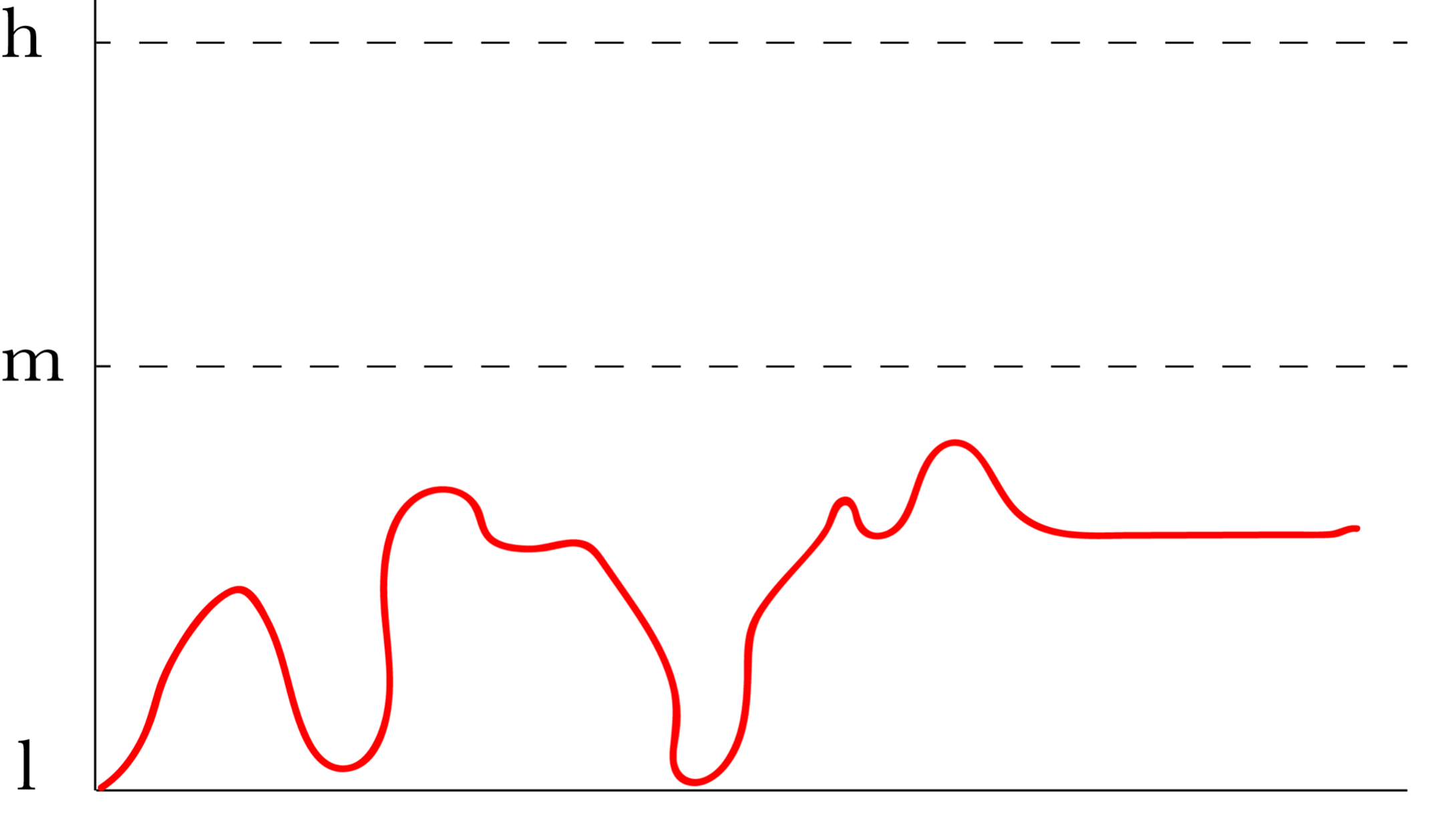
Graph 8. Opening musical phrase for “All Souls’’ Day.”
The two performers decided to keep music in a supporting role on the recitation of the first paragraph in order to keep the emotional mystifying sense of the Segah flavor and prioritize the verse.
The second phrase of the yayli tanbur (“reconciled with them”), a connection between the first and second verse of the poem, moves to the middle area of Segah, signaling a brighter color and a raise of intensity both because of higher pitch as well as due to the use of softer intervals [12] (Graph 9).
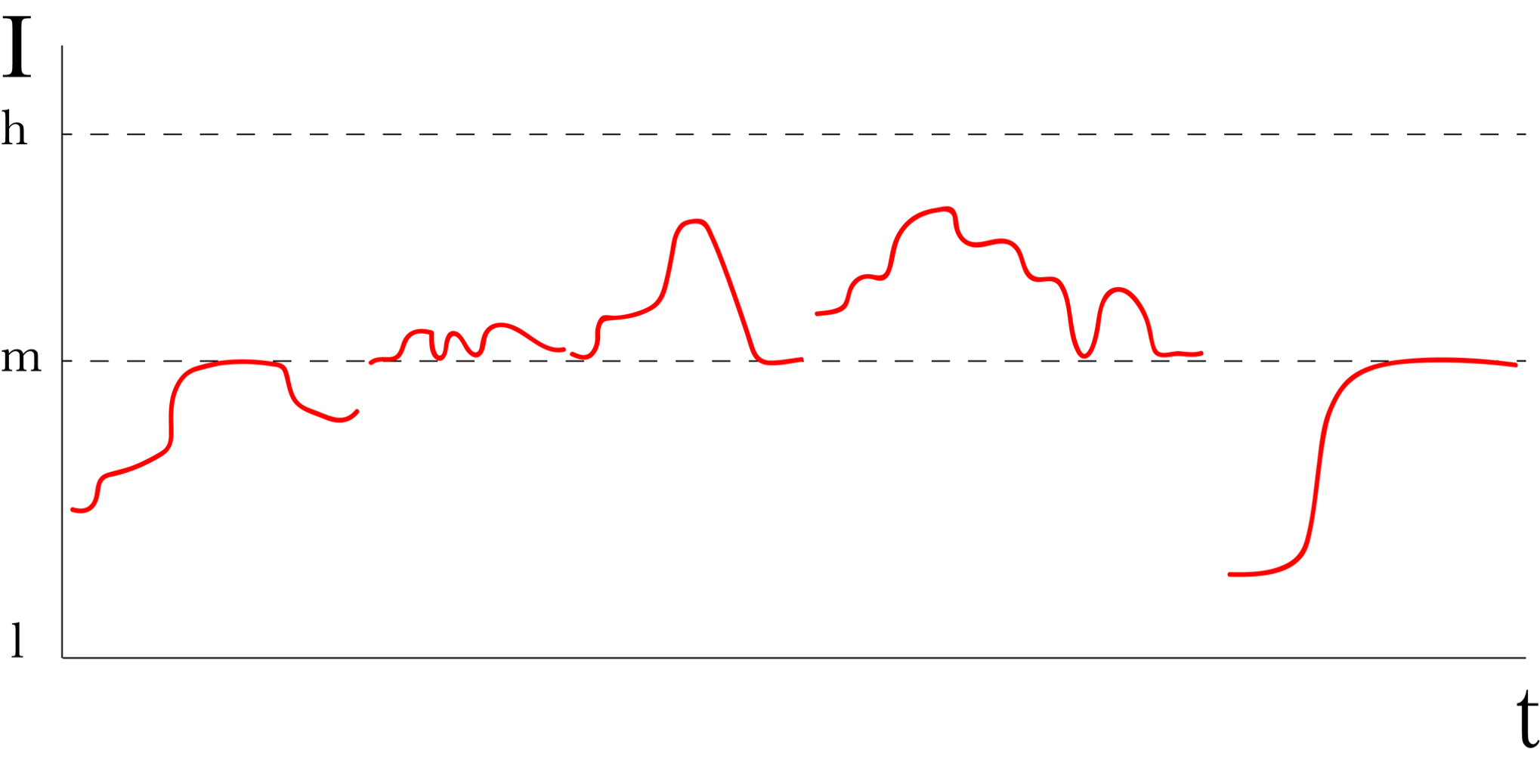
Graph 9. Second musical phrase for “All Souls’ Day.”
As in the case before the second phrase, a similar decision was made here to keep the music involved in the performance, discreetly commenting and supporting the recitation of Andrew Watson and prepare the audience for a climax (Graph 10). The line “How they endure so much life” was in the performers’ point of view the emotional peak of the poem, which was thus supported by a melodic movement on the upper part of the Segah makam spectrum, an intensification of the phrase in volume and a faster and shorter phrasing.
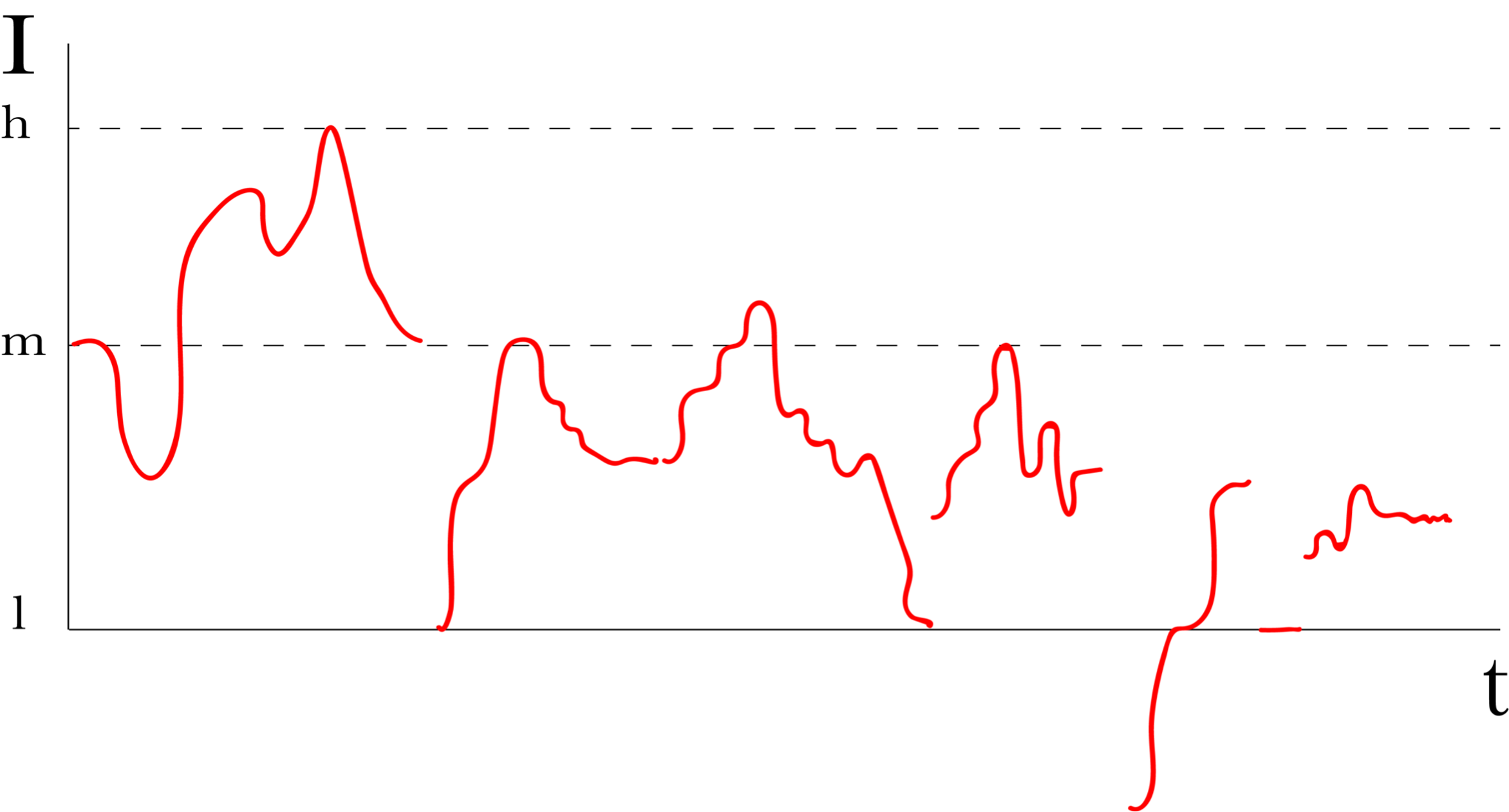
The yayli tanbur stayed involved performing on the background of the text and preparing the conclusion by descending from the upper part of the mode to the middle part. The last words recited by Andrew (“In our dream the earth, only the earth and the blackbird’s song”) signaled the final musical conclusion and the return to the base of the makam, closing the ascending form of makam’s route and fading away with the intention to leave the audience with a feeling of emotional exaltation (Graph 11).
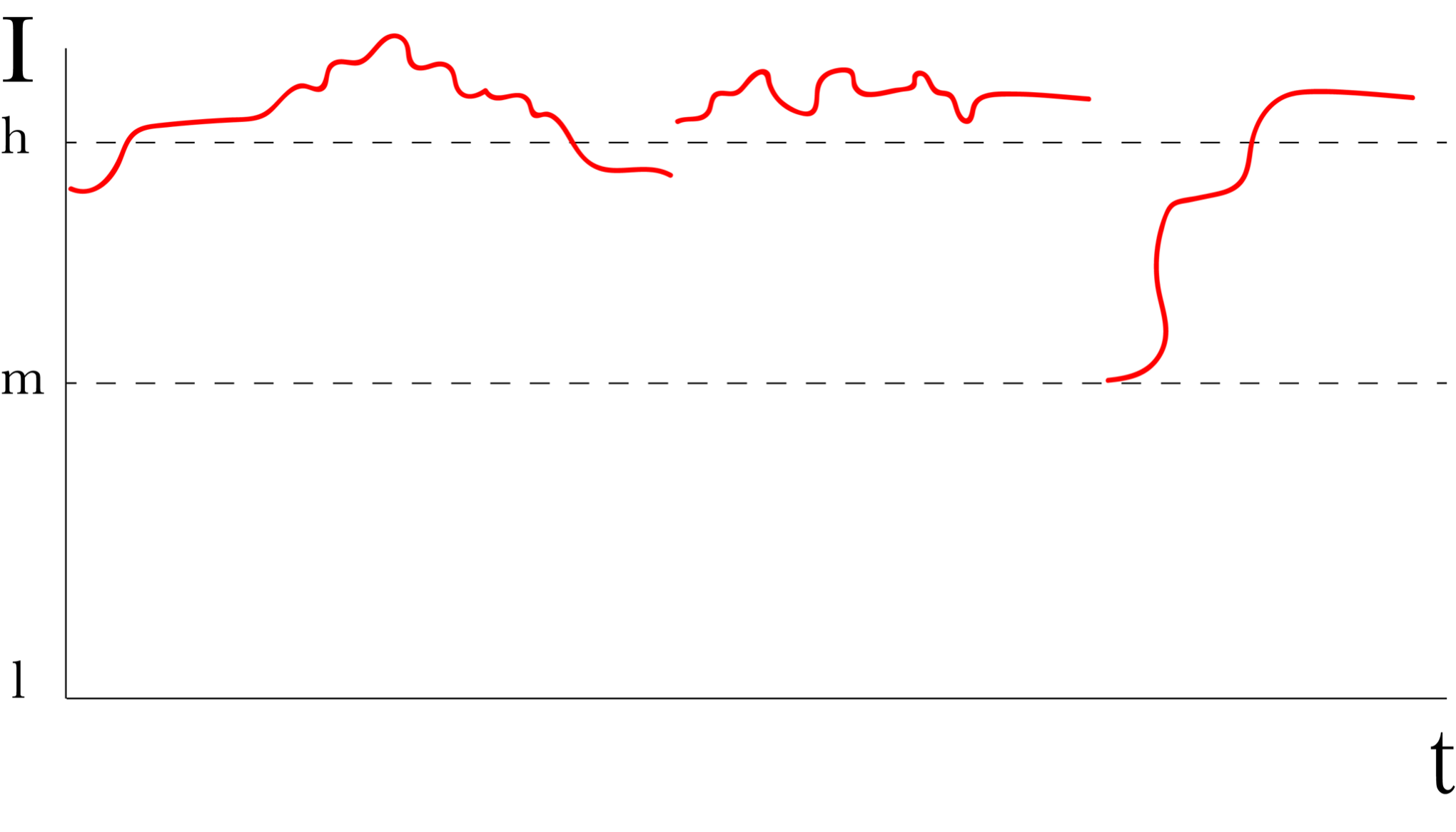
Graph 10. Third musical phrase for “All Souls’ Day.”
Graph 11. Fourth musical phrase for “All Souls’ Day.”
In comparing the performance of the two poems one may discern the differences in the choice of sound color, the decision around intervals and coexistence of recitation and music improvisation, as well a notable contrast between intensity movement. However, the preparation of both recitations was perceived by the performers as a whole, one that is marked by the unifying element of Gotis’s poetic landscape, as combined and imprinted on the soundscape of diachronic Eastern Mediterranean music dialects, which are strongly influenced by practices of improvisation, melodic and poetic combination, and a powerful appeal to the audience’s imagination.

Tracing Affinities in Performative Ways

Applying the repertoire of a practice-based makam toolbox on the poetry of Giorgos Gotis, our intention in this discussion has been to illustrate the dialogue that emerged between the two performers during preparation and make it evident “onstage” as a reciprocal exchange between two expressive forms. Building on recent research regarding the ways that emotions can be communicated via musical structure, [13] our performance was an attempt to create an environment for the emotional influence of the listeners, [14] basing our choices on the appropriate sound stimuli, [15] which we found was in this case paradigmatically animated by the instrument yayli tanbur.
Our expressive choices and the development of the performance have been informed by a genealogy of cultural elements, which we have found to be commonly evident in the poetry of Giorgos Gotis, in its forceful depiction of mundane ritual and local cosmology, and also imbued in the Makam music tradition, which sprung from the amalgam of music practices of the Eastern Mediterranean region. The work of Valiavitcharska on the Byzantine and Old Church Slavonic rhetoric rhythm has recently brought to light the profound properties of sound and rhythm, challenging the entrenched separation between content and style and emphasizing the role of rhythm as a tool of invention and a means of creating shared emotional experience. [16] Along the same lines, McGuckin has demonstrated the pivotal role of poetry and music in Christian Spirituality in Byzantium and the East Mediterranean. As he notes in reference to the Syrian style of poetic rhetoric vis-à-vis the Christian liturgical tradition in the case of Romanos the Melodist:

It was not expected that a doctrine should be “proved” by a logical linear method; rather, that it should be circled around in poetry and music, until such time as the heart of the performer and hearer had been “seduced” into an apprehension of the mysteries that were depicted in the narrative. This “entering into” the mystery could only be done by empathy and affectivity, not by will or mental effort. [17]
In an effort to retrace these deeply grounded traditions of recitation, immersion, and performance, our contribution lies on the merging of modern-day poetry with makam taksim (improvisation) performance and the forging of an analytic attitude that does justice to both the iconography and the emotional unfolding of the poems, while employing the melismatic and affective characteristics of Eastern Mediterranean musical routes. In this respect, our work marks an effort to stage an online performance by highlighting an artistic but also a cultural stance that supports the joint properties of music and poetry, as they have traversed historical time and geographical space in what is broadly seen as one of the multiple renderings of Byzantine tropes. By prioritizing the emotive characteristics of the seyir, and combining the intensity curves with poetic narration, we have sought to performatively demonstrate that Eastern Mediterranean music is not necessarily determined by ideological and geopolitical historical constructions that remain mutually exclusive (such as Ottoman Empire, Byzantium, Arabic world) but might well be construed as a melodic and affective “promenade” that maintains to this day affinities with multiple traditions and historical eras.

Bibliography

Annand, D. 2011. “Social Presence Within the Community of Inquiry Framework.” International Review of Research in Open and Distributed Learning 12:40–56.
Cholevas, M. 2014. “Makam: Modality and Style in Turkish Art Music.” In Mikrotonalität — Praxis und Utopie, ed. C. Pätzold, and C. J. Walter, 197–203. Stuttgart.
Danforth, L. M. 1982. The Death Rituals of Rural Greece. Princeton.
Delaney, C. 1991. The Seed and the Soil: Gender and Cosmology in Turkish Village Society. Berkeley.
Du Boulay, J. 2009. Cosmos, Life, and Liturgy in a Greek Orthodox Village. Limni, Greece.
Dubisch, J. 1983. “Greek Women: Sacred or Profane.” Journal of Modern Greek Studies 11:185–202.
———. 1989. “Death and Social Change in Greece.” Anthropological Quarterly 62:189–200.
Eerola, T., and J. K. Vuoskoski. 2012. “A Review of Music and Emotion Studies: Approaches, Emotion Models, and Stimuli.” Music Perception: An Interdisciplinary Journal 30:307–340.
Feldman, W. 1996. Music of the Ottoman Court: Makam, Composition and the Early Ottoman Instrumental Repertoire. Vol. 10. Berlin.
Håland, E. J. 2014. Rituals of Death and Dying in Modern and Ancient Greece: Writing History from a Female Perspective. Newcastle upon Tyne.
Jones, G., D. Kokotsaki, and M. Cholevas. 2016. “Creative Music Listening: Its Potential in Generating Emotion and Acting as a Stimulus for Creative Writing.” Presented at the 32nd World Conference International Society for Music Education. Glasgow, 25-29 July, 2019.
Juslin, P. N., and J. Sloboda, eds. 2011. Handbook of Music and Emotion: Theory, Research, Applications. Oxford.
Karadeniz, I. 2019. “Makam-Oriented Symbolism in Batanay’s Nikriz Mevlevi Ayini.” Art-Sanat 12:243–268.
Kartomi, M. 2014. “Concepts, Terminology and Methodology in Music Performativity Research.” Musicology Australia 36:189–208.
McGuckin, J. A. 2005. “Christian Spirituality in Byzantium and the East (600–1700).” In The Blackwell Companion to Christian Spirituality, ed. A. Holder, 90–105. Oxford.
Öztürk, O. M. 2018a. “The Concept of Makam-Based Melody and its Problematic in Musical Analysis.” In Turkic Soundscapes: From Shamanic Voices to Hip-Hop, ed. R. Sultanova and M. Rancier, 28–50. London.
———. 2018b. “How Was the Traditional Makam Theory Westernized for the Sake of Modernization?” Rast Musicology Journal 6:1769–1787.
Roussou, E. 2017. “The Syncretic Religious Landscape of Contemporary Greece and Portugal: A Comparative Approach on Creativity through Spiritual Synthesis.” In Invention of Tradition and Syncretism in Contemporary Religions, ed. S. Palmisano and N. Pannofino, 155–175. London.
Stubbs, F. W. 1994. The Art and Science of Taksim: An Empirical Analysis of Traditional Improvisation from 20th Century Istanbul. PhD diss., Wesleyan University.
Shaw, R., and C. Stewart. 2003. Syncretism/Anti-syncretism: The Politics of Religious Synthesis. London.
Valiavitcharska, V. 2013. Rhetoric and Rhythm in Byzantium: The Sound of Persuasion. Cambridge.

Footnotes

[ back ] 1. For an ethnography of ritual practices in the lived everyday context of Greek Orthodoxy, see Dubisch 1983, 1988.
[ back ] 2. Our interpretation heavily rests on the syncretic character of Greek orthodox religion, as has been broadly discussed by ethnographers of the region. See more Shaw and Stewart 2003; Roussou 2017.
[ back ] 3. Cf. Danforth 1982; Du Boulay 2009; Håland 2014.
See Karadeniz 2019.
[ back ] 5. Taking into account the technical limitations of a live zoom recording (such as the automatic prioritization of the louder sound over the rest of the speakers, the over-compression of the sound and its consequence on the limitation of dynamic range, and the delay between the two performers’ interaction), it is also worth noting that there was a process that followed the live online performance, during which Michalis Cholevas recorded a mixed stereo channel and later edited to clean up the sound and add depth (reverb) and equalization to the performance.
[ back ] 6. See Annand 2011.
[ back ] 7. Kartomi 2014:90.
[ back ] 8. Delaney 1991.
[ back ] 9. Öztürk 2018b:1776–1777; Feldman 1996:272; Stubbs 1994:117.
[ back ] 10. See more: Öztürk 2018a.
[ back ] 11. Cholevas 2014.
[ back ] 12. Cholevas 2014.
[ back ] 13. Juslin and Sloboda 2011.
[ back ] 14. Jones, Kokotsaki, and Cholevas 2016.
[ back ] 15. Eerola and Vuoskoski 2012.
[ back ] 16. See Valiavitcharska 2013.
[ back ] 17. See McGuckin 2005:93.