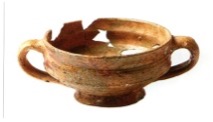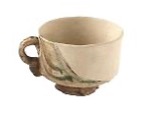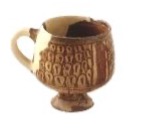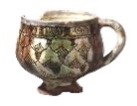
The Unbearable Brokenness of Artifacts: Dining Utensils as Social Markers of Performance in the Byzantine World (ca. seventh-fifteenth centuries)

  Vroom, Joanita. 2025 “The Unbearable Brokenness of Artifacts: Dining Utensils as Social Markers of Performance in the Byzantine World (ca. seventh-fifteenth centuries).” In “Performance and Performativity in Late Antiquity and Byzantium,” ed. Niki Tsironi, special issue, Classics@ 24. https://nrs.harvard.edu/URN-3:HLNC.ESSAY:104135620.


Introduction

Until recently, Byzantine archaeologists were not in the habit of paying much attention to the relation between artifacts they would find during excavations, and actual uses of those utensils in dining practices or other forms of social performances. These were considered to be subjects discussed by sociologists and anthropologists. And indeed, much study on performance, dining rituals, and social distinction in the past and present has been done by eminent anthropologists and sociologists such as Erving Goffman, Jack Goody, and Pierre Bourdieu. [1] Still, archaeologists may learn from their work that there is more to be said about excavated broken pottery than meets the typo-chronological eye, for example, that there are certain general aspects to be found in the relation between artifacts, performance, and foodways in a society.
The ethnographer Richard Bauman was, for instance, quite right to suggest that “performance is a special artful mode of communication” which contains information about a wider sociocultural situation. [2] Richard Schechner, in turn, has shed light on the problem of what performance is, what can be seen “as” performance, and what are “indicators” for performance. He concluded that an act by humans is a performance when historical and social context, convention, use, and tradition define it as performance. [3] So, just about anything may be a performance and can be studied as such, among which foodways and all that is associated with them (for instance, culinary codes and eating protocols). [4]
Indeed, the consumption of food has always been charged with meaning, and thus has always been performative and dramatic. The foodways of common people are interesting enough, and constitute performances in their own right, but the higher one looks up the social ladder, the more complex and conspicuous the performance of consumption becomes. In almost any society feasting and eating sumptuously were important features of court performance, and banquets at a court could be transformed into entertainment but also into a theatrical if not intimidating show-off of power. [5]
This was also the case with the Byzantine court or its equivalent “the palace” (to palation) in Constantinople (present-day Istanbul). As the political, social, and cultural center of gravity of the Byzantine Empire, “the palace” was concerned with the performance of the Emperor’s power, on every macro- and micro-level, including the display of culinary riches and the consumption of spectacular food. [6] For Byzantine archaeologists, this puts the question on the table of how to relate their finds of broken pieces of ceramic artifacts to the historical context and social meaning of performance and dining habits of the Byzantine court.
This is not an easy question, as it is hard enough for archaeologists to diagnose and date those broken artifacts in the first place. Still, this article is an attempt to understand the performance aspect of Byzantine pottery, although I must admit that I will use for my argumentation excavated vessels that have survived more or less complete. Firstly, I will discuss Byzantine banquets in general, followed by a first overview of excavated ceramic finds from Constantinopolitan palaces. Subsequently, I will use pictorial evidence of dining scenes to illuminate the changing uses of table utensils, which are reflected in the changes of shapes, sizes, and capacities of pottery finds in Byzantine palaces from Early Byzantine to Late Byzantine times (ca. 600–1450).

Conspicuous consumption: Byzantine banquets

Although not much is known about the daily diet of common people in the Byzantine world, the wining and dining of the upper classes is quite another matter. Banquets and receptions played a central role in political and sociocultural rituals, both in majestic palaces and in aristocratic households. At the imperial palaces in Constantinople, these events functioned not only as a display of social hierarchy, but also carried a propagandistic message of the Emperor’s extraordinary power and extravagant wealth meant to impress foreign visitors. [7] Three written documents in particular report in detail on these court performances in the various reception and dining halls at Constantinople.

The first manuscript is the tenth-century ceremonial text De Cerimoniis or “Book of Ceremonies,” compiled by the Byzantine Emperor Constantine VII (913–959). It describes a renewal of court ceremonial and offers a vivid picture of how the physical space of the Great Palace was experienced in court ceremonies, by meticulously describing processions, receptions, and banquets. [8] The second text is the Kletorologion or “Banquet Book” written by Philotheus and dated to 899, [9] and the third one is the much later Palaeologan treatise by “Pseudo-Kodinos” dating from the mid-fourteenth century. [10] The first two documents mention various reception and dining halls in the Great Palace at Constantinople, such as the Chrysotriklinos, the Ioustinanos, “the great Triklinos of the Magnaura,” and “the Triklinios of the 19 couches.” This last hall offered for instance space to approximately 229 guests with the Emperor dining at the imperial high table in the apse (Figure 1, upper left; cf. Table 1 for the locations of these halls). [11]
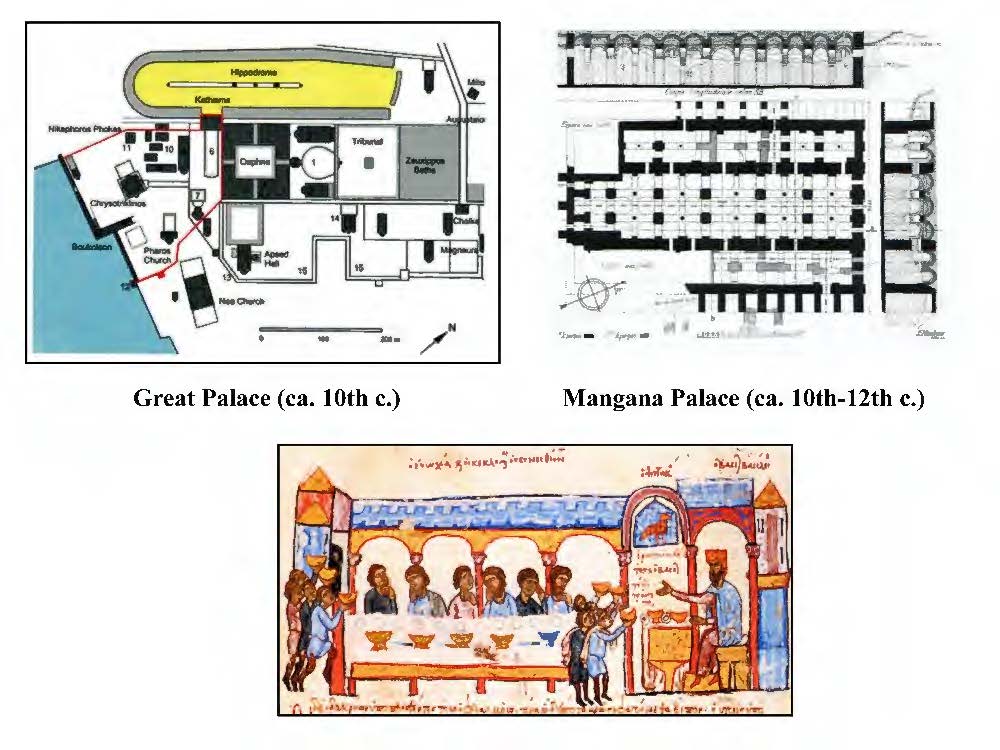
Figure 1. Upper left: Reconstruction of the tenth-century remains of the Great Palace at Constantinople (after Berger 2013:fig. 5); Upper right: map of excavated ruins of the Mangana Palace (ca. tenth-twelfth centuries) at Constantinople (after Demangel and Mamboury 1939); Lower register: twelfth-century miniature from the Skylitzes Manuscript (after Tsamakda 2002:fig. 237).
Part of the Great Palace Dining seats Dining tables Dining utensils Adornments Other Purposes
Chrysotriklinos (lower terrace) Throne(s); a golden chair (sellion) on its left side; a chair (sellion) covered in purple silk on its right side; golden couches Separate table for Emperor; golden table; tables Golden platters; large silver serving bowls in repoussé; small bowls in repoussé; golden bowls with precious stones Golden curtains; bright-purple curtains (with griffins and asses); hangings Kitchens; silver organs; silver polykandela; floor strewn with myrtle, rosemary and roses Throne room; audience hall; promotions of imperial officials; banquets; everyday procession
Ioustinianos (lower terrace) Throne; golden sellion; benches Separate table for Emperor; tables Hand basins in repoussé; silver plate Curtains Two silver organs; hand towels; perfumed waters and oils; polykandela Reception hall banquets; lunch
Aristeterion (lower terrace) Small golden table Enammelled bowls encrusted with precious stones Dessert Breakfast room
Triklinos of the 19 Couches (upper terrace) Reclining on couches; mattresses Round side table Curtains Organ; cymbals; saximon Large banquet hall; funerals; promotion of ‘Caesar’; Christmas festivities; still functioning ca. 1040
Magnaura (upper terrace) Throne of Solomon; golden portable seats (sellia) Silver works/objects in repoussé; golden and enammelled objects Embroidered curtains; Persian covers Golden organ; silver organs; silver polykandela; floor sprinkled with rose-water Throne room; state receptions; banquets
Kathisma in Hippodrome (upper terrace) Carpets; curtains Dining hall; bed chamber; races/games functioning until end of 12th c.
Table 1. Parts of the Great Palace with dining furniture, utensils, and other adornments, as mentioned in the De Ceremoniis concerning receptions and banquets (after Vogt 1935; Featherstone 2007:80-112).
These texts suggest that long rectangular tables for dinner guests and gender-segregated dining were introduced in these halls during Middle Byzantine times, and that the previously used open sigma-shaped couches for reclining were by then gradually replaced by chairs and benches for upright sitting at the tables. Exceptions were certain imperial banquets at which traditional “Roman” practices were followed, including the habit of reclined dining. [12] Furthermore, depictions of festive meals in Byzantine palaces, among which miniatures in the twelfth-century Chronicle of John Skylitzes in the Biblioteca Nacional in Madrid, provide additional iconographical information on the implementation of imperial banquets in this period (Figure 1, lower register). [13]
From an archaeological perspective, the performance of Byzantine banquets can be relevant in the study of the layout of excavated structures of the Constantinopolitan palaces and their dining halls in present-day Istanbul (Figure 1, upper register, shows for example plans of the Great Palace and the Mangana Palace during Middle Byzantine times). [14] Seemingly, food was served in these halls with combinations of ingredients (fish together with meat) which contemporary westerners considered “unnatural” (although today we would welcome these as “surf-and-turf” options). The opulent meals were accompanied by music, songs, dances, and entertainment acts showing “marvelous tricks” (among which acrobatics). [15]
Apart from these aspects of conspicuous consumption, the written sources describe the internal design of these banquet halls, which included portable chairs (sellia) and couches, separate tables, embroidered curtains and carpets, hanging lamps (polykandela), music instruments (including hydraulic organs and cymbals), and specifically mention the sprinkling of floors with myrtle, rosemary, and rose-water. [16] The texts also refer to golden and enameled objects that were used during banquets at the Great Palace, as well as to silver bowls in repoussé and vessels encrusted with precious stones (Table 1). [17] Apparently, during military campaigns the Byzantine Emperor even dined with four solid golden utensils (skoutellia), two solid golden wine cups (minsourakia), and two solid golden vessels (orthomillia) on festive occasions. [18]

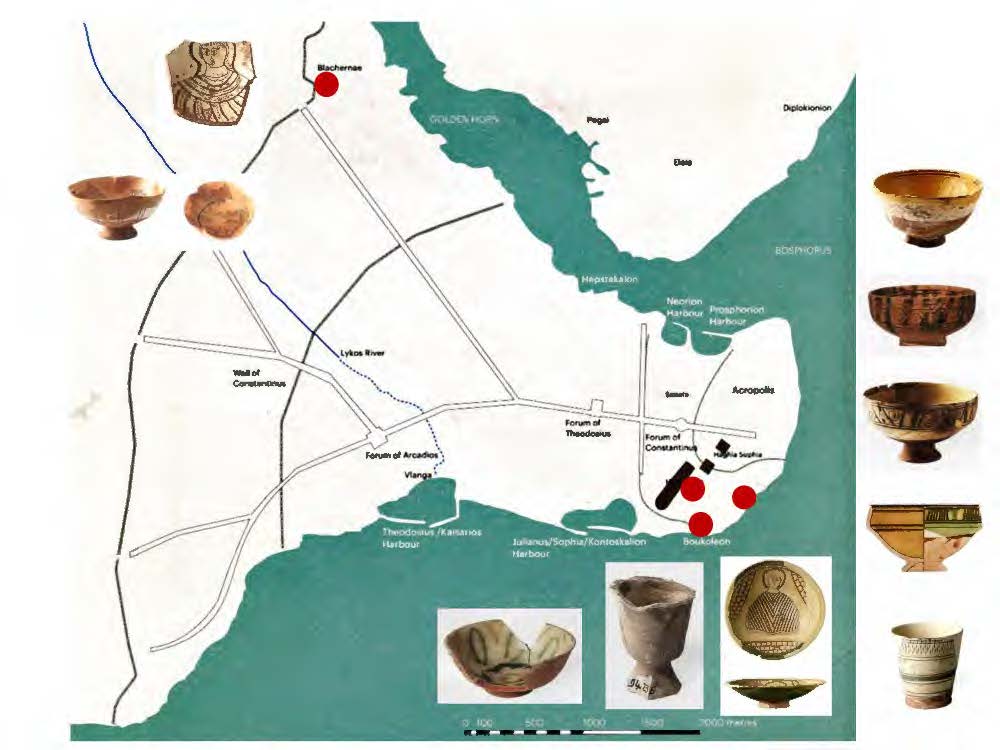
To get some sort of an idea of how these priceless objects must have been used as part of the performance during tenth-/eleventh-century banquets and religious ceremonies at Constantinople, one could nowadays pay a visit to the San Marco Treasury at Venice or the Kunsthistorisches Museum at Vienna and gaze at the Byzantine artifacts on display, a glittering collection of objects made of glass or sardonyx, enriched with gold cloisonné enamel, precious stones, and stunning rock crystal. [19] Other Middle Byzantine food-related artifacts kept in the San Marco treasury at Venice, among which prestigious chalices and dishes (paten) made of alabaster, sardonyx, and Islamic glass, also point in the same direction of dining as dazzling performance. [20] Especially in the three main imperial places at Constantinople (the Great Palace, the fortified Boukoleon Palace, and the semi-suburban Blachernae Palace), [21] such imposing vessels would have been used as social markers or even as some sort of stage props during banquets, receptions, and ceremonies (Figure 2). However, here the focus is not so much on these precious objects made of high-status materials, but rather on the more mundane ceramic artifacts found in the excavated remains of these Byzantine palaces in the imperial capital (Table 2). [22]
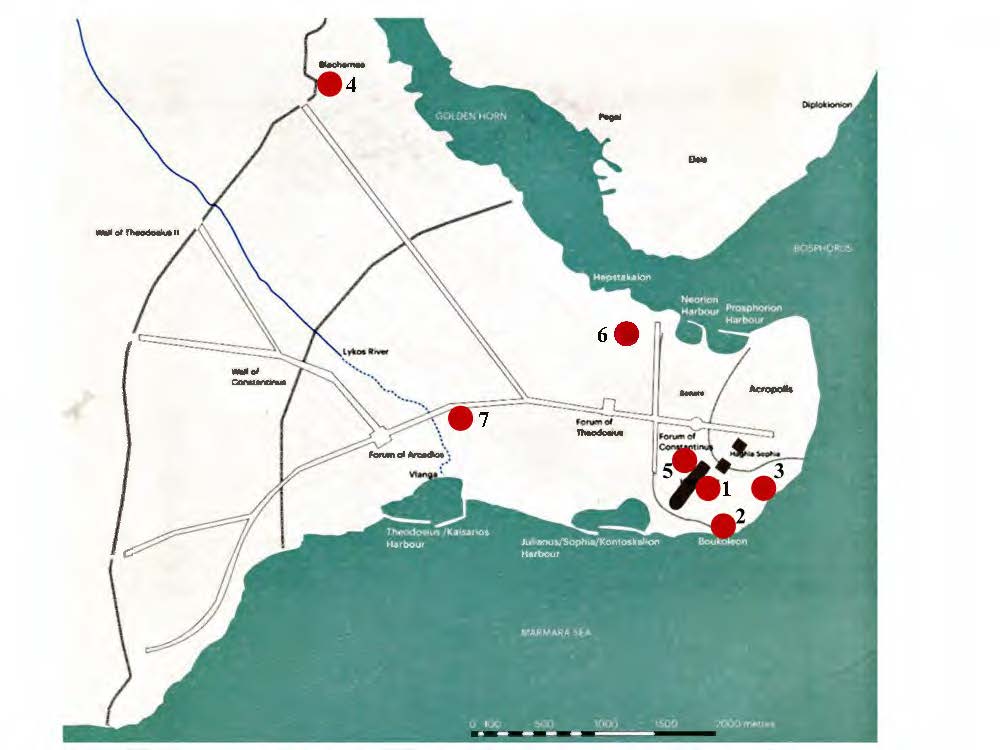
Figure 2. Distribution map with locations of palaces in Constantinople (present-day Istanbul): no. 1, Great Palace; no. 2, Boukoleon Palace; no. 3, Mangana Palace; no. 4, Blachernae palace; no. 5, Palace of Antiokhos; no. 6, Palace of Botaneiates; no. 7, Myrelaion Palace (map after Magdalino 2013:13).
Excavated context MBYZ shape LBYZ shape Ancient names MBYZ/LBYZ names Description
Great Palace (1936–1937) acetabulum
scutula
paropsis
skoutellion
missouraklion
triaflion
Small bowl; made of gold, silver, clay and glass
Former Sultanahmet Prison (2000, 2001) patina
phiale
patera
pinakion
pinaskous
missourion?
Shallow dish or plate; could also be made of gold, silver with relief decoration or Arab script; to serve food and to eat from
Great Palace (1936–1937) gabata gabadion
gavathai
lekanion?
Broad, deep serving vessel/bowl; deepest ones were used for meat
Former Sultanahmet Prison (2001) gararium saltsarion
gararion
Portable chafing dish
Great Palace (1936–1937) /
Former Sultanahmet Prison (2001)
poculum potirion
krion
kupellon
Beaker, chalice; could also be made of metal or emerald
Former Sultanahmet Prison (2000) skyphos
calix
kylix
kaukion
kakos
skyphion
Drinking vessel for wine; made of clay, wood or stone
Great Palace (1936–1937) calathus
modiolus
modiolos
kerastikon
Small cup/mug with straight wall; made of gold, silver, glass, clay, wood, alabaster
Former Sultanahmet Prison (2001) koupa
koupaki
Cup with convex wall
Former Sultanahmet Prison (2003)/
Great Palace (1958)
kandela
lichnari
Lamp
Table 2. Shapes and potential names of Middle Byzantine and Late Byzantine tableware vessels and lighting devices found in excavated contexts of the Great Palace at Constantinople (after Koukoules 1952, vol. 5, ch. 2; Stevenson 1947; Talbot Rice 1958; Denker 2011).

Deep fakes and cheap fakes: Pottery as social imitation

The first thing to note about Middle Byzantine tableware (made of clay) is that many of these were ceramic imitations of the shapes and decoration styles of Middle Byzantine gilded glass and silver vessels. [23] The ceramic utensils were the embodiment of what is known as the trickle-down effect, the process by which the fads and fashions of the rich flow vertically from the upper classes in ever cheaper forms to the lower ones within a society. [24] Among the Byzantine upper classes, ceramic tableware was generally considered of lower quality (and status) than a golden or silver vessel. [25] However, if a household could not afford to have silverware on the table, it was possible to opt for similar-looking vessels made of earthenware. This was also a cost-effective solution for parts of a palace or aristocratic house which were not in view of outside eyes. In fact, ceramic vessels were a relatively cheap commodity and used at all social levels during Byzantine times.

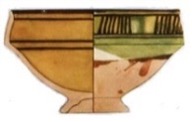
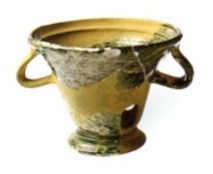
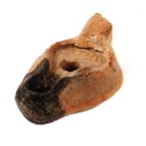
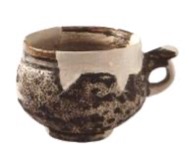
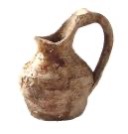
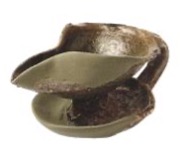
Among the ceramic finds excavated at Constantinople dating from the Early Byzantine era (ca. the seventh to early ninth centuries), of particular interest are in this respect unglazed domestic utensils for food preparation (such as cooking pots and mortaria) which are part of pottery assemblages retrieved from two palaces in the heart of the city: the Palace of Antiokhos and the Great Palace (Figure 3). [26] The last one also yielded locally made glazed dishes, bowls, and a double-handled pot of so-called Glazed White Ware I, the first glazed product par excellence made in Constantinople (Figure 3). [27] Initially, Glazed White Ware I was merely imitating the shape of cooking pots, but eventually became more and more decorated with petal applications and simple incised motifs for use on the table. [28]
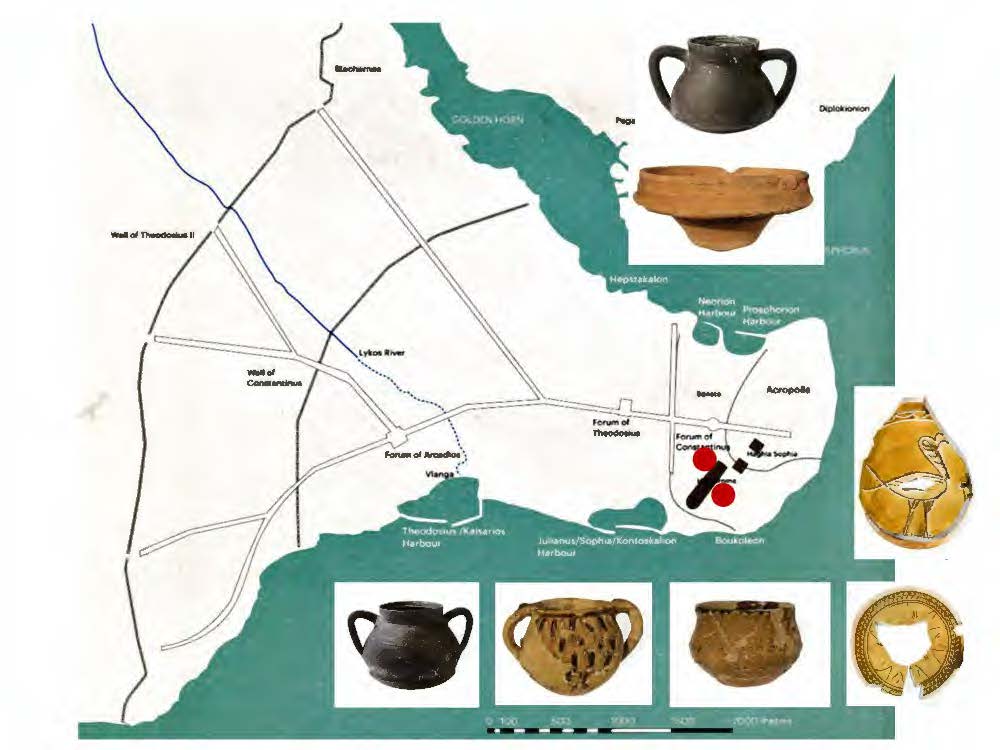
Figure 3. Excavated pottery finds from Constantinopolitan palaces, ca. seventh – eighth/early ninth centuries (images after Stevenson 1947; Denker 2011).

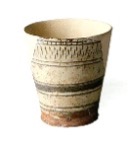
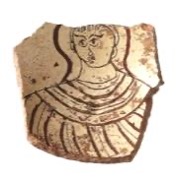
Ceramic finds of the Middle Byzantine era (ca. ninth to eleventh centuries) from four excavated palaces at Constantinople show, on the other hand, a larger amount and a wider variety of glazed tableware shapes (mostly of the Glazed White Ware II and Polychrome Ware repertoire with elaborate incised or painted motifs), which were probably used on or next to the table (Figure 4). [29]
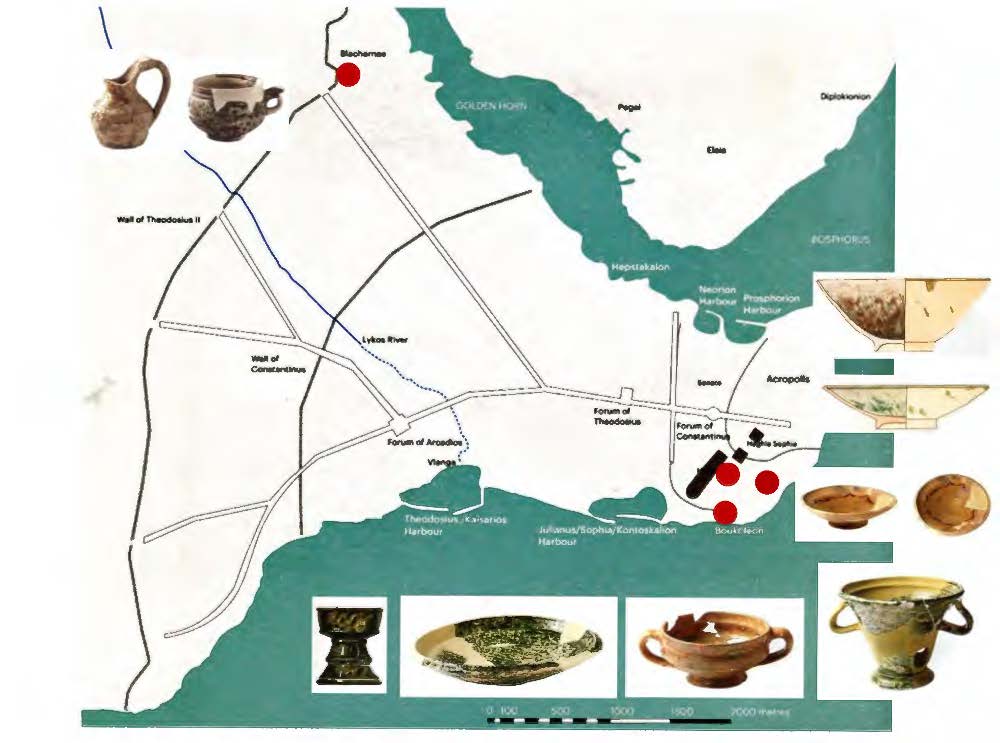
Figure 4. Excavated pottery finds from Constantinopolitan palaces, ca. ninth–eleventh centuries (images after Stevenson 1947; Denker 2011).

These finds included large dishes, broad shallow bowls, and wide-rimmed drinking vessels, as well as chalices, cups, and chafing dishes. [30] It is clear that the practice of using decorated glazed pottery for table purposes—even in the imperial palaces—became more widespread in this period. From the perspective of dining habits, however, not only the decoration is significant, but in particular the increase of large, open, and shallow forms. The archaeological record, which thus shows a change in the pottery repertoire towards large dishes and shallow bowls, raises all sorts of questions concerning their actual use and changes in dining practices.

Pictorial evidence: Eating with hands at the Last Supper

From the perspective of material culture, the increase of large open forms in the Middle Byzantine pottery finds from palaces at Constantinople clearly suggests that the dishes and bowls were meant for communal dining rather than for individual dining. [31] This seems to be confirmed when we compare these actual finds with the depiction of dining scenes on Middle Byzantine miniatures, which show without exception just one large plate placed centrally on the table (Figure 5). [32]
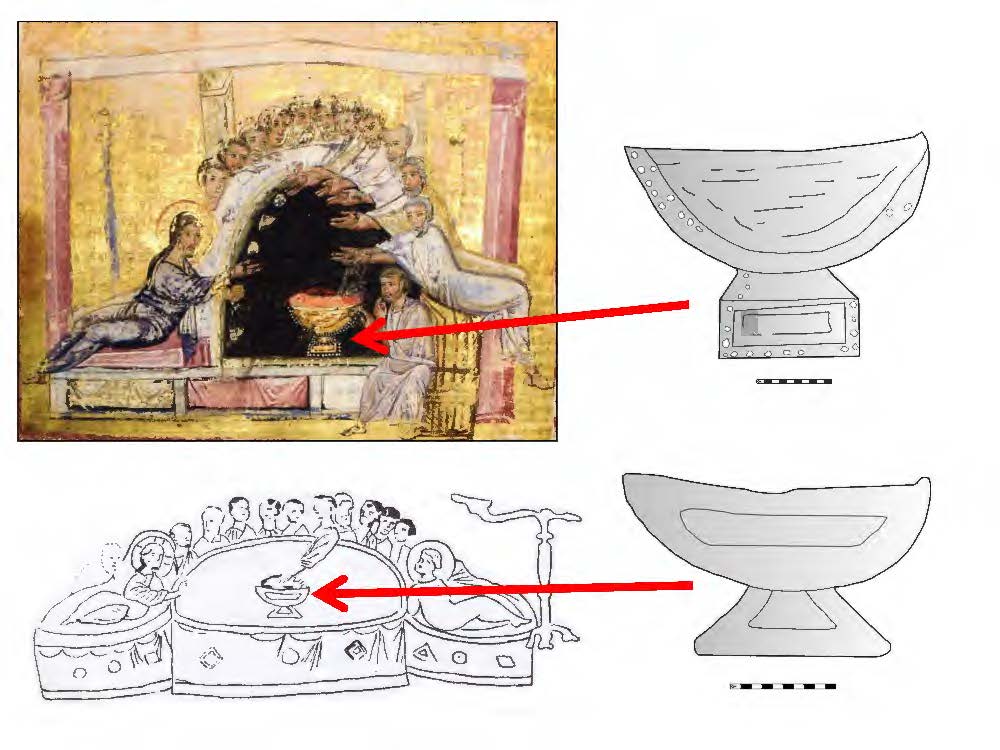
Figure 5. Upper left: miniature, Bibl. Publica Petropol.Gr. 21 Lectionary, St. Petersburg, ninth century (image after Vroom 2003:fig. 11.10). Lower left: miniature, British Libr. Add.19352 Theodore Ps. (fol. 50v), London, ca. 1066 CE (image after Vroom 2003:fig. 11.13).

This dish was apparently used communally for the main course by the diners, who were partly reclining or partly sitting around a semicircular table. By then, some guests are reclining on coaches, which was a dining custom deriving from Late Antiquity and in Byzantine times a mark of high status. This dining position was certainly a privilege for guests of honor, which would be seated in special places—often in the right and left corners of the table. [33] Evidently, there were no knives, spoons, or forks on the table, which implies that all guests used only their fingers to eat directly from the shared central plate or bowl. This also makes sense: using one hand only while dining would be more convenient in a reclining position at the table.

It has to be noted that most Middle Byzantine miniatures with dining scenes are depictions of the Biblical Last Supper. This means that the depicted dishes and table setting may have some sort of symbolic meaning, although it seems safe to assume that to a considerable degree the miniaturists will have taken the context of their daily life and the dining scenes they were familiar with as inspiration. In the end, it seems quite certain that the study of Last Supper scenes can certainly offer information on long-term changes in the depicted tableware and other dining utensils, and thus also on long-term changes in eating habits and foodways. [34]

In fact, other dining scenes on miniatures in eleventh-century Byzantine manuscripts, which do not depict the Last Supper, but for example scenes such as “the feast of Herod” or “Jesus sitting in the House of Simon the Leper,” show each and every time the same pattern of diners reclining and sitting around a large, oval table with one (ostensibly) communal plate or dish in the center. [35] On most miniatures, one may notice an interesting addition of two cups or chalices (perhaps for drinking?) next to the open, communal dish on the table (Figure 6).
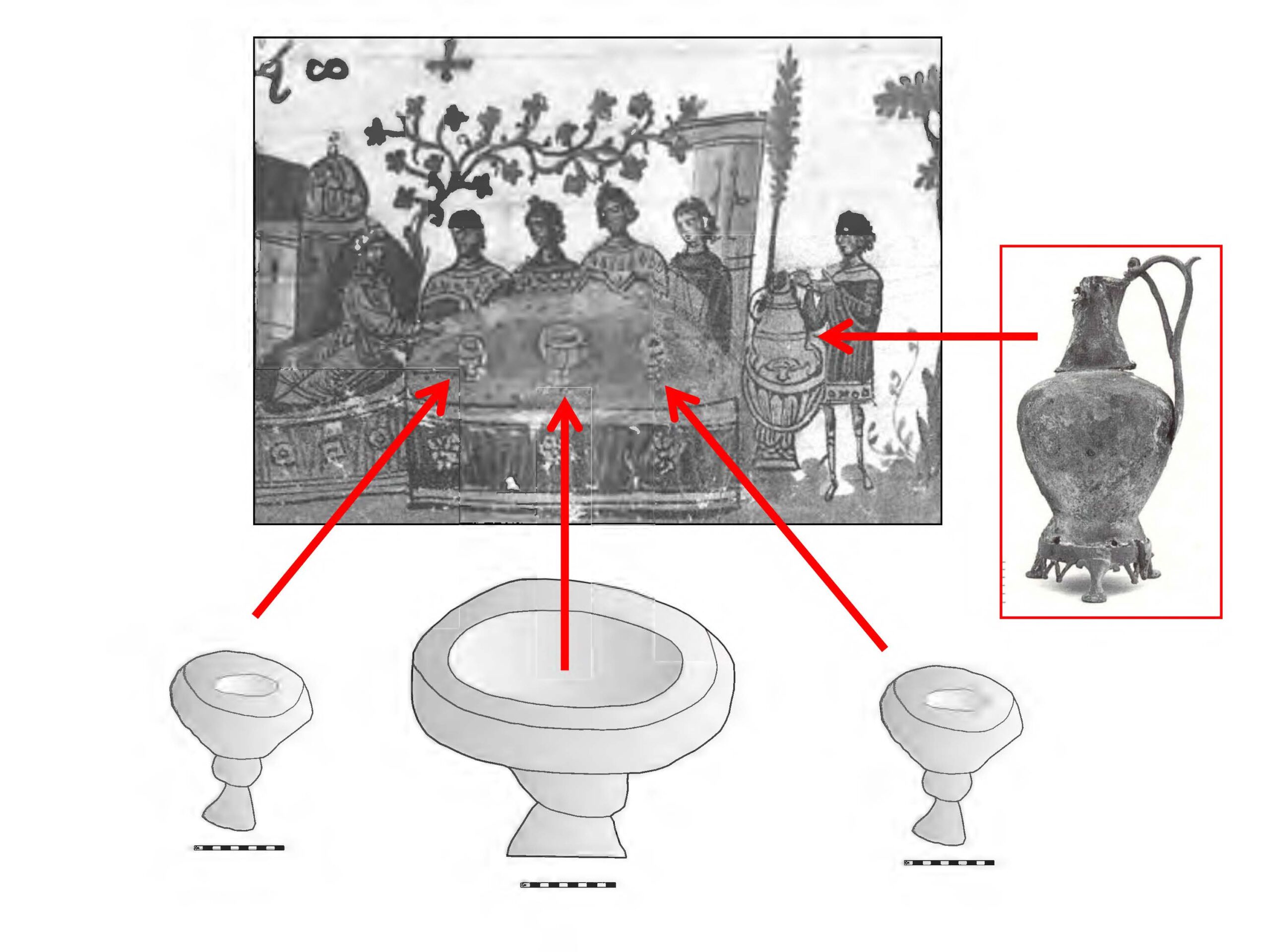
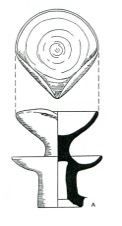
Figure 6. Miniature with banquet scene and authepsa (right), Bibliothèque Nationale gr. 74 Tetraevang., Paris (image after Vroom 2012:fig. 16; authepsa after Waldbaum 1983:no. 50, pl. 34).

On a few miniatures, one can even distinguish a realistic-looking authepsa next to the table (Figure 6, right). This was a metal samovar used for heating water that was meant to be mixed with wine for drinking purposes, as is attested by similar-looking examples with intricate interiors excavated in western Turkey, Italy, and Nubia. [36]

The combination of one dish flanked by two cups/chalices can be seen on many Middle Byzantine miniatures with dining scenes, including depictions of the Last Supper, strongly suggesting communal wining and dining. [37] In fact, an eleventh-century miniature of Job’s Children from St. Catherine’s Monastery at Sinai in Egypt shows for instance—apart from the one large communal plate and two communal cups—the act of communal dining itself: five of the ten diners actually grasp with their hands towards and into the centrally placed dish (Figure 7). [38] In addition, this miniature shows again the use of an authepsa during the meal; this time made in a more old-fashioned style in front of the table (Figure 7, lower right). [39]
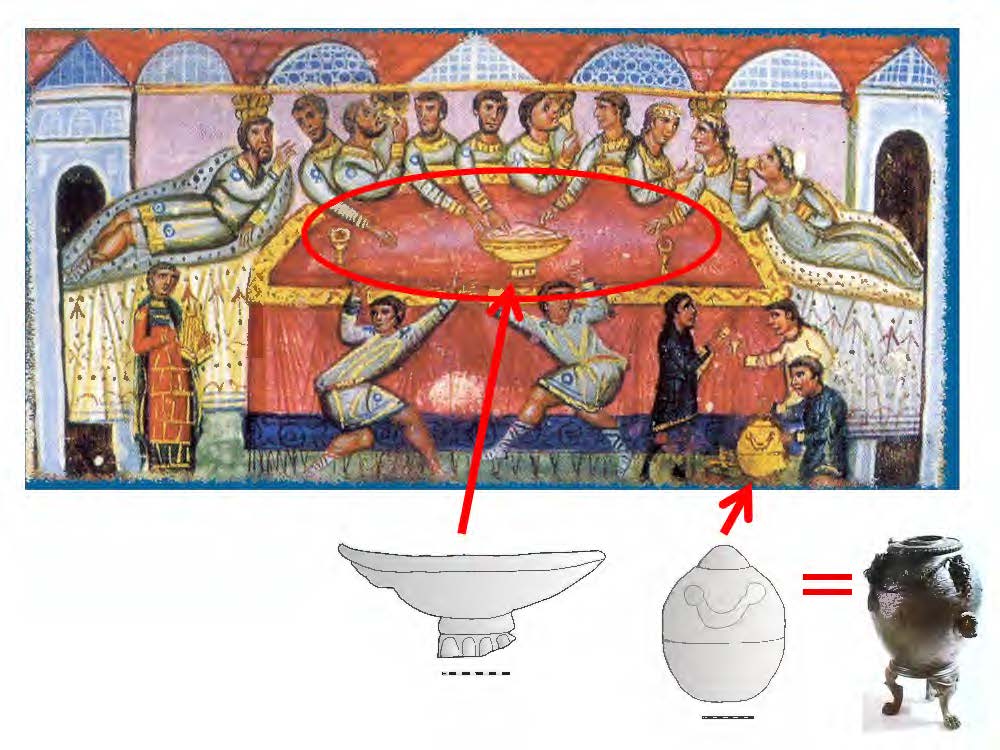
Figure 7. Miniature of Job’s children with banquet scene and authepsa (lower right), St. Catherine’s Monastery gr. 3 (fol. 17v), Sinai, eleventh century (image after Vroom 2003:fig. 11.17; authepsa after Vroom 2012:fig.10).
In short, both the archaeological evidence and the pictorial record point to the sociocultural habit of communal dining in circles of the imperial court during Middle Byzantine times. And as the well-to-do classes were seemingly eating with their hands, the less wealthy were most probably not using another eating performance.

As far as the shapes of ceramic tableware vessels of the seventh/early-eighth to mid-eleventh centuries excavated at the Great Palace are concerned, a wide-rimmed dish on a ring foot was apparently the most commonly used vessel in this period (Figure 8). [40]
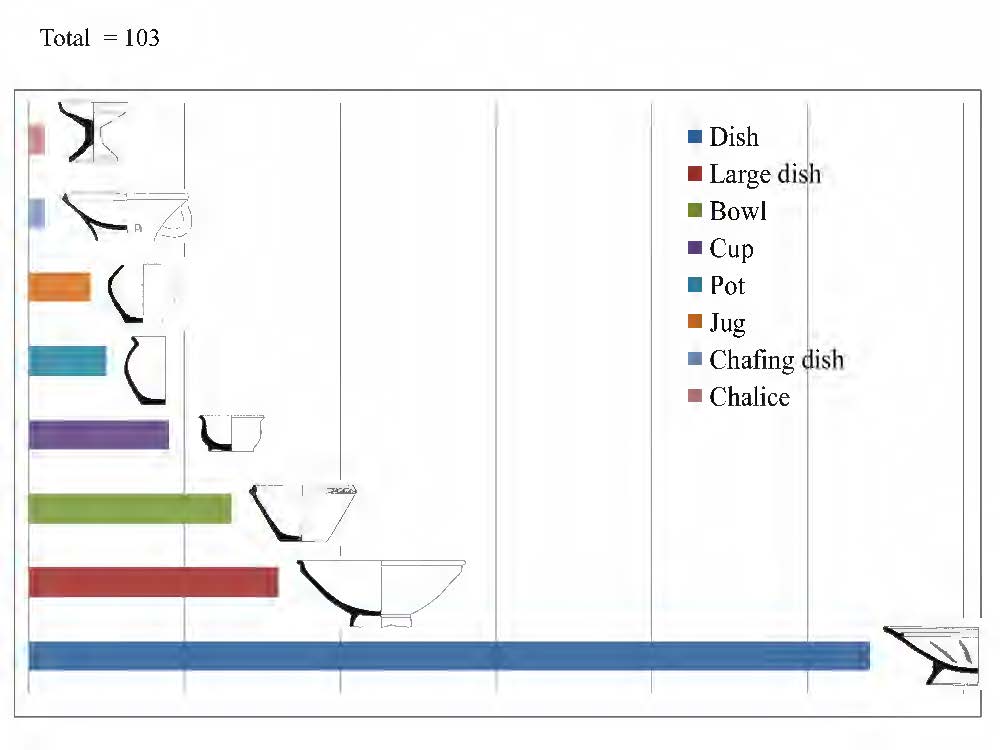
Figure 8. Excavated tableware shapes from the Great Palace at Constantinople (present-day Istanbul), ca. seventh / early eighth – mid-eleventh centuries (images after Stevenson 1947:stages I–IV).

In a more general way, it is obvious that the most used shapes for tableware in the imperial palace were mutually open and large with a wide rim diameter (Figure 9).
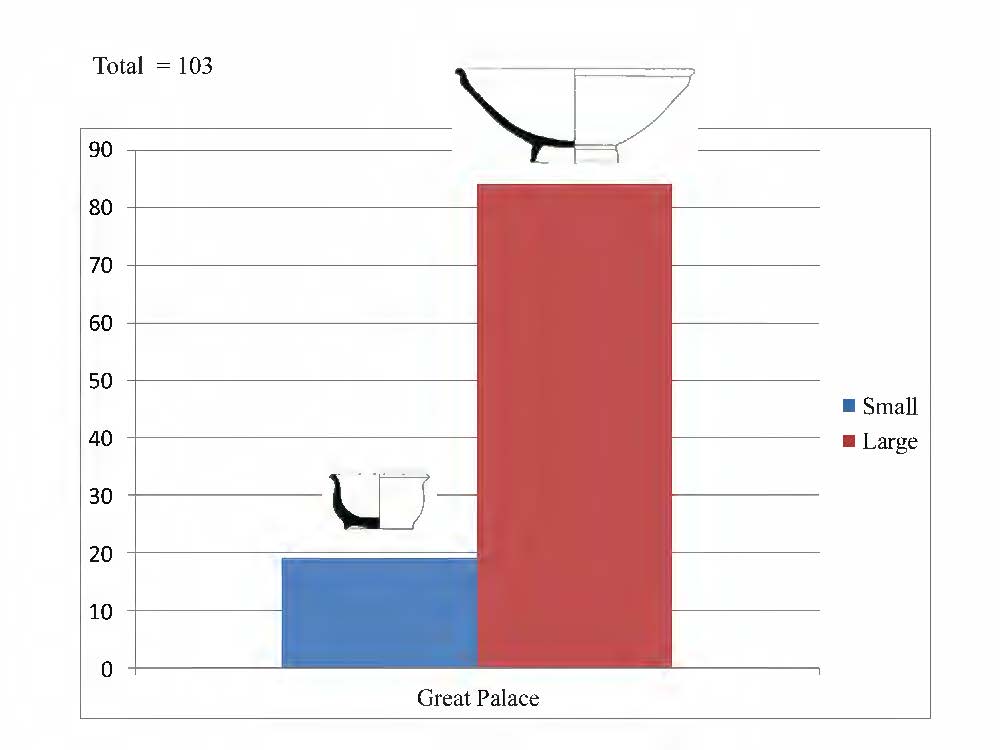
Figure 9. Excavated tableware shapes, divided in small and large ones, from the Great Palace at Constantinople (present-day Istanbul), ca. seventh / early eighth – mid-eleventh centuries (images after Stevenson 1947:stages I–IV).

That this typology was not confined to the imperial court alone is confirmed by similarly dated pottery vessels from other excavations in the city, among which those found at the churches of St. Eirene and St. Polyeuktos. [41]

The wide-open communal dishes and flanking drinking cups, recovered in the imperial palaces at Constantinople and shown on Middle Byzantine dining scenes, have many similarities with shapes of tableware of the tenth to twelfth centuries that were excavated in the Aegean basin and the Black Sea region. [42] Middle Byzantine pottery assemblages found here show a marked increase in dishes with a larger rim diameter (sometimes up to 30 cm). [43] Measuring their diameter and height, the calculated volume of these vessels used in Middle Byzantine dining ranges roughly between 3.5 and 11.3 liters. So, they were more than suited for grabbing with your fingers in quite opulent dishes.

Dining with the eyes: Late Byzantine shapes and the civilizing process

Things were about to change after the twelfth century, both in the territorial power of the Byzantine Empire and in the dining habits. A late twelfth/thirteenth-century Byzantine miniature of a Last Supper dining scene on a croce dipinta (painted cross) in the Museo Nazionale di San Matteo in Pisa (Italy) shows five bowls for the apostles, instead of one large dish in the middle of the table (Figure 10, upper left). [44]
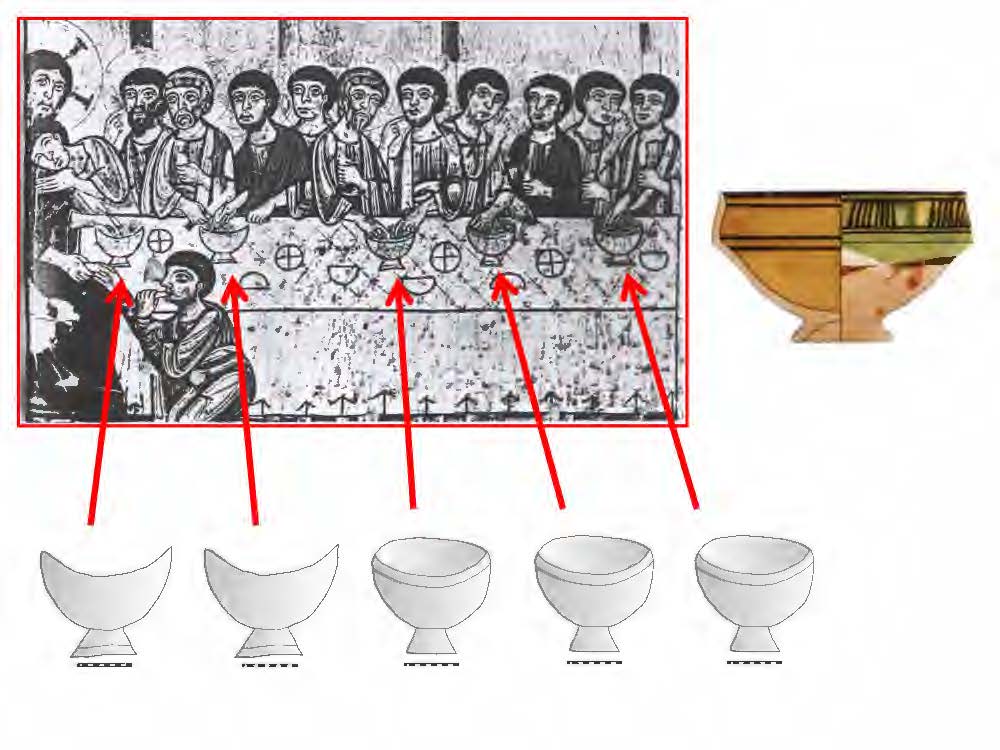
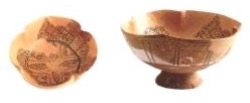
Figure 10. Miniature in a croce dipinta, Museo Nazionale di San Matteo, Pisa, ca. twelfth–thirteenth centuries (image after Vroom 2003:fig. 11.28; drawing after Stevenson 1947:stage V, no. 25).

In this way, the diners, who were sitting upright and not reclining, were sharing one small bowl between two or three men. They were apparently expected to eat together from the same bowl only with their immediate neighbors. Furthermore, the food was by now not only handled with the fingers but also with a knife, which as a table utensil became more easily accessible for diners in a sitting position at the table.

The archaeological records show substantial changes in Byzantine ceramics as well. The typical Middle Byzantine tablewares seem to have gone out of use in the palaces of Constantinople during the thirteenth century, being overtaken in the so-called Late Byzantine/Frankish period by incised tableware with sometimes two or more colors in the glaze. [45] In addition to the vast improvement in the quality of the lead glaze (which became thicker and with a more glassy appearance), a fine, thinly potted ware replaced the previous thick-walled tableware of the Middle Byzantine era.
Noteworthy is also a change in shape: from the thirteenth century onwards deep small bowls replaced the shallow large dishes (Figure 10, right). These deep bowls seem to have been specifically suited for fairly liquid mixtures or were perhaps even used as drinking vessels (hanap). [46] In general, it is clear from the archaeological assemblages that in the Late Byzantine/Frankish period (between ca. the thirteenth and mid-fifteenth centuries) much smaller bowls with smaller rim and base diameters formed the majority of diagnostic forms. [47]

Apart from size, it is also worthwhile to measure the volume capacity of the Byzantine tableware. To do this, I have selected some pottery assemblages from the eastern Mediterranean, preferably from single datable closed deposits, ranging from Early Byzantine to Late Byzantine/Frankish times (ca. mid-seventh to fifteenth centuries). [48] When looking at the graph in Figure 11, it is clear that the height of the vessels goes up throughout the centuries, while the volume becomes less over time.
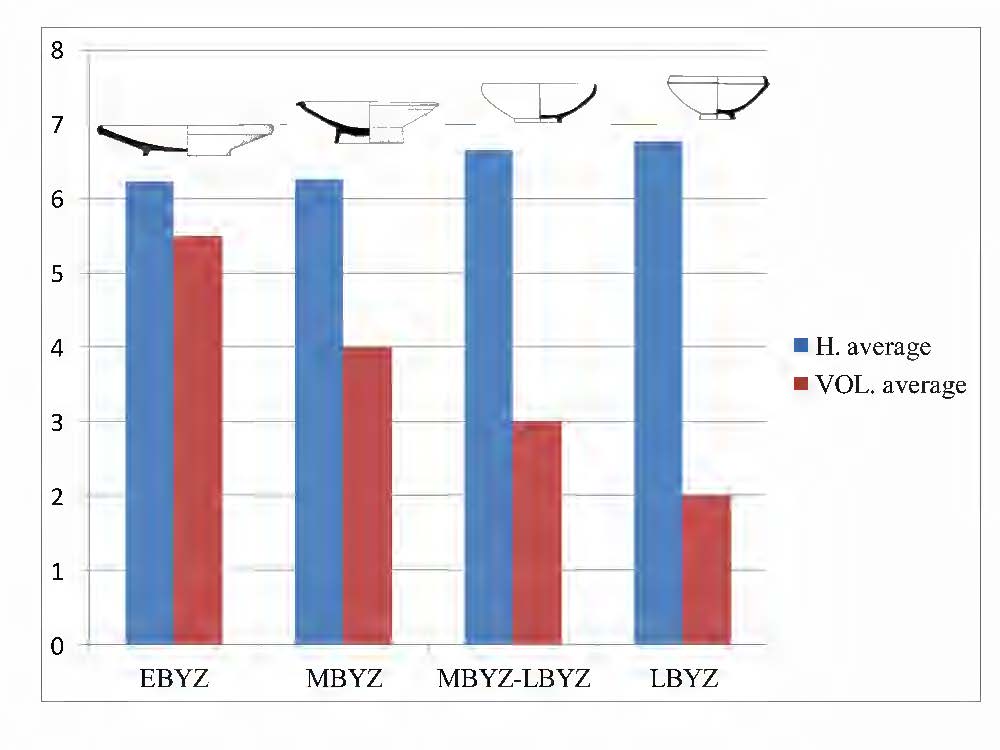
Figure 11. Average vessel height and volume of Byzantine tablewares (after Vroom 2016:fig. 13.5).

The same trend from Early Byzantine to Late Medieval times can be distinguished in excavated examples in combination with the iconography of that period. Measuring their diameter and height, the calculated volume of the Late Byzantine/Frankish vessels roughly ranges between 1.3 and 2.4 liters (Figure 10, lower register).

In addition, other trends in Late Medieval ceramics in the eastern Mediterranean shed light on new developments in dining practices. Of particular interest is, for instance, the use of different color percentages on pottery per period found at excavations in the so-called Triconch Palace at Butrint in southern Albania (see the graph in Figure 12). [49]
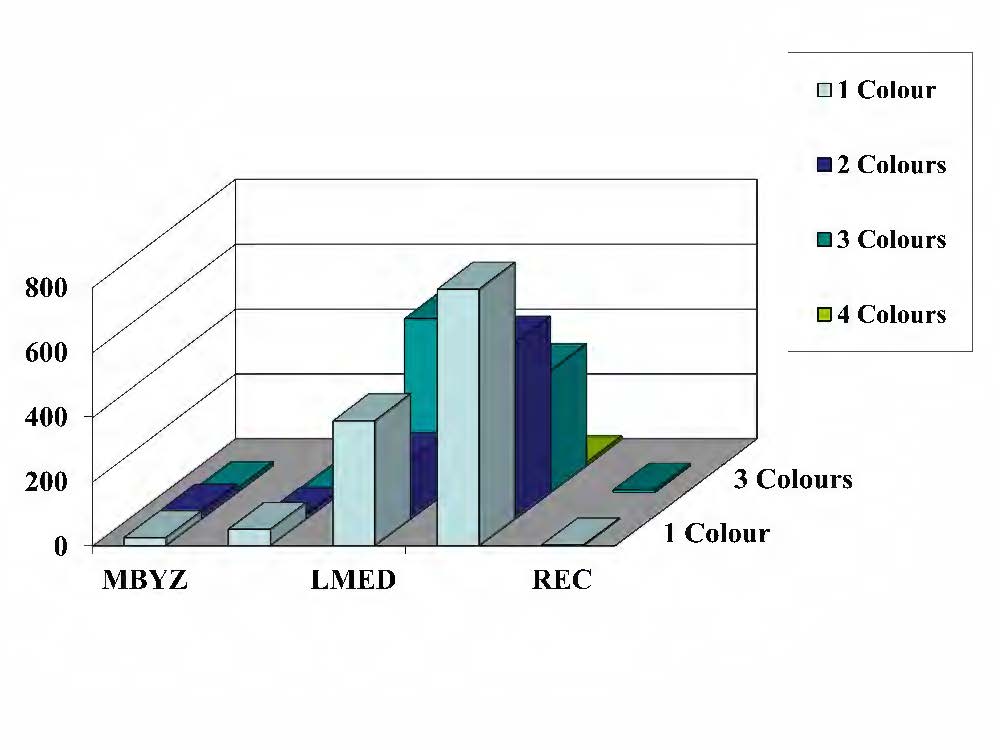
Figure 12. Butrint, Triconch Palace: color percentages of ceramic tablewares per period (after Vroom 2011:fig. 20).

Although this is hardly explored territory, the presence or the absence of colored decoration on ceramics can contribute to the development of methodologies by which consumption patterns can be recognized in archaeological contexts. I have, therefore, divided the pottery assemblages from the Triconch Palace into decorated wares with one painted color, two painted colors, three painted colors, and, finally, four (or more) painted colors. After differentiating these four groups from Middle Byzantine to more recent times, it is obvious that the Late Byzantine/Frankish (here “LMED”) and Early Venetian periods (here “EVEN”) in Butrint produced by far the most colorful wares (Figure 13).
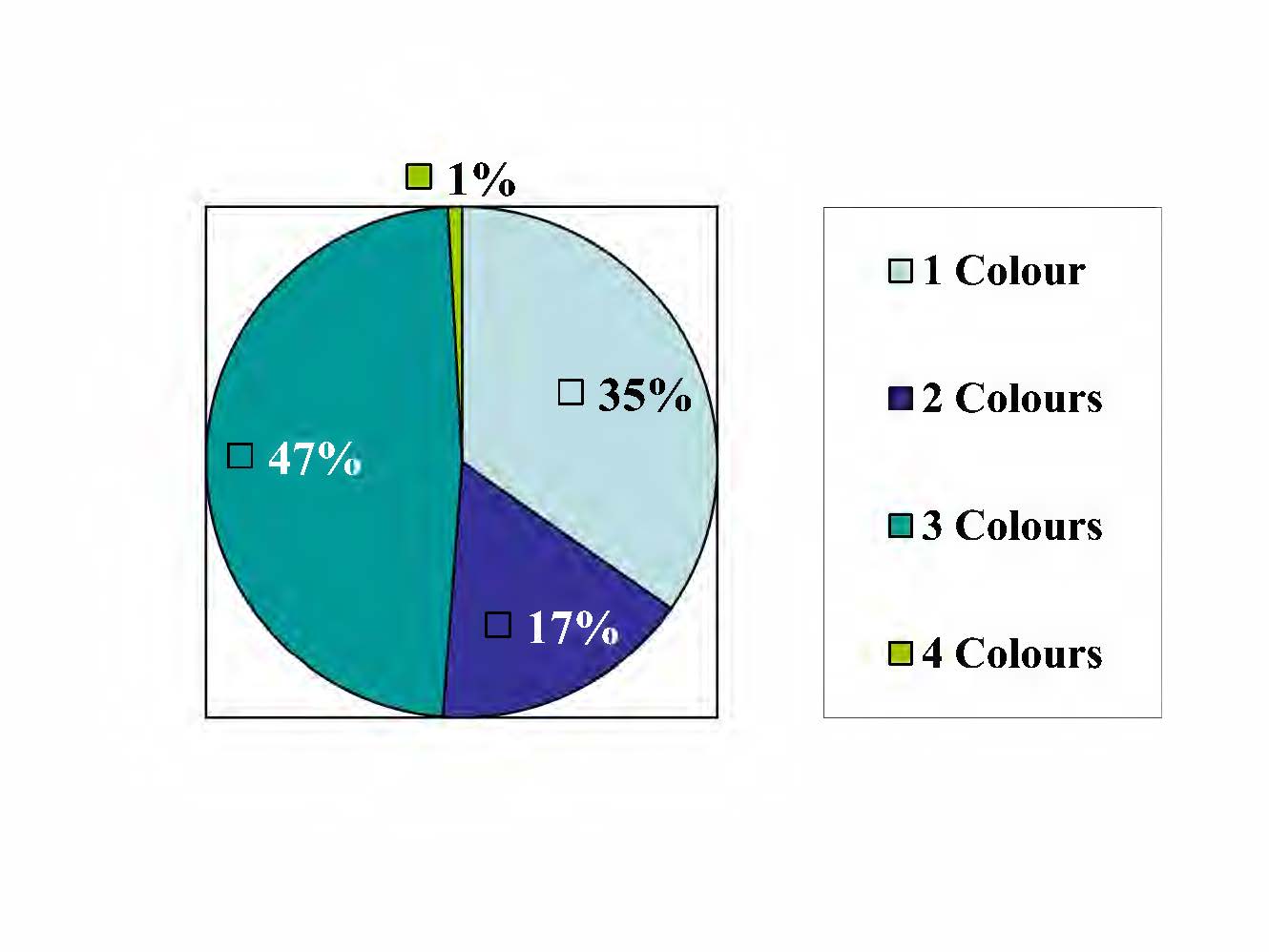
Figure 13. Butrint, Triconch Palace: color percentages of ceramic tablewares during the Late Medieval period (after Vroom 2011:fig. 21).
This may reflect the taste for colorful everyday objects during these Late Medieval periods (ca. thirteenth to fourteenth centuries), but it reflects also other aspects of sociocultural performance. The large number of decorated wares with three colors (47%) clearly underlines the complexity of decoration on serving vessels during the Late Middle Ages, and it is tempting to relate this to wider socioeconomic developments in this part of the Mediterranean. Certainly partly as a result of flavors of the Arab cuisine coming northward via Sicily, southern Italy, and Spain, as well as by way of returning Crusaders, there was, for instance, an increasing interest in food in Late Medieval southern Europe. A clear symptom of this interest was the emergence of the first cookery and etiquette books since Roman times. [50]
Striking in this period was also the desire to endow food itself with form, appearance, and color. To the physical side of eating and the existing sociocultural performance of dining, a new aspect seems now to have suddenly been added: the aesthetic pleasure of looking at food and at the utensils in which it was served. [51] In other words: the emphasis at the dinner table was at least partly migrating from the mouth to the eyes. From this perspective, it is no wonder that colors made a spectacular entry in this period, not only in food but also in ceramic tableware. The Late Medieval table became crowded with colorful artifacts as never before: not only in Butrint, but also in other places in the eastern Mediterranean, among which the Byzantine palaces at Constantinople.

Smaller-scale dining and a new hierarchy of materials

As far as the capital of the Byzantine Empire was concerned, the introduction of colorful tableware and food was not the only change with impact on the performance of daily life of the elite. An important event in the history of the majestic palaces was the development of a second imperial residence, the Blachernae Palace at the opposite end of Constantinople. Originally it had been a mere fortified building in the extreme northwest of the city, but from the eleventh/twelfth century onwards, it became rather a castle that looked very much like a Western Medieval-style small royal palace, including a banquet hall (Figure 2). [52]
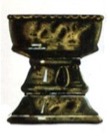
In the late fourteenth-century treatise on court ceremony and protocol by “Pseudo-Kodinos” we learn about a single reception-cum-dining hall (triklinos) used for banquets following ceremonies (such as the prokypsis on a platform) in the palace’s courtyard. [53] The large halls in the Great Palace would have been rather suited for big receptions and events, while the smaller dining area at the Blachernae Palace would be more appropriate for dining on a smaller scale, such as feasting for limited gatherings or private parties. In such an intimate setting, smaller-sized ceramic bowls and beakers (potiria) would obviously fit much better than the large vessels used at the Great Palace before (Figure 14). [54] And, interestingly enough, both the pictorial and the archaeological record of this period seem to illustrate a shift towards smaller-sized pottery (see, for instance, Table 3). [55]
Excavated context MBYZ shape LBYZ shape Ancient names MBYZ/LBYZ names Description
Anamas dungeons (1993) acetabulum
scutula?
paropsis
skoutellion
missouraklion
triaflion
Small bowl
Anamas dungeons (2006) patina
phiale
patera
pinakion
pinaskous
missourion?
Shallow dish or plate (rather small sized)
Tekfur Palace (2008) koupa
koupaki
Cup with convex wall
Anamas dungeons (2005) kerastikon One-handled jug
Repair walls Egrikapi and Anemas dungeons kandela
lichnari
Lamp
Table 3. Shapes and potential names of Middle Byzantine and Late Byzantine tableware vessels and lighting devices found in excavated contexts in the Blachernae Palace at Constantinople (after Koukoules 1952, vol. 5, ch. 2; Barak Çelik and Kiraz 2011).
Figure 14. Excavated pottery finds from Constantinopolitan palaces, ca. twelfth–fourteenth centuries (images after Stevenson 1947; Denker 2011; Baran Çelik and Kiraz 2011).

Many depictions of dining scenes of this later period show a quite sudden change towards a greater variety and a larger number of vessels, jugs, cutlery, and individual pieces of bread on the table. [56] The food is now divided into several smaller bowls, which were apparently shared by only three or four guests at the table. A fourteenth-century fresco from Cyprus for instance clearly shows this separation of food into various smaller bowls, as well as the individual use of jugs and even of glass beakers and glass wine jugs (Figure 15, upper left). [57]
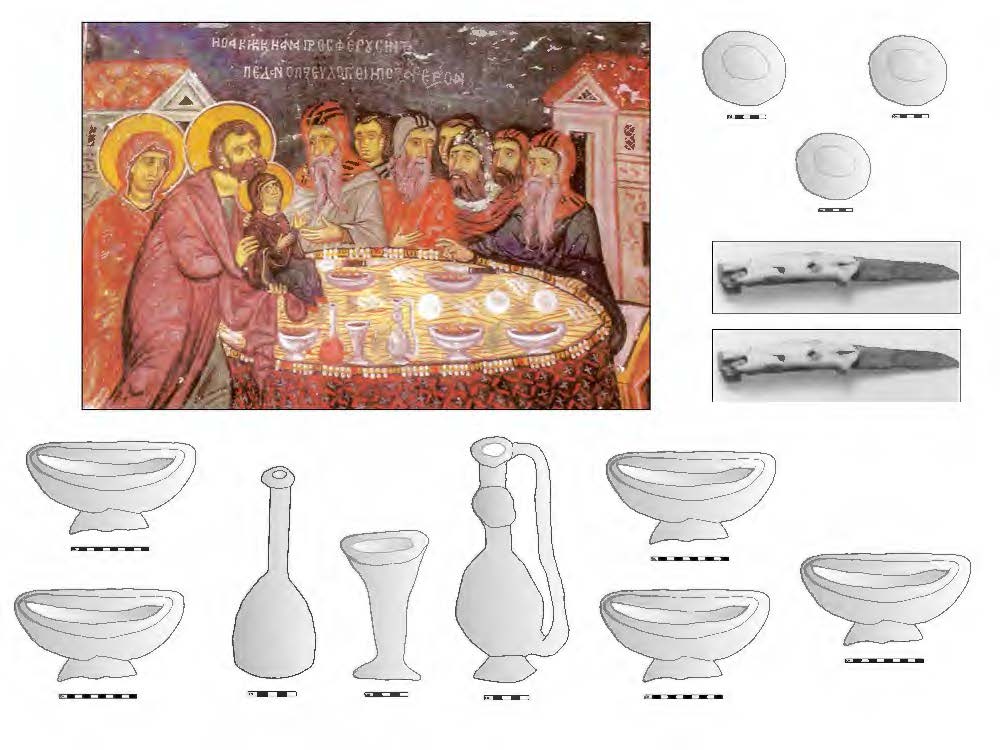
Figure 15. Fresco of Double annunciation at the well and at the house, third quarter of the fourteenth century, Church of the Holy Cross, Pelendri, Cyprus (image after Stylianou and Stylianou 1985:229, fig. 131).

Furthermore, the vessels with food and containers of wine or water on the fresco are not placed in a clear order on the table. The guests were expected to share the bowls and two knives between three or four men. Of particular interest is also that the wall painting shows simultaneously an oinochoe (a jug with a short neck and trefoil rim) and a potirion (a drinking cup) for the distribution and (individual or semi-individual) drinking on this table (Figure 15, lower register, center). [58]

The archaeological record shows likewise an increase in smaller-sized tableware and the use of ostensibly individual or semi-individual drinking utensils. At excavations in Istanbul, Thessaloniki, and Corinth, fairly ordinary glass finds (not seen since Late Roman times) reappear again in archaeological contexts from the eleventh century onwards. [59] The assemblages of these excavations include a wide range of drinking vessels, such as bowls, goblets, (prunted) beakers, cups, bottles, and jugs, usually made of transparent glass in a pale greenish color. [60] Interestingly enough, the Byzantine written sources clearly suggest simultaneously a change towards increased wine consumption since the twelfth century. [61]
Most of the above-discussed developments in dining habits and performance at the Byzantine table are related to elite contexts. We just do not know the precise level of use and importance of ceramics within more modal urban or rural Byzantine households. Where silver and rock crystal vessels were certainly largely confined to the court and upper aristocratic/clerical classes, in humbler households, food could be prepared, cooked, and served in vessels made of clay, wood, basketry, leather, or stone. We may assume that vessels made of nonceramic materials almost certainly occupied a position at least as important as that of pottery in the hierarchy of materials. [62] As it is often difficult, if not impossible, to find the remains of organic materials or certain metal wares in the excavated layers of Constantinopolitan palaces or other Byzantine sites in the Aegean, the problem of these “missing artifacts” in archaeological assemblages should be a constant concern for archaeologists. [63]
A telling reminder of this issue is to be found in a text of the fourteenth-century Byzantine historian Nicephoros Gregoras. He stresses a new hierarchy of materials in his troublesome time, when the imperial court at Constantinople is so impoverished that this required the replacement of gold and silver vessels by those made of “ceramic and clay,” suggesting also the use of other materials. [64] His text coincides with the transfer of eating performances of the imperial court to the small-scale dining hall in the Blachernae Palace. The impoverished Emperor could now only entertain on a reduced scale, and his family and guests had to eat from smaller-sized bowls, made of colorful glazed earthenware if they were lucky.

Conclusion

It is possible that between the seventh and ninth centuries golden, silver, and cloisonné enamel vessels were used more often than is known as social markers of performance on the dining table of the Byzantine elite, but unfortunately it is impossible to establish this because—for obvious reasons—remains of precious metals are seldom part of archaeological assemblages. It is, however, certain that the first locally made glazed ceramics from Constantinople were rather used for utilitarian reasons (such as food processing) than as tableware. The usage of glazed earthenware tableware increased significantly in the capital only between the tenth and twelfth centuries. In particular, substantial amounts of large, wide-rimmed dishes dating from this period (obviously used for communal dining) have been found in excavated layers of the city’s imperial palaces.
It is quite likely that during this period these portable ceramic utensils, which offered at least some sensory experience due to their colorful glazed interiors, gradually replaced high-status golden, silver, sardonyx, and glass vessels which were formerly used at the imperial court. Centrally placed on the table, large earthenware dishes (with rim diameters up to 30 cm) were apparently used communally by all diners around the table, who used their fingers to consume the food.
My hypothesis is that the shift in materials, fabrics, shapes, and functions of the Constantinopolitan tableware, as reflected in the assemblages excavated in the imperial palaces, can be explained by changes in court ceremonials, dining habits, and eating protocols. In this perspective, both the archaeological record of the material culture, the pictorial evidence, and the textual sources tell the same story of shifting performances, both at the court, and perhaps in a wider sociocultural sense.
If we are to explore this line of approach, the consequence would be that we understand broken pottery not only as an archaeological dating tool, but that we should also “read” the assemblages as sources of information about their own functional, cultural, and social contexts. In fact, ceramic vessels were in Byzantine times (as they still are) quite omnipresent objects of daily life, containers from which both the rich and the poor, both the emperor and the peasant, once ate and drank—while they could also have been used in a variety of other ways, even as realistic looking stage props during Byzantine banquets and ceremonies of the elite.
Above I have tried to understand the shifts and changes in shapes and functions of excavated Byzantine pottery finds from Constantinopolitan palaces in conjunction with written documents on court performances, the depiction of dining scenes, and with wider socioeconomic developments. The combination of the various kinds of information leads to a pattern, which links shifts in dining practices to changes in sociocultural and political contexts. I would suggest that there were rather clear changes from exclusively communal dining in Middle Byzantine times (more focused on sharing food together) to a gradual transitional form of more Western noncommunal, small-group dining in the Late Byzantine/Frankish period (which may represent the beginning to personal consumerism). And that these changes would explain much of the changing shapes, sizes, volumes, and decoration styles in the excavated pottery assemblages, especially in the case of the Blachernae Palace. This transition probably took place at a different pace in different parts of the capital, not to speak of different parts of the Empire.
However, all this needs further study. In the future, it may prove also worthwhile to undertake research of differences between and changes in the cultural values of food and drink among the well-to-do and the poorer classes in Byzantine society. In short: one could try to look past the court elite and adjust the focus a bit closer to the individuals behind the broken pieces of pottery. Because in the end, the job of an archaeologist is to try and answer questions about genuine people in the real past, whether they broke their ceramic dishes as a theatrical act at a communal dinner party in an imperial banquet hall, or by accident in a humble farmer shack.

Acknowledgments

It is a pleasure to thank Niki Tsironis and the other organizers of the international workshop on “Performance and Performativity in Late Antiquity, Byzantium and Beyond” for inviting me to participate in this exciting meeting. Furthermore, I would like to extend my thanks to Sebastiaan L. Bommeljé for critically reading my text and to Federico Cappadona for helping me with the drawings in Figures 5, 6, 7, 10, and 15.

Bibliography

Alcouffe, D. 1984. “Islamic Hardstone Carving.” In Buckton 1984:207–230.
———. 1992. “Les vases en pierres dures.” In Byzance 1992:289–300.
Antonaras, A. C. 2010. “Early Christian and Byzantine Glass Vessels: Forms and Uses.” In Daim and Drauschke 2010:383–430.
Archetti, G., and P. Vila, eds. 2003. La civiltà del vino: Fonti, temi e produzioni vitivinicole dal medioevo al novecento. Brescia.
Bagnall, R. S., K. Brodersen, C. B. Champion, A. Erskine, and S. R. Huebner, eds. 2013. The Encyclopedia of Ancient History. London.
Bakirtzis, C., ed. 2003. VIIe Congrès International sur la Céramique Médiévale en Méditerranée. Thessaloniki 11–16 October 1999: Actes. Athens.
Ballian, A., and A. Drandaki. 2003. “A Middle Byzantine Silver Treasure.” Mouseio Benaki 3:47–80.
Baran Ҫelik, G., ed. 2011. Istanbul’Daki Bizans Saraylarι / Byzantine Palaces in Istanbul. Istanbul.
Baran Çelik, G., and Z. Kızıltan, eds. 2013. Stories from the Hidden Harbor: Shipwrecks of Yenikapı. Trans. B. Cezar and E. Güler. Istanbul.
Baran Ҫelik, G., and M. Kiraz. 2011. “Blakhernai Palace.” In Baran Ҫelik 2011:124–130.
Bardill, J. 2006. “Visualizing the Great Palace of the Byzantine Emperors at Constantinople: Archaeology, Text, and Topography.” In Bauer 2006:5–45.
Bauer, F. A., ed. 2006. Visualisierungen von Herrschaft: Frühmittelalterliche Residenzen – Gestalt und Zeremoniell. Byzas 5. Istanbul.
Baumann, R. 1989. “American Folklore Studies and Social Transformation: A Performance‐Centered Perspective.” Text and Performance Quarterly 9:175–184.
Beihammer, A., S. Constantinou, and M. Parani, eds. 2013. Court Ceremonies and Rituals of Power in Byzantium and the Medieval Mediterranean: Comparative Perspectives. Leiden.
Berger, A. 2006. “Die akustische Dimension des Kaiserzeremoniells: Gesang, Orgelspiel und Automaten.” In Bauer 2006:63–75.
———. 2013. “The Byzantine Court as a Physical Space.” In Ödekan, Necipoğlu, and Akyürek 2013:3–12.
Bourdieu, P. 1979. La Distinction: Critique sociale du jugement. Paris.
Brett, G., W. J. Macaulay, and R. B. K. Stevenson, eds. 1947. The Great Palace of the Byzantine Emperors. Oxford.
Brubaker, L., and K. Linardou, eds. 2007. Eat, Drink, and Be Merry (Luke 12:19) – Food and Wine in Byzantium. Papers of the 37th Annual Spring Symposium of Byzantine Studies, in Honour of Professor A. A. M. Bryer. Publications of the Society for the Promotion of Byzantine Studies 13. Aldershot.
Bryer, A. 2008. “Food, Wine, and Feasting.” In Jeffreys, Haldon, and Cormack 2008:669–676.
Buckton, D., ed. 1984. The Treasury of San Marco, Venice. Milan.
Cameron, A. 1987. “The Construction of Court Ritual: The Byzantine Book of Ceremonies.” In Cannadine and Price 1987:106–136.
Cannadine, D., and S. Price, eds. 1987. Rituals of Royalty: Power and Ceremonial in Traditional Societies. Cambridge.
Cormack, R., and M. Vassilaki, eds. 2009. Byzantium 330–1453. London.
Cutler, A. 1994. “Uses of Luxury: On the Functions of Consumption and Symbolic Capital in Byzantine Culture.” In Guillou and Durand 1994:289–307.
———. 2009. “At Court.” In Cormack and Vassilaki 2009:111–139.
Cutler, A., and A. Papaconstantinou, eds. 2007. The Material and the Ideal: Essays in Medieval Art and Archaeology in Honour of Jean-Michel Spieser. Leiden.
Dagron, G. 2000. “L’Organisation et le déroulement des courses d’après le Livre des ceremonies.” Travaux et mémoires 13:1–200.
Daim, F., and J. Drauschke, eds. 2010. Byzanz—das Römerreich im Mittelalter, Teil I: Welt der Ideeën, Welt der Dinge. Mainz.
Davidson, G. R. 1952. Corinth XII: The Minor Objects. Princeton.
Demangel, R., and E. Mamboury. 1939. Le Quartier des Manganes et la première région de Constantinople. Paris.
Denker, A. 2011. “The Great Palace (Palatium Magnum).” In Baran Ҫelik 2011:14–69.
———. 2013. “Excavations at the Byzantine Great Palace (Palatium Magnum) in the area of the Old Sultanahmet Jail.” In Ödekan, Necipoğlu, and Akyürek 2013:13–18.
Dennert, M. 2011. “II.3.4 Sardonyxschale (nicht ausgestellt).” In Fourlas and Tsamakda 2011:234–235.
Duindam, J., T. Artan, and M. Kunt, eds. 2011. Royal Courts in Dynastic States and Empires: A Global Perspective. Leiden.
Dunbabin, K. M. F. 2003. The Roman Banquet: Images of Conviviality. Cambridge.
Elias, N. 1939. Über den Prozess der Zivilisation, Soziogenetische und psychogenetische Untersuchungen. 2 vols. Basel.
Featherstone, J. M. 2006. “The Great Palace as Reflected in the De Ceremoniis.” In Bauer 2006:47–61.
———. 2007. “Δι’ένδειξιν: Display in Court Ceremonial (De Cerimoniis II,15).” In Cutler and Papaconstantinou 2007:75–112.
———. 2013. “De Ceremoniis: The Revival of Antiquity in the Great Palace: Acclamations and Dances in the Service of Imperial Ideology.” In Ödekan, Necipoğlu, and Akyürek 2013:139–144.
Fourlas, B., and V. Tsamakda, eds. 2011. Wege nach Byzanz. Mainz.
Frazer, M. E. 1984. “Byzantine Enamels and Goldsmith Work.” In Buckton 1984:109–206.
Goffman, E. 1959. The Presentation of Self in Everyday Life. New York.
Gonçalves, M.-J. and S. Gómez-Martinez, eds. 2015. Actas do X Congresso Internacional A Cerâmica Medieval no Mediterrâneo, Silves – Mértola, 22 a 27 outubro 2012. Silves.
Goody, J. 1982. Cooking, Cuisine and Class: A Study in Comparative Sociology. Cambridge.
Guillou, A., and J. Durand, eds. 1994. Byzance et les images. Paris.
Hayes, J. W. 1992. Excavations at Saraçhane in Istanbul. Vol. 2, The Pottery. Princeton.
Heher, D. 2020. Mobiles Kaisertum: Dat Zelt als Ort der Herrschaft und Repräsentation in Byzanz (10.–12.Jahrhundert). Münster.
Jeffreys, E., J. Haldon, and R. Cormack, eds. 2008. Oxford Handbook of Byzantine Studies. Oxford.
Kazhdan, A. P., and M. McCormick. 1997. “The Social World of the Byzantine Court.” In Maguire 1997:167–197.
Kongaz, G. 2011. “Boukoleon Palace.” In Baran Ҫelik 2011:74-84.
Kirschenblatt-Gimblett, B. 1999. “Playing to the Senses: Food as a Performance Medium.” Performance Research 4.1:1–30.
Kislinger, E. 2003. “Dall’ubriacone al krasopateras: consume del vino a Bisanzio.” In Archetti and Vila 2003:173–196.
Koukoules, P. 1947–1955. Byzantion Bios kai Politismos [Byzantine Life and Civilisation]. Athens.
Lymberopoulou, A. 2007. “‘Fish on a Dish’ and its Table Companions in Fourteenth-Century Wall-Paintings on Venetian-Dominated Crete.” In Brubaker and Linardou 2007:223–232.
Macrides, R. 2011. “Ceremonies and the City: The Court in Fourteenth-Century Constantinople.” In Duindam, Artan, and Kunt 2011:217–235.
———. 2013. “Inside and Outside the alace: Ceremonies in the Constantinople of the Palaiologoi.” In Ödekan, Necipoğlu, and Akyürek 2013:165–172.
Magdalino, P. 2007. Studies on the History and Topography of Byzantine Constantinople. Aldershot.
———. 2011. “Court and Capital in Byzantium.” In Duindam, Artan, and Kunt 2011:131–144.
———. 2013. “The Harbors of Byzantine Constantinople.” In Çelik and Kızıltan 2013:13–15.
Maguire, H., ed. 1997. Byzantine Court Culture from 829 to 1204. Washington, DC.
———. 2003.“The Feasting Cycle and the Meanings of Hybrids in Byzantine Ceramics.” In C. Bakirtzis 2003:205–210.
Malmberg, S. 2003. Dazzling Dining: Banquets as an Expression of Imperial Legitimacy. Uppsala.
———. 2013. “Banquets, Byzantine.” In Bagnall, Brodersen, Cahmpion, Erskine, and Huebner 2013:1035–1036.
Mamboury, E, and T. Wiegand. 1934. Die Kaiserpaläste von Konstantinopel zwischen Hippodrom und Marmara-meer. Berlin.
Mango, C. 1997. “The Palace of the Boukoleon.” Cahiers Archéologiques 45:41–50.
Mundell Mango, M. 2007. “From ‘Glittering Sideboard’ to Table: Silver in the Well-Appointed Triclinium.” In Brubaker and Linardou 2007:127–161.
Musée du Louvre. 1992. Byzance: L’art byzantin dans les collections publiques françaises. Paris.
Ödekan, A., N. Necipoğlu, and E. Akyürek, eds. 2013. The Byzantine Court: Source of Power and Culture, Papers from the Second Sevgi Gönül Byzantine Symposium, Istanbul, 21–23 June 2010. Istanbul.
Oikonomidès, N., ed. 1972. Les Listes de préseance byzantines des IXe et Xe siècles. Paris.
Papanikola-Bakirtzi, D., ed. 1999. Byzantine Glaze Ceramics: The Art of Sgraffito. Athens.
Parani, M. G. 2018. “Mediating Presence: Curtains in Middle and Late Byzantine Imperial Ceremonial and Portraiture.” Byzantine and Modern Greek Studies 42.1:1–25.
Peschlow, U. 1977–1978. “Byzantinische Keramik aus Istanbul. Ein Fundcomplex bei der Irenenkirche.” Istanbuler Mitteilungen 27/28:363–414.
Pitarakis, B. 2005. “Survivance d’un type de vaisselle antique à Byzance: Les authepsae en cuivre des Ve-VIIe siècles.” In Mélanges Jean-Pierre Sodini, ed. F. Baratte, V. Déroche, C. Jolivet-Lévy, and B. Pitarakis, 673–686.
———. 2013. “From the Hippodrome to the Reception Halls of the Great Palace and the ‘Macedonian Renaissance’.” In Ödekan, Necipoğlu, and Akyürek 2013:129–138.
Pomerantz, M. A., and E. B. Vitz, eds. 2017. In the Presence of Power: Court and Performance in the Pre-Modern Middle East. New York.
Schechner, R. 2002. Performance Studies: An Introduction. London.
Schopen, L., ed. 1830. Nikephoros Gregoras’ Byzantina Historia. Vol. 2. Bonn.
Schreiner, P. 2006. “Zu Gast in den Kaiserpalästen Konstantinopels. Architektur und Topographie in der Sicht fremdländischer Betrachter.” In Bauer 2006:101–134.
Schrijver, F. 2018. “The Court of Women in Early Palaiologan Byzantium.” Byzantine and Modern Greek Studies 42:219–236.
Seyer, M., ed. 2012. 40 Jahre Grabung Limyra: Akten des Symposions, Wien, 3–5 December 2009. Vienna.
Sibbesson, E., B. Jervis, and S. Coxon, eds. 2016. Insight from Innovation: New Light on Archaeological Ceramics; Papers Presented in Honour of Professor David Peacock’s Contributions to Archaeological Ceramic Studies. St. Andrews.
Simmel, G. 1904. “Fashion.” International Quarterly 10:130–155.
Stevenson, R. B. K. 1947. “Chapter II: The Pottery, 1936–7.” In Brett, Macaulay, and Stevenson 1947:31–63.
Stylianou, A., and J. A. Stylianou. 1985. The Painted Churches of Cyprus: Treasures of Byzantine Art. London.
Talbot Rice, D. 1958. The Great Palace of the Byzantine Emperors: Second Report. Edinburgh.
Tsamakda, V. 2002. The Illustrated Chronicle of Ioannes Skylitzes in Madrid. Leiden.
Verpeaux, J. 1966. Pseudo-Kodinos. Traité des offices. Paris.
Vitz, E. B., and M. A. Pomerantz. 2017. “Introduction.” In Pomerantz and Vitz 2017:1–14.
Vogt, A. 1935–1939. Constantin Porphyrogenitus. Le Livre de Cérémonies. 4 vols. Paris.
Vroom, J. 1998. “Medieval and Post-Medieval Pottery from a Site in Boeotia: A Case Study Example of Post-Classical Archaeology in Greece.” The Annual of the British School at Athens 93:513–546.
———. 2003. After Antiquity: Ceramics and Society in the Aegean from the 7th to the 20th centuries A.C.; A Case Study from Boeotia, Central Greece. Archaeological Studies Leiden University 10. Leiden.
———. 2007. “The Changing Dining Habits at Christ’s Table.” In Brubaker and Linardou 2007:191–222.
———. 2011. “The Morea and its Links with Southern Italy after AD 1204: Ceramics and Identity.” Archeologia Medievale 38:409–430.
———. 2012. “Tea and Ceramics: New Perspectives on Byzantine Pottery from Limyra.” In Seyer 2012:341–355.
———. 2014. Byzantine to Modern Pottery in the Aegean: An Introduction and Field Guide. 2nd rev. ed. Turnhout. Orig. pub. 2005.
———. 2015. “The Archaeology of Consumption in the Eastern Mediterranean: A Ceramic Perspective.” In Gonçalves and Gómez-Martinez 2015:359–367.
———. 2016. “Pots and Pies: Adventures in the Archaeology of Eating Habits of Byzantium.” In Sibbesson, Jervis, and Coxon 2016:221–244.
———. Forthcoming. “The Consumptive Capital: Commercial Activities and Ceramic Finds at Constantinople (ca. 500–1000).” In Zavagno and Bakirtzis Forthcoming.
Vroom, J, and E. Tzavella. 2017. “Dinner Time in Athens: Eating and Drinking in the Medieval Agora.” In Vroom, Waksman, and van Oosten 2017:145–180, 378–380.
Vroom, J., Y. Waksman, and R. van Oosten, eds. 2017. Medieval MasterChef: Archaeological and Historical Perspectives on Eastern Cuisine and Western Foodways. Medieval and Post-Medieval Mediterranean Archaeology Series 2. Turnhout.
Waldbaum, J. C. 1983. Metalwork from Sardis. Archaeological Exploration of Sardis, Monograph 8. Cambridge, MA.
Woys Weaver, W. 2017. “The Court Cuisine of Medieval Cyprus: Food as Table Theater.” In Pomerantz and Vitz 2017:179–195.
Zavagno, L., and N. Bakirtzis, eds. Forthcoming. Routledge Companion to the Byzantine City: From Justinian to Mehmet II (ca. 500–1500). London.

Footnotes

[ back ] 1. Goffman 1959; Bourdieu 1979; Goody 1982.
[ back ] 2. Baumann 1989:177.
[ back ] 3. Schechner 2002:30; see also Vitz and Pomerantz 2017:8.
[ back ] 4. Kirschenblatt-Gimlett 1999:1–2.
[ back ] 5. Vitz and Pomerantz 2017:12.
[ back ] 6. See for an adequate description of a Byzantine court or rather “palace,” Kazdan and McCormick 1997:173; Magdalino 2011:141.
[ back ] 7. Malmberg 2003:chapter 6; Schreiner 2006; Featherstone 2006; 2007; 2013; Beihammer et al. 2013.
[ back ] 8. Vogt 1935–1939:chapters 1–83; see also Cameron 1987; Dagron 2000; Featherstone 2007:80–112; 2013.
[ back ] 9. Oikonomidès 1972:81–235; see also Kazhdan and McCormick 1997:175–176, 180–181.
[ back ] 10. Verpeaux 1966; Magdalino 2007:no. XI; MacCrides 2013.
[ back ] 11. Dunbabin 2003:195; Bryer 2008:673; Featherstone 2006; see for a tenth-century reconstruction of the Great Palace, Berger 2013:5–10 and figure 5 (based on a plan by Jan Kostenec).
[ back ] 12. Bryer 2008:674; Malmberg 2013:1035; Schrijver 2018:225–228.
[ back ] 13. See for instance Tsamakda 2002:figure 237, fol. 105v, top: “A banquet of Emperor Basileios I with the senators.”
[ back ] 14. Mamboury and Wiegand 1934; Demangel and Mamboury 1939; Brett et al. 1947; Talbot Rice 1958; Featherstone 2006, and in particular Bardill 2006 with further literature.
[ back ] 15. Maguire 2003:205–210; Pitarakis 2013:131–138.
[ back ] 16. Berger 2006; Featherstone 2007; Pitarakis 2013:132; Parani 2018; Bauer 2006:152–162.
[ back ] 17. Koukoules 1947-1955: vol. 5, chapters 1–2; see also Heher 2020:83–85.
[ back ] 18. Heher 2020:83 and note 144.
[ back ] 19. Buckton 1984; Alcouffe 1992:289–300; Cutler 2009:122, no. 62: Antonaras 2010:395–397, figures 19–22; Dennert 2011:234–235, no. II.3.4; see also in general, Cutler 1994.
[ back ] 20. Frazer 1984:129–140, nos. 10–11, 156–170, nos. 15–18, 181–190, nos. 21–23, 194–200, nos. 25–27; Alcouffe 1984:209–214, no. 29; Cutlery 2008:136–137, nos. 80–81.
[ back ] 21. Mango 1997; Magdalino 2011:139.
[ back ] 22. Most of the ceramic finds came from the 1936–1937 and 1958 Great Palace excavations and from the 2001 and 2003 digs in the area of the Former Sultanahmet Prison; cf. Stevenson 1947; Talbot Rice 1958; Denker 2011; 2013; see also Vroom forthcoming.
[ back ] 23. Ballian and Drandaki 2003:figures 1a–b to 6a–b, 20a–b to 22; Mundell Mango 2007:136–141,figures 14.15–14.18; see for ceramic imitations, Papanikola-Bakirtzi 1989:123–141; Denker 2011:61, no. 96.
[ back ] 24. Simmel 1904:130–155.
[ back ] 25. Vroom 1998:541.
[ back ] 26. Denker 2011:37, no. 31; Karagöz 2011:91–92, no. 149–150 (the mortarium should be dated in the second half of the seventh century); cf. Hayes 1992:10, figure 3, nos. 1–2.
[ back ] 27. Stevenson 1947:stage II, nos. 8, 10, 12, 16; Denker 2011: 44, nos. 48–49; see also in general, Hayes 1992:15–18.
[ back ] 28. Vroom 2014:62–63.
[ back ] 29. Vroom 2014:74–79.
[ back ] 30. Stevenson 1947:stages III–V; Denker 2011:41–42, nos. 41–43, 47, no. 55; Baran Çelik and Kiraz 2011:129, nos. 196–197; see also in general, Hayes 1992:18–30 and 35–37.
[ back ] 31. Bryer 2008:673–674; Vroom 2003:303–334.
[ back ] 32. Vroom 2003:313–321, figures 11.10–11.13.
[ back ] 33. Malmberg 2003; 2013.
[ back ] 34. Vroom 2011:420–421.
[ back ] 35. Vroom 2003:figures 11.14–11.15; 2012:figure 16, miniature with banquet scene and authepsa, Bibliothèque Nationale gr. 74 Tetraevang., Paris.
[ back ] 36. Vroom 2012:349–350, figures 14–16 and note 57; see also Waldbaum 1983:nos. 520–522, plate 34; Pitarakis 2005:figures 1–2, 4–5, 8–11.
[ back ] 37. Vroom 2003:figures 11.16–11.27.
[ back ] 38. Vroom 2003:figure 11.17, miniature of Job’s children with banquet scene and authepsa, St. Catherine’s Monastery gr. 3 (fol. 17v), Sinai, eleventh century; see also 2016:figure 13.7 with a schematic table setting.
[ back ] 39. Vroom 2012:348–349, figures 10–11; see also Dunbabin 2003:167, figure 98 for a similar looking third-century authepsa from Kaiseraugst, Germany.
[ back ] 40. Stevenson 1947:stages I–IV.
[ back ] 41. Peschlow 1977–1978:figures 7 and 16; Hayes 1992:25–27, figure 9.
[ back ] 42. Vroom 2007:199, figure 17.13 and note 35.
[ back ] 43. Vroom 2003:234, table 7.3; 2016:figure 13.3.
[ back ] 44. Vroom 2003:321–322, figure 11.28, miniature in a croce dipinta, Museo Nazionale di San Matteo, Pisa, ca. twelfth–thirteenth century; see also 2016, figure 13.8 with a schematic table setting.
[ back ] 45. Vroom 2014:108–119; see also Denker 2013:17, figure 10.
[ back ] 46. Vroom and Tzavella 2017:159.
[ back ] 47. Vroom 2003:234, table 7.3 and 329.
[ back ] 48. Vroom 2015:360–363, table 1, figures 2–5; 2016:230–233, table 13.C, figures 13.4–13.5.
[ back ] 49. Vroom 2011:424, figures 20–21.
[ back ] 50. Vroom 2011:426; see for this civilization process in general, Elias 1939.
[ back ] 51. Vroom 2011:426; see also Woys Weaver 2017.
[ back ] 52. Macrides 2011:225–235; 2013; Berger 2013:10–12 and figure 6.
[ back ] 53. Verpeaux 1966:195–204; Magdalino 2011:141–142; Macrides 2011:234; 2013:166–167.
[ back ] 54. Vroom 2003:329–331 and table 11.1; Baran Çelik and Kiraz 2011:129–130, nos. 198–199; see also Stevenson 1947:stage V, no. 25; Denker 2011:62–65, nos. 98–101, nos. 104–110; Kongaz 2011:83–84, nos. 141–144; Öztopbaṣ 2011:102–103, nos. 168–171.
[ back ] 55. Most of the ceramic finds came from excavations at the Anamas dungeons (1993, 2005, and 2006) and Tekfur Palace (2008) and the repairs at walls of Egrikapi and Anemas dungeons: cf. Barak Çelik and Kiraz 2011.
[ back ] 56. Vroom 2007:200–203.
[ back ] 57. Stylianou and Stylianou 1985:229, figure 131: “Double annunciation at the well and at the house,” third quarter of the fourteenth century, Church of the Holy Cross, Pelendri, Cyprus.
[ back ] 58. For an excavated shape of a similar-looking beaker (potirion) from the 2001 Former Sultanahmet Prison excavation, see Table 2 and Denker 2011:63, no. 102.
[ back ] 59. Davidson 1952:83–90, figures 12–18; Hayes 1992:401–409; see also Lymberopoulou 2007:figures 18.1–18.5.
[ back ] 60. Lymberopoulou 2007:figures 18.3 and 18.5.
[ back ] 61. Kislinger 2003:173–196.
[ back ] 62. Vroom 1998:541.
[ back ] 63. Vroom 1998:541 and note 77.
[ back ] 64. Schopen 1830:788.15–789.8; Macrides 2011:218.